
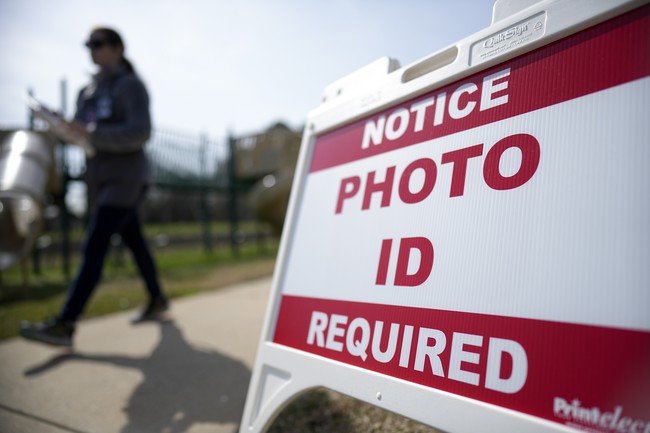
The SAVE America Act aims to tighten voter eligibility and require secure identification at the ballot box; this article argues from a conservative perspective that the bill is necessary to stop illegal votes, confront partisan double standards about election security, and restore public trust in American elections.
President Trump has made clear he will withhold his signature on other legislation until the SAVE America Act passes, and that stance reflects a deep concern about election integrity. Many conservatives see the bill as a straightforward effort to ensure only U.S. citizens cast ballots in federal elections. Opponents call the measure “suppressing voters,” but supporters counter that the real goal is to stop fraud and protect the value of every lawful vote.
Over recent years, large-scale illegal immigration has altered the voter environment in ways that worry many citizens. The argument here is not an attack on immigrants already in America legally, but a critique of policies and incentives that, intentionally or not, expand the pool of potential unlawful voters. If noncitizens can obtain identification that’s accepted for voting, the incentives and opportunities to vote illegally increase.
Federal law says voters in national elections must be U.S. citizens, yet enforcement and documentation requirements vary dramatically across states. Some states require a government ID at the polls, while others do not require any form of identification at all. That patchwork system creates gaps that make consistent, verifiable citizen-only voting impossible without a federal standard.
Critics often label voter ID protections as “racist” or claim measures will “marginalize women,” but those claims rely on assumptions that many see as unfounded. Asking for a valid form of identification to confirm citizenship is commonplace around the world and unremarkable in everyday life in the United States. People use IDs to fly, buy restricted items, enroll in programs, drive, and prove identity for countless transactions every day.
The most common rebuttal from opponents is that some communities have difficulty obtaining IDs, a claim sometimes framed in terms of race or class. That line of argument can itself be condescending and dismissive, implying entire groups are incapable of navigating bureaucratic processes. Practical solutions exist, such as accepting established documents like birth certificates, passports, or citizenship papers as valid verification when needed.
There is a political double standard on election security that frustrates conservatives. When left-of-center officials are in power, the narrative often insists American elections are already secure and that fraud claims are baseless. When conservatives win, suddenly concerns about integrity reappear and are labeled as dishonest or dangerous.
Examples of contested outcomes feed public skepticism and fuel the sense that rules are applied differently depending on who benefits. Whether in local primaries or national contests, allegations of irregularities inflame partisanship and erode trust in institutions. Passing a federal standard to document voter eligibility would cut through that inconsistency.
Under the proposed legislation, voter verification would become a uniform federal baseline so that every state adheres to the same expectations for federal elections. That approach aims to remove local variation that currently allows loopholes and inconsistent enforcement. For many supporters, consistency and transparency are the most important elements to rebuild confidence in results.
Opponents sometimes argue the bill is driven by partisan motives, but supporters say the motive is simple: protect the democratic process so citizens know elections reflect only eligible voters. Ensuring that only U.S. citizens vote in national elections is a commonsense standard that other democracies enforce without controversy. The concern here is about protecting electoral legitimacy rather than excluding legitimate voters.
Practical details matter, and reasonable accommodations for those who genuinely struggle to produce identification are achievable without compromising security. Acceptable alternatives like a birth certificate, naturalization paperwork, or a U.S. passport can verify citizenship when a modern ID is not available. Those safeguards address fairness concerns while maintaining a strict requirement that only citizens vote in federal contests.
The debate over voter ID and federal standards is ultimately about confidence in outcomes and the rule of law at elections. For many conservatives, the SAVE America Act is not an attack on participation but a proposal to ensure participation is lawful and verifiable. Without clear verification, every contested result will continue to be tainted by suspicion and partisan accusations, and that outcome harms democracy itself.
Passing a uniform federal requirement for verifying voter eligibility would be a significant step toward restoring trust and preventing the kinds of irregularities that fuel polarization. Supporters argue this is a pragmatic, legal, and moral necessity to guarantee that election results reflect the will of citizens, not the influence of those who are not eligible to vote.



Add comment