
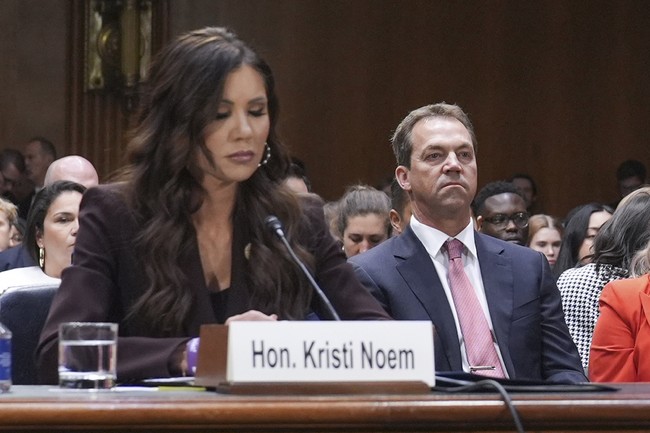
The story examines new reporting about Kristi Noem’s husband and how his online activities exposed a potential national security weakness around a senior official, raising questions about vetting, judgment, and the kinds of vulnerabilities opponents or foreign actors could exploit.
New reporting has surfaced alleging that Bryon Noem engaged in consistent online behavior that many would call compromising while his wife served in a top national security role. The details make clear this was not a one-off lapse but a pattern involving payments and explicit exchanges that intersected with his public identity. For anyone who cares about secure leadership, the case highlights how private conduct in the digital age can create public risk.
“Kristi Noem’s husband is today revealed as a secret crossdresser who dons gigantic fake breasts and pink hotpants to chat with online fetish models.
“While his wife has operated at the highest echelons of government, handling matters of national security in her recent role as DHS secretary, Bryon Noem, 56, has been dressing up and paying adult entertainers to talk dirty.
“The Daily Mail has reviewed hundreds of messages involving three women from the ‘bimbofication’ scene – where porn performers transform themselves into real-life Barbie dolls by pumping colossal amounts of saline into their breasts.
“Bryon has lavished praise on their surgically-enhanced bodies, confessed his lust for ‘huge, huge ridiculous boobs,’ and even made indiscreet remarks about his 34-year marriage…”
From a Republican perspective, the central issue here is not prurient fascination but the clear national security implications when a top official’s household is exposed. Vetting exists to catch precisely these kinds of liabilities—financial ties, embarrassing behavior, and opportunities for coercion or blackmail. If the claims are accurate, then the vetting process failed to flag an ongoing situation that overlapped with a DHS secretary’s tenure.
Sources allege the phone used in these chats was tied to the family business and that funding for the encounters came through an identifiable PayPal setup. Those details matter because they suggest operational links to the official’s public life rather than a completely separate, anonymous hobby. In plain terms, mixing family business lines and public service creates an avoidable vector for compromise.
A PayPal account belonging to ‘Jason Jackson’ sent the woman regular deposits, typically between $500 and $1,000.
She says he openly admitted to having a wife and family.
‘He’d say, ‘I love my wife, I want to get better.’ Then he’d disappear, come back, and start again,’ the woman added.
Over time, the models began to figure out the real identity of their shadowy benefactor.
A second woman told the Daily Mail she pocket-dialed Jason and was astonished to hear a voicemail greeting saying: ‘Noem Insurance, leave a message.’
A quick Google search pulled up photos of Kristi and Bryon Noem.
‘I was completely shocked. I said, ‘Why are you doing this?’ I didn’t think hot guys did this,’ the woman said.
‘He said he didn’t care. I thought, you should care – your wife could lose everything she’s ever worked for.’
Those who prepare cabinet-level nominees have long warned that family members can sink a nomination or cause security headaches. The argument is simple: public servants must minimize exposure that adversaries can exploit. Whether the administration missed warning signs or judged the risk acceptable, the result here is the same—sensitive positions should be shielded from preventable vulnerabilities.
Some of the alleged online contacts reportedly received tens of thousands of dollars via Cash App and PayPal, and messages show recurring financial pressure when payments lagged. That sort of recurring transaction history is the kind of footprint that makes a public servant’s household susceptible to extortion. Intelligence services and criminal enterprises alike look for patterns like this to apply leverage.
Texts and WhatsApp messages reveal that Bryon was being repeatedly asked for money during the 14 months Noem led the nation’s largest federal law enforcement agency.
He sent his secret roster of online acquaintances at least $25,000 via Cash App and PayPal but when the payments were delayed or failed to materialize the chats would quickly turn sour.
One of the women became so disgruntled she posted about his behavior on social media before later deleting it.
Jack Barsky, a former Soviet spy turned US counterintelligence asset, told the Daily Mail the potential for blackmail was alarming.
‘It’s astounding that somebody whose spouse is at that level has that kind of bad judgment,’ he said.
There are also allegations tying the leak of materials to an individual involved in the underground trade, suggesting how easily such material can be weaponized. For anyone who has spent time on national security, this is textbook danger: if a household member has compromising material, foreign adversaries and criminal networks can use it to influence outcomes. That risk is structural, not partisan.
Even now, as Kristi Noem serves in an envoy role dealing with Latin America and cartels, the potential misuse of this information should be a concern. Cartels and hostile actors routinely gather and trade leverage; they are not bound by decency and will exploit any opening. The optics and practical exposures here make a strong case for stricter vetting and clearer rules about separating private financial and digital footprints from public office.
The central takeaway for Republicans and conservatives should be straightforward: defend our national security by enforcing tougher standards on vetting and household exposure for anyone in a sensitive post. When political leaders put the safety of the nation at risk by allowing preventable vulnerabilities, accountability and better procedures must follow.
Reports also reference speculation about personal relationships affecting judgment, but the more important point remains the same: the appearance and the reality of vulnerability create opportunities for foreign and criminal actors to interfere. Public servants have a duty to minimize that risk; when they do not, the consequences can be severe.

Add comment