
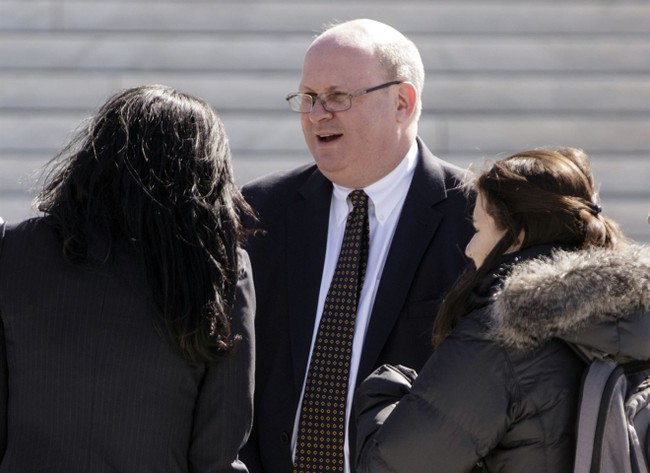
The Virginia Supreme Court decision that blocked Democrats’ redistricting referendum triggered an extraordinary response from the left, culminating in a provocative tweet from prominent Democrat lawyer Marc Elias that many saw as a threat to state government, and that reaction deserves serious attention from conservative voters and civic leaders.
Democrats have a history of intense reactions when the courts don’t side with them, but the fallout from the recent rulings feels different. The Supreme Court held in Louisiana v. Callais that race-based congressional redistricting is unconstitutional, and Virginia’s high court found the General Assembly’s process for placing a referendum on the ballot violated the state constitution. Those rulings stripped a hoped-for advantage from Democratic strategists and set off an unhinged response.
The anger we’ve witnessed isn’t merely political grandstanding. Threatening rhetoric aimed at judges and institutions ratchets up real danger for those officials and for public trust in the rule of law. Conservatives should call out threats no matter where they come from, and insist on the safety of our institutions while pushing back on left-wing attempts to delegitimize court decisions.
That brings us to Marc Elias, long known within conservative circles as a lawyer who crafts litigation strategies for Democratic interests. Elias’s tweet after the SCOVA decision touched a nerve so deep that commentators and legal scholars instantly sounded alarms, interpreting his message as endorsing extraordinary measures. When a lawyer with Elias’s résumé speaks about power and remedies, people listen, and not all of them are reassured.
The backlash was immediate and intense, and social media filled with reactions dissecting Elias’s wording and intent. Observers demanded clarification; Elias has been conspicuously vague in response. His refusal to explain himself only amplifies concerns that a figure with ties to national party litigation networks might be hinting at radical moves rather than sober legal strategy.
Some defenders have tried to frame Elias’s comment as a constitutional citation or rhetorical flourish, but context matters. When influential partisan lawyers react to a court ruling by suggesting extreme institutional responses, it crosses a line. The point isn’t to silence political debate; it’s to ensure even heated disagreement stays within constitutional limits and doesn’t endanger judges or democratic norms.
Prominent conservative voices like Jonathan Turley have not hesitated to call out Elias directly, which matters because Turley is widely respected in legal circles for clear-eyed critiques of judicial overreach on both sides. Turley’s analysis linked Elias’s approach to a broader pattern on the left: a willingness to discard institutions and norms when they stand in the way of short-term political goals. That pattern is dangerous whether it comes from elected officials, activists, or lawyers with national influence.
It is another example of the “by any means necessary” culture of the left today. There is no institution or value that is sacred. This is why I recently wrote about the rise of “the new Jacobins” in my book Rage and the Republic, lawyers and law professors rationalizing the trashing of the Constitution and our institutions to achieve their political goals.
Elias has long been controversial for his tactics.
It was Elias who was the general counsel to the Clinton presidential campaign when it secretly funded the infamous Steele dossier and pushed the false Alfa Bank conspiracy. (His fellow Perkins Coie partner, Michael Sussmann, was later indicted but acquitted).
Turley also reminded readers of Elias’s extensive involvement in high-stakes redistricting fights across the country, pointing to a trail of lawsuits and contested maps. Those battles haven’t just been abstract lawyering; they’ve reshaped political power in states from Maryland to New York. When litigation strategy consistently aims to redraw the rules of electoral competition, citizens ought to be skeptical about the long-term consequences.
In Maryland, Elias’s team supported another abusive gerrymandering scheme that a court found not only violated Maryland law but the state constitution’s equal protection, free speech and free elections clauses. The court found that the map “subverts the will of those governed.”
One media site accused Elias and his group of “making millions off gerrymandering efforts” while publicly denouncing Republican gerrymandering.
[…]
His group’s work for New York redistricting was ridiculed as not only ignoring the express will of the voters and also effectively negating the votes of Republican voters.
In 2024, the Chief Judge of the Western District of Wisconsin criticized the Elias Law Group for one of its challenges. Judge James Peterson (an Obama appointee) said that the argument “simply does not make any sense.”
This clash of legal philosophies matters for more than court dockets; it matters for elections, institutions, and public confidence. Conservatives should insist on vigorous legal defense of constitutional limits while making clear that threats, intemperate rhetoric, and calls for extra-constitutional fixes are unacceptable. A healthy democracy tolerates passionate disagreement, not coercion or intimidation.
As the midterms approach, the Virginia episode is a reminder that legal fights and public rhetoric interact in dangerous ways. Voters should pay attention to who is shaping legal strategy for the major parties, and demand accountability when influential figures cross lines that endanger judges or the rule of law.



Add comment