
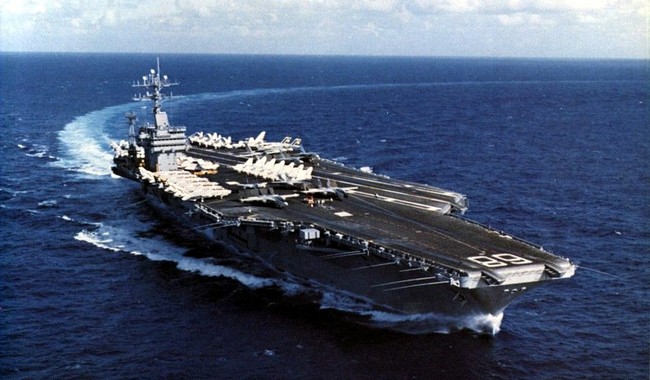
The U.S. Navy’s Nimitz Carrier Strike Group sailed into the Caribbean this week, a clear signal of American resolve near Cuba as Washington ramps up pressure on Havana; the move coincides with a high-profile indictment tied to a 1996 attack and follows fresh sanctions and public warnings from senior U.S. officials.
The Nimitz Carrier Strike Group, centered on the USS Nimitz, arrived within range of Cuba, and its presence is impossible for the regime in Havana to ignore. While the deployment had been scheduled in advance, the timing is politically charged, matching a tougher U.S. posture toward Cuban authorities. The carrier brings a full carrier air wing and escort ships, a combination that underlines deterrence and readiness.
The capabilities aboard the strike group make the point plain: it is a floating, mobile base of power with reach and lethality. That power projection is meant to protect American interests and send a message that the United States will not tolerate attacks on its citizens or partners. For those in the Cuban leadership, the arrival should be a reminder that actions have consequences and that U.S. resolve can be shown both on land and at sea.
The Nimitz-class carrier is operating alongside its air wing — including F/A-18E Super Hornets, EA-18G Growlers and C-2A Greyhounds — as well as the USS Gridley, an Arleigh Burke-class destroyer, and the USNS Patuxent, a Henry J. Kaiser-class replenishment oiler, according to U.S. Southern Command, which oversees military operations in the region.
“USS Nimitz has proven its combat prowess across the globe, ensuring stability and defending democracy from the Taiwan Strait to the Arabian Gulf,” Southcom said on X.
The increased pressure on Havana did not happen in a vacuum. This movement comes after formal legal action announced by U.S. authorities tied to the 1996 shoot-down of civilian planes, an incident that killed Americans and a permanent resident. The indictment of a senior Cuban figure on allegations tied to that episode escalates tensions and adds legal teeth to political and diplomatic measures already in play.
Acting Attorney General Todd Blanche made a blunt statement reflecting American priorities and memory: “My message today is clear. The United States and President Trump does not and will not forget its citizens.” That direct language aligns with a policy of enforcing accountability and signals that those responsible for past violence remain in the crosshairs of U.S. justice. For policymakers in Havana, the phrase is a warning that political cover and time do not erase alleged crimes.
The Nimitz itself has a storied track record, and its deployment is symbolic as much as strategic. It has operated across multiple theaters and now sails where it can influence events in the Caribbean and across the wider region. The carrier’s longevity and continued operational tempo make it a fitting centerpiece for a visible American response to provocation and instability.
On the diplomatic and economic fronts, the White House has tightened the screws on the Cuban leadership. Recent U.S. measures include cutting fuel supplies, imposing new sanctions, and applying sustained political pressure aimed at isolating and penalizing those responsible for repression. These steps are coordinated to undermine the regime’s capacity to act with impunity and to support a reversal of harmful policies.
Former and current officials with Cuban ties have been vocal in Washington, and voices such as Secretary of State Marco Rubio have made no secret of their disdain for the communist rulers in Havana. That political pressure in the U.S. is matched by operational readiness at sea, creating a combined approach that blends coercive diplomacy with military posture. The combination is meant to maximize leverage while retaining the option to respond more forcefully if necessary.
Whether military action is imminent remains unclear, but the United States has signaled both willingness and capacity to protect its citizens and enforce consequences. The Nimitz Carrier Strike Group’s presence is part of that signal: it establishes an unmistakable capability in short order and reassures allies and partners in the region. For Americans watching, it is a demonstration that strength and principle are being applied together.
Editor’s Note: Thanks to President Trump and War Secretary Pete Hegseth’s leadership, the warrior ethos is coming back to America’s military.

Add comment