
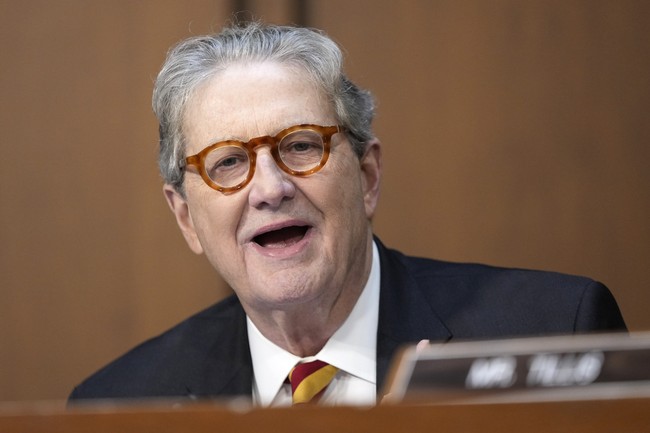
This piece examines Senator John Kennedy’s colorful take on the Supreme Court tariff ruling and how he likens President Trump to a grizzly, discusses the policy angle on tariffs and trade wins, and notes the political theater that follows such legal decisions.
Senator John Kennedy has a knack for sharp, folksy lines that stick, and his recent remarks about the Supreme Court decision are no exception. He framed the setback on tariff authority as something President Trump could still claim as a victory, pointing to the broader effects of his trade policy. That perspective mixes amusement with political calculation, and it’s worth looking at how that plays into the larger economic story. Kennedy’s humor keeps this from feeling dry even when the topic is legal and technical.
Sen. John Kennedy, R-La., offered an optimistic perspective on the Supreme Court’s tariff ruling, arguing the “grizzly” in the Oval Office should view it as a win.
In a 6-3 ruling Friday, the high court struck down President Donald Trump’s global tariff authority under the International Emergency Economic Powers Act (IEEPA).
Despite the legal setback, Kennedy argued Trump’s use of tariffs has secured strong trade deals and could boost the economy.
The imagery Kennedy used taps into a very American idea: strength and unpredictability rolled into one big animal. He compares the president to a grizzly, an image meant to underscore toughness and danger. The analogy resonates in places that know bears well, where toughness is admired and taken seriously. It’s a political shorthand meant to reassure supporters that setbacks won’t slow a powerful leader.
There’s also a policy thread running under the colorful talk. The Supreme Court limited the president’s authority under IEEPA in a 6-3 decision, which changes the legal toolkit for imposing broad tariffs quickly. But Kennedy pushes back by saying the practical outcomes matter more to voters than legal technicalities. He points to trade deals and economic indicators as evidence that, regardless of the ruling, the administration’s approach is producing results.
The rhetoric around tariffs often blends economic argument with theatrical politics, and Kennedy’s comments are a good example. He concedes the legal loss but reframes it as a strategic regrouping rather than a defeat. That’s a classic political move: control the narrative and keep momentum by emphasizing wins elsewhere. For supporters, that framing helps turn a court decision into a footnote, not a turning point.
People who live where grizzlies roam know the power of the metaphor: these animals are huge, fast, and not to be trifled with. Bringing that metaphor into politics serves to amplify the image of a leader who won’t back down. Kennedy’s folksy delivery makes it easier to sell that image to a broad audience. It’s theater and strategy wrapped together, and it’s designed to keep the base feeling confident.
The aftermath of the court’s ruling is likely to be a mix of legal maneuvering and political spin. Administrations can pursue other mechanisms within the law to address trade grievances, and allies will talk up whatever gains they can point to. Meanwhile, opponents will emphasize the limits the court placed on executive power. Expect both sides to use this ruling as fuel for their narratives heading into the next rounds of political debate.
In the middle of all this, the grizzly line sticks because it’s simple and evocative. It turns a complex legal ruling into a clear image voters can grasp: a tough leader, momentarily checked by the courts, but still capable of charging back. That’s exactly the sort of messaging that frames policy as personality, and policy debates as battles. Whether you find the comparison flattering or overwrought, it does a lot of work in a few words.


Add comment