
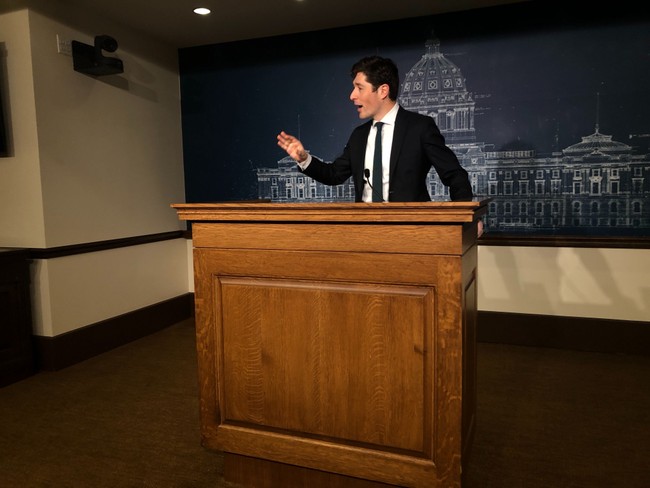
Checklist: I will criticize Mayor Jacob Frey’s handling of immigration and public safety, highlight the church invasion and the muted Democratic response, note Frey’s public pandering to immigrant communities, show why ICE and DHS support were necessary, preserve original quoted material, and keep embeds in place.
Minneapolis Mayor Jacob Frey has become a case study in political priorities gone wrong, putting the interests of illegal immigrants above the safety of everyday citizens. His pattern of public gestures and language choices signals to many residents that law enforcement and border control are secondary concerns. That perception matters when communities expect officials to protect churches, schools, and neighborhoods from disruptive and even violent actions.
Frey’s public performances—addressing immigrant communities in their languages and celebrating cultural symbols—read as political theater to critics, not governing. Those acts may win applause in certain circles, but they do not address the underlying issues of crime, fraud, and the strain on local services. Minnesotans watching their neighborhoods change want practical solutions, not photo ops and speeches designed to signal virtue.
Recent revelations about fraud prosecutions within parts of the Somali community make the optics even worse for a mayor who appears more comfortable defending organizers than backing law enforcement. When municipal leaders prioritize appeasement, they weaken law enforcement’s ability to do its job and create the impression that some groups are above the law. That breeds resentment and erodes trust between citizens and local government.
Frey’s now-deleted video of himself on Hispanic radio, speaking Spanish, hugging listeners, and touting noncooperation with ICE, only deepened the divide. Deleting the clip after it circulated suggests awareness of the political liabilities, yet the underlying policy choices remain. Voters deserve to know whether their officials are protecting all residents or selectively shielding some from legal consequences.
The response from state Democrats to the anti-ICE church invasion in St. Paul was slow and sparse, with very little immediate public leadership. That lack of urgency sends a chilling message to families who were present and traumatized during the incident. A prompt, clear defense of religious worshipers and condemnation of any assault on law enforcement would have been the right call for any responsible leader.
Frey’s actual statement about the event criticized the Department of Justice for making arrests rather than condemning the disruption of a worship service. That stance flips normal priorities: it appears to side with the agitators and against the victims and the officers trying to maintain order. Minnesotans who want safety and accountability see this as a dereliction of duty.
In other remarks, Frey boasted about city systems that, critics argue, make it harder for ICE to do its work and easier for criminal aliens to evade detection. Outsiders and locals alike read those policies as a deliberate sheltering that undermines cooperation with federal immigration enforcement. When federal resources were surged to Minnesota earlier, it was to restore basic rule of law in places where local policy choices had created gaps.
Frey’s actions and rhetoric quickly triggered backlash on social platforms, where citizens vented frustration over perceived double standards and unsafe policies. People who attended that church, whose children were reportedly terrified, felt ignored by city leaders who seemed more eager to placate agitators than to defend peaceful worship. The anger is political and personal for many who live in these neighborhoods.
Several commentators pointed out the simple fact that the worshipers in the church are part of Frey’s community too, deserving the same protection and support as anyone else. That line of criticism hits home because it asks whether public officials serve all constituents equally. A mayor who protects only a subset of residents is not fulfilling the basic compact of local government.
Additional embeds captured moments of the fallout and responses from national observers, underscoring how this local episode resonates beyond Minnesota. National attention on these local policy choices has real consequences, feeding calls for stronger federal support where local practices have weakened enforcement. The Trump administration’s move to boost DHS resources in Minnesota was in part a reaction to that weakening and to protect both citizens and lawful immigration systems.
Public frustration is not abstract; it is grounded in real fear about safety and the expectation that law and order will be upheld. When a mayor appears to excuse violence against ICE agents while criticizing arrests of those who interrupted church services, it reinforces the need for decisive federal support. Law enforcement and federal agencies play a necessary role when local policies fail to keep communities secure.
Editor’s Note: The mainstream media continues to deflect, gaslight, spin, and lie about President Trump, his administration, and conservatives.

Add comment