
The House approved Rep. Nancy Mace’s amendment to the 2027 National Defense Authorization Act that bars male students from participating in girls’ sports at Department of Defense Education Activity schools, passing both a sports-related amendment and a separate TRICARE coverage restriction after five House Democrats joined Republicans to vote with the majority.
The vote on the amendment about girls’ sports finished 221 to 203, with every Republican who voted in favor and one independent who caucuses with Republicans joining the majority. Those five Democrats were Henry Cuellar, Don Davis, Shomari Figures, Vicente Gonzalez, and Terri Sewell, and their votes flipped what might otherwise have been a strictly party-line result.
The amendment requires the Secretary of Defense to ensure that no DoDEA school allows a male student to participate in an athletic program designated for females, and it defines male and female according to their respective reproductive systems. It also permits male students to practice or train with female teams only when no female athlete loses a roster spot or other opportunities tied to the program.
Mace argued the change protects military families and the children who attend DoDEA schools, saying schools that serve the kids of service members should not be arenas for experimental policies. She framed the issue as one of fairness and safety for girls who compete and train under established rules designed to protect female athletes.
“Women and girls have fought for so long to have equal opportunities in education and athletics. As the first female graduate of The Citadel’s Corps of Cadets, no one understands this more than I do. Unfortunately, these rights are now under attack. Over 900 medals have been stolen from women and girls by biological males. This flies in the face of common sense and our most basic notions of fairness and women’s rights.”
On the House floor Mace emphasized real-world consequences and cited injuries and lost opportunities when girls compete against biological males. Republicans saw the amendment as a commonsense measure to preserve fair competition, protect private spaces, and keep athletic opportunities for girls intact.
Earlier the same night, the House passed a separate Mace amendment that would block TRICARE from covering certain gender-transitioning procedures and treatments, with the same five Democrats joining Republicans. That vote was 219 to 208, and it touches the military’s health system that covers roughly 9.5 million beneficiaries.
Blocking TRICARE coverage for specific procedures was framed as protecting military readiness and preventing taxpayer-funded medical care from being diverted to elective treatments for service members and their families. For many Republicans, the change is about setting sensible limits on what the military health system pays for and preserving its primary mission.
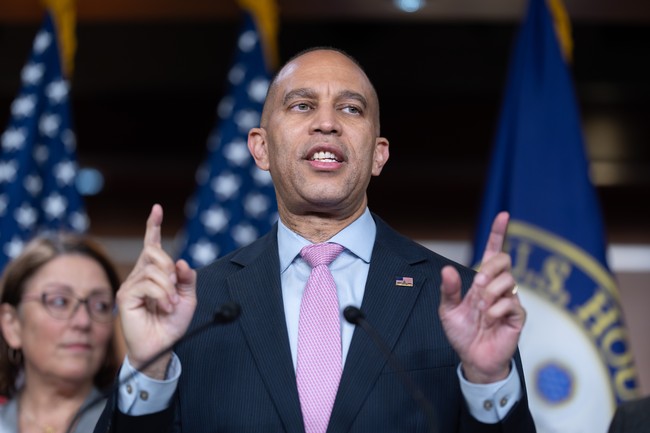
House Democratic leadership, including Minority Leader Hakeem Jeffries, opposed both measures, and the broader Democratic conference voted against the amendments. Jeffries and other Democrats have argued that bans on transgender participation risk harm and discrimination, while Republicans counter that protecting women’s sports and establishing clear standards are matters of fairness, safety, and commonsense policy.
https://x.com/RepNancyMace/status/2079755828387610978
The contrast between the failed Boebert amendment and Mace’s wins highlights how a narrowly drawn, service-focused approach gained broader support. Rep. Lauren Boebert’s proposal, which sought to codify a policy requiring military personnel to serve according to their biological sex, failed after a couple of Republican defections, but Mace’s targeted DoDEA and TRICARE amendments succeeded with unified Republican backing and five Democratic crossover votes.
Those crossover votes complicate the path forward in the Senate, where a 60-vote threshold can be used to remove similar provisions during conference negotiations. Democrats have in the past used that procedural threshold to strip provisions from the NDAA, and the presence of five Democrats who broke with their conference changes the dynamics as this moves to the upper chamber.
Republicans argue that military families deserve clarity and stability in the schools that serve their children, and that DoDEA schools should prioritize fair competition and safety for female athletes. The successful floor amendments are presented by GOP lawmakers as limited, targeted reforms that respect service members while reasserting lines around biological sex in athletics and medical coverage.
Advocates on both sides expect the fight to continue in the Senate and in conference, where each chamber’s version of the NDAA will be reconciled before final passage. For now, supporters of the amendments see Tuesday’s House votes as proof that a majority recognizes the need for clear, biologically based protections in girls’ sports at DoDEA schools and limits on TRICARE coverage for certain procedures.
“DoDEA schools serve the children of our warfighters, and they should not have to worry about their little girls having their private spaces invaded, having their accomplishments and opportunities stolen from them, and being injured competing against men.”
The debate is likely to remain sharp as it moves into the Senate, where the rules and vote thresholds differ and where bipartisan coalitions can look different. Republicans intend to press the case that these are narrow, necessary protections for girls and military families, while Democrats will continue to cast the measures as discriminatory and harmful to transgender people.



Add comment