
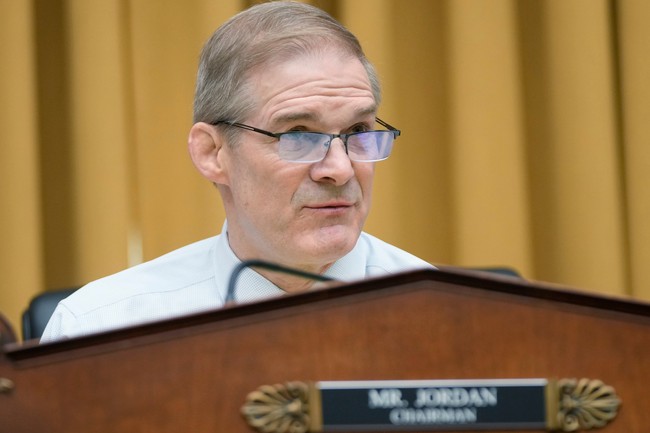
House Judiciary Chairman Jim Jordan pushed back hard on what he calls a repeated, politically driven pattern inside the FBI and other institutions, arguing newly declassified documents show coordinated efforts to target President Trump and his allies during multiple election cycles.
On Fox News’ “Sunday Morning Futures” with Jackie DeAngelis, Jordan laid out a narrative tying together the Clinton campaign’s research efforts, the FISA court authorizations, and later probes aimed at associates of President Trump. He framed those moves as more than isolated errors, instead calling them deliberate operations designed to influence outcomes in 2016, 2020, and beyond. That claim is shaped by a string of actions and documents now being reviewed publicly, which Jordan says reveal a consistent pattern of bias and misuse of government power.
https://x.com/SundayFutures/status/2089001640447594701
Jordan emphasized the sequence of events that began with the Clinton campaign hiring outside firms and culminated in what he described as improper surveillance of the Trump campaign. He pointed to the role of a dossier compiled by a foreign source and used, in his view, as the basis for applying to spy on Americans associated with a political campaign. The chairman argued that when investigations started to catch up to those steps, the response was not reform but escalation.
DEANGELIS: Joining me now is the chairman of the House Judiciary Committee, Congressman Jim Jordan. Thank you so much, Congressman, for being here. And I want to talk about this FBI investigation — March Toll — because the timing is not coincidental, and we are just learning about some of these details. So, President Trump is trying to fix things within the FBI because they’re going after him on unsubstantiated reports. And so, he fires James Comey. Then the next day, they go after Jeff Sessions because the Democrats couldn’t leave the breakdown of the institution right where it was. They had to try to further it even more.
JORDAN: Yeah. And remember, even before that, when this all got started, was the Clinton campaign hiring the law firm Perkins Coie, who hired the public relations firm Fusion GPS, who hired the foreigner, Christopher Steele, who wrote the bogus document called the dossier that Comey takes — he knows it’s bogus — he takes it to the secret court, the FISA court, to get a warrant to go spy on President Trump’s campaign. That happened.
And then when people start digging into that and figuring something out, then it’s on to this next thing. He fires Comey, and they go after Jeff Sessions. And then, as you point out they they launched this operation a few years later, when we are start — when a number of us — are starting to dig into Joe Biden, all the crazy things that went on there with Ukraine and Barisma and his son, Hunter Biden, and they run an operation against members of Congress and other people affiliated with the, or associated with, the Trump campaign and the Trump administration. That’s how ridiculous it was — running ops against the government — the FBI was doing this.
DEANGELIS: Yeah. And on the Biden side, of course, it was Russian disinformation. Nobody wanted to pursue that narrative or look into any of the details, but when it came to President Trump, you needed a special counsel investigation where we did get more detail, which was helpful. But when you learn little pieces of the timeline like this, you see just how bad it was.
JORDAN: Yeah. Remember, so the Clinton campaign does that. Comey uses that ridiculous document to go spy on President Trump’s campaign. Four years later, they run an operation against members of Congress and members of President Trump’s administration to try to help Biden win. So, it was always designed to hurt President Trump and help his opponent win. It was designed to help Clinton win in 16, Biden win in 24. And then, frankly, you could say — or in 20 — and then in 24 you could say, well, Jack Smith was designed to help Biden or Kamala Harris win, and President Trump lose in 24. So, they ran operations each and every time President Trump was running for office.
DeAngelis pressed on the criticism that Congress hasn’t done enough to respond, and Jordan responded with a list of referrals and confrontations his committee has made. He noted criminal referrals for individuals he believes obstructed oversight or lied under oath, and he said the committee has pursued accountability through every avenue available. The claims of referrals underscore the committee’s efforts, but they also raise questions about whether prosecutors will follow through.
Jordan outlined specific referrals he says prove Congress didn’t sit idle, including actions against intelligence figures and Department of Justice officials. He said the committee has referred people for prosecution and set out examples where witnesses provided incomplete or misleading testimony. To him, those referrals are evidence Congress has used its oversight powers aggressively, even if criminal outcomes remain uncertain.
The chairman also described a broader strategy he sees at work: using federal investigatory tools selectively against political opponents while shielding allies and dismissing inconvenient leads. He argued that the same institutions which should be neutral instead took sides at critical moments, shaping both public perception and legal exposure for high-profile figures. That belief drives the committee’s continued push to declassify documents and press for public transparency.
Public debate over how to respond will continue, with House Republicans insisting on further scrutiny and conservative voices calling for prosecutions where they believe laws were broken. Jordan’s remarks aim to keep pressure on the Justice Department to act on referrals and to maintain public focus on what he calls a repeated pattern of political targeting. Whether that pressure produces criminal charges or further reforms remains a central question for the months ahead.


Add comment