
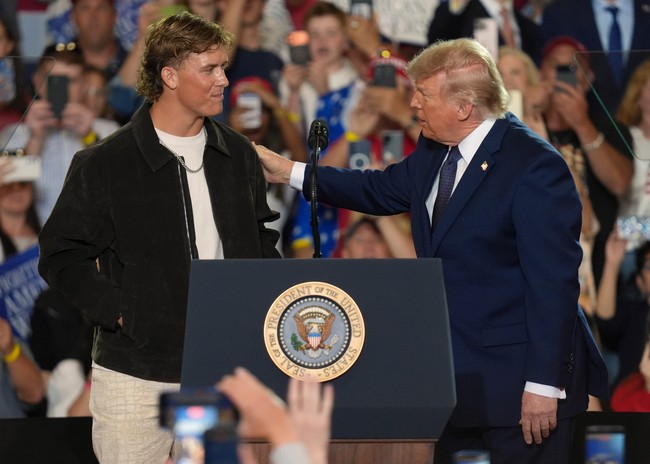
The short version: New York Giants quarterback Jaxson Dart introduced President Donald J. Trump at a Rockland Community College event and then calmly addressed the fallout, insisting his words came from respect for the office and family history rather than politics. Teammate Abdul Carter reacted publicly, deleted tweets, and later spoke about unity in the locker room. Media and social pundits turned the moment into a controversy, but both players moved to contain it and keep the focus on football.
Jaxson Dart’s introduction of President Trump at the May 22 event in Suffern drew predictable outrage from the usual corners, but Dart didn’t flinch. He opened with a nod to the Giants fans and then said, “I’m grateful, I’m honored, I’m pleased to introduce the 45th and 47th president of the United States of America, President Donald J. Trump.” That line set off a media feeding frenzy that exaggerated a simple act of civility into something more scandalous than it was.
After the introduction, Trump praised Dart, calling him a “future Hall of Famer” who had “legs like tree trunks,” and that praise only added fuel to the overreaction. People who claim to champion tolerance suddenly demanded public shaming, with some calling Dart a “traitor” and demanding he be booed. The response spoke more about the critics than it did about the player’s intentions.
Watch:
https://x.com/RapidResponse47/status/2057910338838724716
The locker room felt the ripple effects almost immediately, and linebacker Abdul Carter reacted in the moment with a tweet he later deleted saying, “Thought this s**t was AI, what we doing man.” Carter followed up with another deleted message clarifying, “Me and JD6 are good! We spoke earlier as Men. Yall can keep yall narratives.” Those deleted tweets show a player reacting emotionally before choosing to handle it privately and move forward.
At a Giants media availability, Dart addressed the situation himself and avoided an apology while explaining his perspective. He framed his actions as rooted in respect for the office and his family’s military and public service history, not a partisan statement. His words were straightforward and personal, not political posturing.
“I’ve always loved this country. I have extended family members who have fought in wars, two uncles who retired from the Air Force Academy and served, and even a great-grandfather who served as Secretary of the Treasury. The presidency is a position I’ve always deeply respected, regardless of political affiliation or party. My intentions were just that.”
Dart also emphasized that teammates have diverse views and that mutual respect is essential for cohesion. He said he wanted to move past the media spectacle and focus on the team and football, a practical choice given the season ahead. The locker room needs alignment on goals, not public score-settling, and Dart made that clear.
When a reporter pressed for more, Dart because he preferred to prioritize team matters over feeding the controversy. That reaction underscored a desire to keep personal beliefs private and protect the team’s focus. It’s a reminder that athletes are adults with lives and convictions beyond the headlines.
Abdul Carter later explained his initial reaction at the same press gathering, saying he felt a responsibility to represent teammates who disagree with the choice to introduce Trump. He also stressed that he did not hate Dart and that they had spoken like men and aligned on team goals. Carter’s follow-up comments moved the conversation from outrage to reconciliation.
Carter’s approach in the aftermath showed a willingness to de-escalate and prioritize the locker room over social media drama. Critics who slammed him for initially treating Dart as if he had forfeited his rights missed the larger point: teammates must be able to disagree and still work together. Carter acknowledged that and tried to steer the narrative back to unity and mutual respect.
There’s an important lesson here about public life and private intent: players can show respect for public figures without it being a referendum on their character or loyalty to teammates. Teammates are family, and family members sometimes clash over politics, but they usually find ways to maintain trust and focus on what matters together. If the media treated every respectful gesture as a scandal, teams would constantly be distracted from competing.
At the end of the day, Dart and Carter both signaled they want to move on and get back to work. The smart play for anyone involved is to let the noise die down and concentrate on preparing for the season. That’s what winners do.

Add comment