
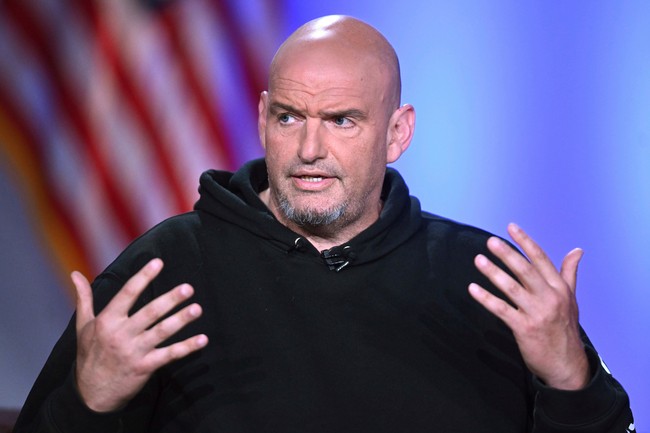
Sen. John Fetterman pushed back on his party after Pennsylvania Supreme Court Justice David Wecht left the Democratic Party, accusing Democrats of tolerating antisemitism and prompting a rare public rebuke from a prominent senator who still identifies as a Democrat.
In recent weeks, Fetterman has stood out inside his party for blunt, plain-spoken comments about trends he sees as dangerous, and his response to Justice Wecht’s announcement got attention because it echoed concerns many voters are hearing. The senator said he won’t change parties, but he acknowledged and supported Wecht’s decision as a necessary wake-up call. That stance has sharpened the contrast between Fetterman’s public posture and the broader Democratic leadership, which has been criticized by some for failing to confront hostility aimed at Jewish Americans.
Fetterman recently that Pennsylvania Supreme Court Justice David Wecht has announced he is leaving the Democrat Party because of increasing antisemitism. Wecht said that he is now an independent. Fetterman, who knows both Justice Wecht and his father, Cyril, posted a short tribute that sounded both personal and pointed.
I know David and his legendary father, Cyril. As I’ve affirmed, I’m not changing my party—but I fully understand David’s personal choice. The Democratic Party must confront its own rising antisemitism problem.
Wecht made his public announcement through a long statement explaining why he could no longer remain registered as a Democrat, and the language he used was stark and specific. He traced the change in tone and tolerance within the party back decades, but said the pace and severity of recent incidents left him no choice but to step away. His words landed hard because he has deep roots in Pennsylvania Democratic circles and served as a vice chair earlier in his career.
From 1998 to 2001, years that preceded my judicial career, I served as Vice-Chair of the Pennsylvania Democratic Party. In the quarter century that has passed since then, the Democratic Party has changed. Nazi tattoos, jihadist chants, intimidation and attacks at synagogues, and other hateful anti-Jewish invective and actions are minimized, ignored, and even coddled. Acquiescence to Jew-hatred is now disturbingly common among activists, leaders and even many elected officials in the Democratic Party. I can no longer abide this. So, I won’t. I am no longer registered within any political party. It is my hope that Pennsylvanians, and Americans, of all viewpoints and backgrounds will oppose and resist the scourge of Jew-hatred before it undermines what our ancestors have built here.
That passage pushed a lot of buttons across the political spectrum because it accused party activists and officials of tolerating symbols and chants tied to violent, hateful movements. People who follow Pennsylvania politics saw it as unusual for a sitting justice to put his break with a major party in such plain terms. For voters who’ve watched internal Democratic debates over Israel and antisemitism, the announcement felt like a crystallization of long-simmering disputes.
Fetterman’s alignment with Wecht on this point is notable because the senator has also been outspoken in his support for Israel, saying he would stand up for the country even as other Democrats shift positions. That stance has already drawn heat from some corners of his own party, which has discussed mounting primary challenges. Even so, Fetterman’s refusal to join in party-wide silence on this kind of conduct marked him as an outlier, and that has political consequences.
Justice Wecht said his switch to independent registration “will have minimal impact on the balance of power in the state’s Supreme Court,” but he framed his move as moral and symbolic rather than tactical. Observers noted the symbolic weight of a lifelong Democrat and judicial figure stepping away because he believes the party has tolerated or downplayed violent, antisemitic behavior. That perception is now part of the public conversation about party identity and accountability.
The debate is playing out in town halls, on social media, and inside state party organizations, and it illustrates how internal cultural battles can spill into public life. Senators like Fetterman who call attention to those internal failures risk isolation, but they also signal to voters that the disagreement is real and consequential. For many Pennsylvanians, the story underscored how national trends and local politics intersect when party institutions face moral tests.
It remains to be seen whether this moment will force a broader reckoning within the statewide party or whether it will be remembered as a sharp, short-lived clash. For now, the facts are straightforward: a respected justice changed his registration because of what he described as growing antisemitism, and a sitting U.S. senator publicly acknowledged and supported that judgment without abandoning his own party label.



Add comment