
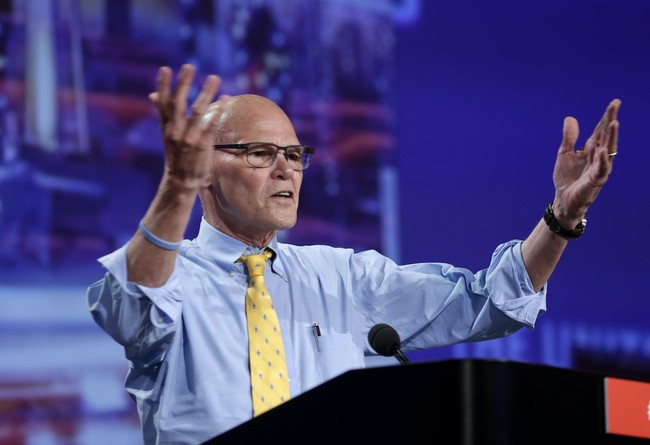
The Democratic Party is facing a reckoning as old-school operatives push back against a growing radical wing, and veteran Democrat James Carville has openly warned that figures like Hasan Piker represent a point of no return for many. This article examines how that split is playing out, why it matters for upcoming races, and what Carville’s blunt refusal to share a party with certain voices signals about the party’s future direction.
James Carville, a long-time Democratic strategist known for his blunt takes, has sounded an alarm about the direction of his party and the rising influence of democratic socialists and hard-left media personalities. He didn’t couch his complaint in polite political language; he made a personal declaration that he would not remain in a party that embraced certain voices. That level of public disavowal from an establishment figure is rare and telling.
The leftward push inside the Democratic coalition has been visible for years, but it has accelerated through organized groups and high-profile influencers who blend media reach with political organizing. Those activists and commentators have not only shifted rhetoric but backed candidates who promise sweeping changes to economic and cultural policy. For traditional Democrats who prefer incremental reforms and electoral pragmatism, this feels like a strategic and ideological shove in the wrong direction.
Carville framed the issue in stark terms, warning that if figures like Hasan Piker become a force within the Democratic Party, he will personally walk away. He said, “I am NOT going to be in the same party as Hasan Piker! I can tell you that right now!” and later added, “If he becomes a force within the Democratic Party, I’m out of here! I have no intention of ever being in the same political party with that guy!” Those words are a clear red line from someone who once helped steer Democratic messaging.
That kind of rupture matters because parties survive by building broad, sometimes uneasy coalitions; when prominent veterans openly reject part of that coalition, it strains the ability to present a united front to voters. Carville’s stance reflects a worry that ideological purity, amplified by social media and activist groups, could replace coalition-building as the dominant logic. If those tensions drive voters away or suppress turnout, the practical consequences could be immediate at the ballot box.
Prominent left-leaning internet personalities have proven effective at mobilizing younger voters and drawing attention to ambitious policy agendas, but influence does not always translate into broad electoral success. The divide is not purely about personalities; it’s about which messages win swing voters in exurban and working-class districts. Carville’s concern squares with polling and anecdotal evidence that many Americans remain wary of sweeping economic transformations labeled socialist.
https://x.com/EricLDaugh/status/2083940370430210235
Some within the party insist that a “big tent” approach can accommodate both establishment pragmatists and outspoken radicals, but Carville sees that as wishful thinking if extreme rhetoric gains institutional power. He pointed at party platforms and activist organizing as proof that these factions are not merely peripheral. For voters who prioritize economic stability, national security, or cultural cohesion, a party that tolerates extreme proposals risks alienating the middle.
The political math matters. If a sizable share of Democrats shift toward elected candidates who embrace radical proposals, it could cost the party competitive races in places like Michigan and other swing states. Carville highlighted emerging primary victories and activist endorsements as signals that the balance within the party is tilting. For those who track elections closely, seeing established operatives warn publicly suggests these internal fights will shape campaign strategies in the months ahead.
From a Republican perspective, the split is both an opening and a warning: opening because disaffection on the left can translate into lost Democratic turnout or defections to moderates, and warning because misreading the dynamics could lead to complacency. Where Democrats fracture, Republicans see chances to win over disenchanted voters who prioritize steady governance over ideological experiments. But exploiting that opportunity still requires clear messaging and responsible campaigning.
Carville’s refusal to share a party with certain public figures is as much a cultural statement as a political one, signaling that some Democrats may choose exile over alignment. That kind of split creates narratives that both parties will use to define each other, and it will influence candidate recruitment, primary fights, and general election storytelling. Expect this debate to intensify as activists and insiders jockey for influence ahead of major midterm and statewide contests.
Whether the Democratic Party ultimately moves to absorb, marginalize, or be reshaped by its radical wing remains uncertain, but the debate is no longer confined to think tanks and small-group meetings. With a veteran strategist publicly threatening to leave and a rising activist class eager to push boundaries, voters and operatives alike are watching to see which direction holds sway. The outcome will weigh on campaigns, messaging, and the choices voters face in the coming election cycles.
How this internal contest resolves will affect more than intra-party pride; it will shape which candidates win primaries, which policies get a hearing, and how both parties define viability to the broader electorate. For pragmatic voters and political operatives, the stakes are immediate: governing requires coalitions, and the health of those coalitions is now under strain. That strain is the story Carville has forced into the open, and it will be a recurring theme in the months ahead.

Carville is a Crazed Leftist Maniac Imbecile that needs to be locked away permanently!
This freaking loser is the epitome of the adage a Day Late and a Dollar Short only it’s really “the exponentiation of 10 to the power of 10” which equals 10,000,000,000!!! After what this lunatic promoted that increased America’s National Deficit with “Bidenomics and the AOC-Ranting/Biden New Green Deal,” that went from around 23.5 $Trillion when Trump finished his first term as president to around an insane whopping 37$Trillion and that along with mopping up all the mess the Demoncraps made of the country during that Auto-pen Insane Asylum Administration’s multiple catastrophes that President Trump and his team are doing their best to straighten out and compensate for with some Real Economics and GDP remedies, we as a Nation of Americans have this bulging 40 $Trillion, which is as horrible as hell on earth in terms of what that really means about the future of any American Citizens hope of a bright future ahead with peace of mind!!! So much treasure and resource pissed-off into insanity and criminal enterprises or kickback deals around the globe!!! Hey Carville go find your defunct Party’s Mascot that Jackass and kiss it’s ass; because that is all you and that lost souls party are worth!