
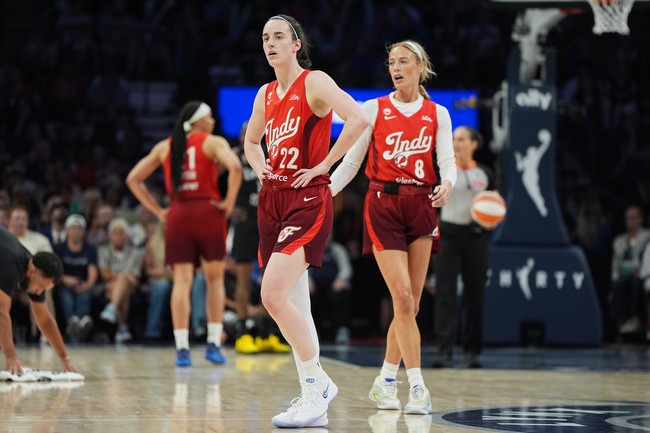
The piece looks at Caitlin Clark’s brief, clipped response when asked about Sophie Cunningham’s comments on transgender participation in girls’ sports, the pushback Cunningham has faced from league figures and media, and how those tensions highlight broader cultural and political divides inside the WNBA and sports coverage. It tracks the press exchanges, Cunningham’s statements in full, the reactions from league personalities, and the sense among some conservatives that the league is rewarding political messaging over protecting girls’ sports and fair competition.
Caitlin Clark was pressed in a postgame news conference about the controversy around Sophie Cunningham and gave a short, firm answer that redirected the conversation back to basketball. Clark told reporters that the topic belongs to “leagues and the governing bodies” to sort out, and she emphasized the team’s focus on wins and performance. Her tone made it clear she did not want to be drawn into a divisive cultural fight while still very much under the glare of national attention.
Reporters tried to pursue the line of questioning, and Clark shut it down quickly with, “I just answered for you.” That exchange carried weight because Clark is a high-profile rookie navigating intense scrutiny from fans, media, and political activists. Conservatives watching the sport read her brief refusal as a sane, practical move: don’t let a mob drag a player into politics when her job is to play and prepare her teammates.
Sophie Cunningham’s own comments are at the center of this storm and they were blunt enough to provoke a variety of responses across the sports world. Cunningham said she wanted to “protect young girls in a locker room, or young girls in sport who shouldn’t have to go against biological men,” and she pushed back on accusations that she hates trans people. Those exact words have been repeated widely and have, in turn, triggered investigations, public apologies, and social media assaults.
“I got a lot of negative feedback about me hating trans. And I’m like, ‘I never once said that.’ I think that I am here to extend love. But I also think with that love is truth, being honest. And I want to protect young girls in a locker room, or young girls in sport who shouldn’t have to go against biological men.”
“I’m very much in the middle. I agree with things on both sides, disagree with things on both sides. And that’s all I’ve ever said about my political beliefs. But people love to assume.”
After Cunningham spoke, the WNBA and parts of the sports media treated the remarks as a flashpoint, and some figures moved to discipline or publicly distance themselves from supporters of her stance. That reaction has fed a narrative among many conservatives that the league prioritizes ideological policing and signaling over the simple integrity of girls’ sports. The pattern looks familiar: outspoken players who defend sex-separated competition draw blowback that often morphs into professional consequences.
https://x.com/JackThompsonFOX/status/2084048270796419407
There have been confrontations beyond interviews, including an incident where two teenagers wearing supportive shirts were berated by a team owner, and the owner later received a short suspension. Cunningham called the incident “Truly embarrassing of the co-owner. Unfortunately shows the type of leader she is.” Those moments have amplified the belief among critics that league leadership and some media personalities are policing speech selectively while endorsing a specific cultural agenda.
Caitlin Clark’s public comments reflect a different approach: acknowledge the issue exists, but refuse to let it dominate the team environment. That stance contrasts with coaches and media figures who have used visibility to broadcast political messages, such as celebrating slogans about transgender youth in ways that some parents and fans find troubling. Conservatives argue that sports should shield young athletes and families from ideological pressure and that league platforms are not the place to normalize experimental trends.
Some observers point to roster and award decisions as potential signs of bias, noting Clark’s high profile and statistical performance alongside questions about whether league and Olympic roster choices treated her fairly. Whether those decisions stem from politics, evaluation criteria, or other factors is debated, but the perception of unfairness fuels the larger argument that politics has crept into selection and recognition in ways that harm players and fans.
When media outlets and league figures praise coaches who wear advocacy shirts and call those messages “incredibly thoughtful,” it deepens the cultural divide. Many parents and conservatives see the glamorization of a trend that affects vulnerable young people as irresponsible. They want sports leaders to prioritize physical safety, fair competition, and the wellbeing of children over ideological performance.
Amid all this, Clark’s short, pragmatic answer — and her refusal to be drawn into a heated debate on the spot — looked to many like a model of how an athlete can protect her career and her team focus. Meanwhile, Cunningham’s insistence on speaking plainly about protecting girls’ sports continues to draw both praise and the kind of league-level consequences that stoke political outrage. The clashes reveal how much cultural conflict now plays out on basketball courts and in postgame rooms, and why conservative voices keep calling for boundaries between politics and play.
“I definitely have privilege. I’m obviously White but I think … I’m somebody that grew up a huge fan of this league. I grew up watching this league, going to games, supporting this league. So, I know where this league comes from.
“A lot of Black women that grew up making this league what it is. That’s kind of the shoulders that we stand on. So, I think that was something I’m very aware of and something I’m very thankful for. And they definitely deserve all the credit and the more we can give credit to them, the better. I’m very aware of that and I know that and I think there is responsibility in acknowledging that.”



You either agree that this is deranged and SIN which God Almighty has already made clear in His word which He warned will be judged harshly and most severely; meaning a person’s soul is in jeopardy of eternal damnation for it!
I just stated the following elsewhere on this site in another article on this matter which I’m posting here.
Leviticus 18:22 “Do not practice homosexuality, having sex with another man as with a woman. It is a detestable sin.”
It’s put in a concise clear identification perspective of reality as God did make it perfectly clear! What follows is a short, sweet and concise explanation of why so many persons are being duped or what the Devil does in the details; tricks (with a lie)!
Isaiah 5:20 “Woe (judgment is coming) to those who call evil good, and good evil; Who substitute darkness for light and light for darkness; Who substitute bitter for sweet and sweet for bitter!”
Lucifer is now working overtime every second of every day to “trick and trap” as many souls in his web of deceit and lies so he can claim them as his to pull down into the bottomless pit for eternity! Discern people!!! We all get this one chance to choose whether our souls go up or down forever!
{Does Genesis 1:27 Teach Gender Fluidity?}
“There has been a historic first in the Church of England.1 Bingo Allison has become the first gender-queer priest who considers himself non-binary and uses they/them pronouns. He claims to have discovered Scriptural support for gender fluidity2 in Genesis 1:27, believing that God guided him one night into a new understanding of the verse. Genesis 1:27 (NIV) reads, “So God created mankind in his own image, in the image of God he created them; male and female he created them.” Allison claims “male and female” is understood as “maleness to femaleness.” This translation thus describes a gender fluid range rather than a binary system of male and female. Is this translation correct?”
(Like a snowball’s chance in hell it is correct!!!)
“The Scriptures are clear that God has made humans male and female. Allison is mistaken in his interpretation and is dangerously leading many astray, especially children. One would be hard pressed to find a true biblical scholar that would agree with his spiritual experience and assessment of Genesis 1:27.
Genesis 1:27
In order to assess Allison’s “spiritual experience” of Genesis 1:27, we turn to the Hebrew. First, do the words male and female indicate something different than man and woman? The simple answer is no. “Zākār [Hebrew male] is a gender-specific designation; it always specifies the male individual or a group of males.3 The Abridged BDB affirms this in saying that zākār refers to “men, male persons (of all ages)…”4 These dictionaries affirm the same reality in the Hebrew word for female.5
Second, are we suppose to understand the word “and” as “to”? Again, the simple answer is no. The Hebrew gives us a conjunction here, not a preposition. A conjunction expresses male and female as two distinct categories that are related in one system. Genesis 1:27 teaches that God made human kind either male or female. If the author of Genesis wanted to express the word “to” instead of “and,” he would have used a preposition instead of a conjunction, which he clearly did not.
This interpretation is further affirmed when we examine the usage of Genesis 1:27 in the New Testament. Jesus cites Genesis 1:27 in Mark 10:6 and also uses a conjunction rather than a preposition.
Lesson Learned
Allison’s “spiritual experience” instructs us. Let us be careful not to read our situations or desires into a text of Scripture; we must seek the author’s meaning. The Scriptures are not a fortune cookie that we turn to and make it immediately apply to our lives. There is an original context and audience to whom it was first written. In order to interpret it into our context, we must first begin with understanding it in theirs. This takes work, but it is important into understanding God’s Word and interpreting it faithfully.” ://branchsd.org/articles/does-genesis-1-25-teach-gender-fluidity
I say also that modernist times we are now in have produced far too many people with an attitudinal issue by which many get up on their high horse and think they know better than all of the collective sages and wise one’s of the last few millennia! Fools for sure!
God bless in Jesus’ name!
Amen.