
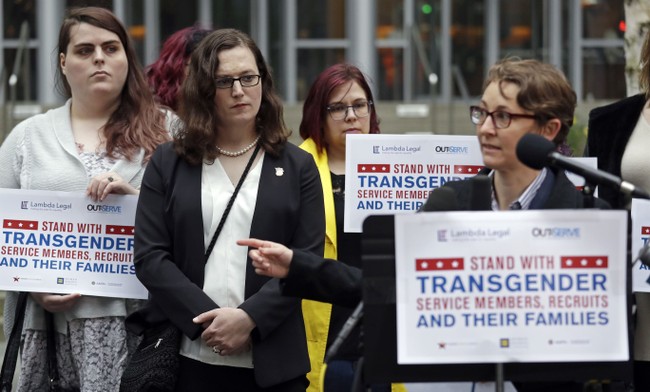
The D.C. Circuit issued a split ruling on the Trump administration’s military policy that restricts transgender service, upholding protections for current service members while narrowing relief for recruits and named plaintiffs; the opinion used unusually forceful language, finding that parts of the policy appear rooted in animus rather than military necessity and setting the stage for further appeals.
The court’s decision was fractured but consequential, with two judges voting to preserve the lower court’s injunction for current service members and two judges siding to vacate or limit that injunction for prospective recruits. That divided outcome leaves current troops protected for now, while the path for future accessions is less clear and likely to be litigated further. The ruling also highlights a rare instance where appellate judges applied strong equal protection reasoning in the military context. Those elements together make this an important judicial moment for both legal precedent and policy dispute.
At the heart of the dispute is Executive Order 14183, issued on January 27, 2025, which asserted that persons “expressing a false ‘gender identity’ divergent from an individual’s sex cannot satisfy the rigorous standards necessary for military service.” The administration’s policy, later fleshed out in guidance attributed to Secretary Pete Hegseth, reshaped accession and retention rules to exclude certain transgender individuals. Opponents challenged the policy in court, and the D.C. District Court previously imposed a nationwide injunction blocking its enforcement.
The appeals panel reached different conclusions depending on the question before it: retention versus accession and universal versus individualized relief. Judges Wilkins and Rogers were willing to maintain the injunction for those already serving, finding the government had not met its burden to show the policy was justified. Judge Walker dissented from any portion of the injunction, emphasizing deference to military judgment, while agreeing with narrowing the scope of relief to named plaintiffs. That narrowing follows recent Supreme Court guidance limiting universal nationwide injunctions in favor of case-specific relief.
The President, and later Secretary of Defense Pete Hegseth (now redesignated as Secretary of War), also declared that persons afflicted with gender dysphoria are unfit for military service because, among other things, the character of such persons (in the President’s and Secretary’s words) is “inconsistent” with the “high standards . . . [of] honesty, humility, . . . and integrity.” DEP’T OF DEF., ADDITIONAL GUIDANCE ON PRIORITIZING MIL. EXCELLENCE AND READINESS (2025) (hereinafter “Hegseth Policy”); see also J.A. 50.
Judge Robert Wilkins wrote the opinion sustaining the injunction for current service members, and his language struck a stern tone. He noted the policy “goes far beyond disqualifying persons currently or recently suffering from gender dysphoria” and identified unexplained disqualifications that lack reasonable justification. Wilkins contrasted the present policy with an earlier Mattis-era approach that permitted transgender troops to remain, concluding the shift appeared motivated by “the bare desire to harm a politically unpopular group.”
[T]he record shows that the purpose of the Hegseth Policy is to target applicants and servicemembers who express what the Administration believes is a “false gender identity,” and the Policy goes far beyond disqualifying persons currently or recently suffering from gender dysphoria. Some of those disqualifications are completely unexplained and have no reasonable justification. The sharp contrast to the Mattis Policy, adopted in the first Trump Administration, which allowed servicemembers who were transgender or who had suffered from gender dysphoria to remain in the military, appears to be driven by the bare desire to harm a politically unpopular group: persons who identify as transgender. As such, at this preliminary stage, I conclude that the Hegseth Policy is both arbitrary and based upon animus, and for those reasons the Policy violates Plaintiff-Appellees’ constitutional right to equal protection of the law.
Wilkins went further, explaining that even if the record offered only circumstantial evidence of discriminatory purpose, the policy’s broad and unmoored classifications could be “inexplicable by anything but animus.” He cited precedent describing when unexplained departures from normal protocols can indicate purpose to disfavor a class, reasoning that the unexplained scope and departures here meet that threshold. That kind of rhetoric is notable because courts typically give the executive wide latitude on military matters, and the opinion signals skepticism about the government’s stated justifications.
But even if this were the run-of-the-mill case where the classifications are merely unexplained and we were left with only circumstantial evidence of animus, the Hegseth Policy contains classifications that are “‘divorced from any factual context from which we c[an] discern a relationship to legitimate state interests[,]’ and ‘[their] sheer breadth [is] so discontinuous with the reasons offered for [them]’ that the [classifications] see[m] ‘inexplicable by anything but animus.’” See Hawaii, 585 U.S. at 706 (quoting Romer v. Evans, 517 U.S. 620, 632, 635 (1996)). These unexplained and unreasoned departures from standard protocols are the kind of “unusual deviation” that provide “strong evidence of a law having the purpose and effect of disapproval of a class” of individuals. See United States v. Windsor, 570 U.S. 744, 746 (2013).
Judge Judith Rogers agreed with Wilkins on the outcome for current service members and would have extended the injunction to prospective recruits as well. Her concurrence reflects a view that the policy’s defects are not limited to retention rules but infect the accession standards too. That division among experienced judges underlines how close and contested these legal judgments are, even before any further review.
The administration is expected to seek rehearing en banc and will likely appeal to the Supreme Court, meaning this dispute will continue through the courts. Until then, current service members named in the litigation remain protected by the injunction, while the rules for future recruits and the breadth of relief face continued legal uncertainty. The appellate opinion’s sharp tone signals ongoing judicial resistance to certain administration policies, especially when the court perceives unexplained departures from prior military practice.



Add comment