
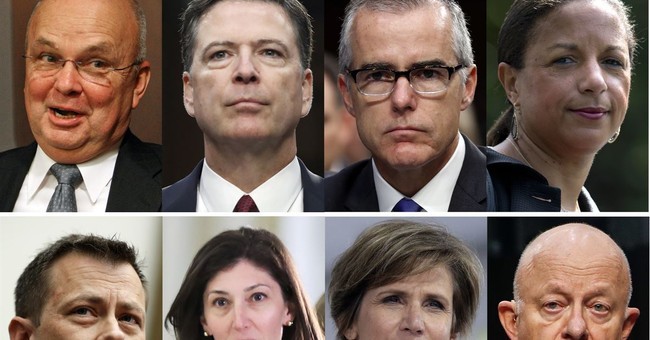
The White House released a set of declassified documents that, according to officials aligned with the administration, exposed a long-running, politically charged FBI effort against Donald Trump that morphed from Crossfire Hurricane into a follow-on probe labeled Oxferd Comma; these files are being presented as proof the Russia-collusion narrative was hollow and the FBI pressed forward anyway.
Americans were told for years the FBI’s Russia collusion probe was a sober, nonpartisan national security investigation. What the newly released memos show, from the viewpoint of many conservatives, is a very different picture: an investigation driven by assumptions and political motives rather than clear evidence.
The timeline in these records traces the transition from Crossfire Hurricane into a newer operation called Oxferd Comma after President Trump fired James Comey on May 9, 2017. Instead of closing the book when key leads fell apart, the agency reportedly kept digging and funneled material into Special Counsel Robert Mueller’s investigation.
Journalist John Solomon, acting with the White House Government Transparency Task Force, announced the release and summarized the documents. He framed the file dump as a decisive disclosure that shows federal agents continued a criminal inquiry into the president despite internal findings that undercut the core allegations.
The papers highlight several problematic episodes from within the bureau, including agents who had previously debunked the Steele dossier and notes indicating there was “no big there, there.” Conservatives argue this internal language undercuts the claim the probe was built on a solid evidentiary base.
These documents show the FBI criminally investigated President Donald Trump beginning in May 2017 on the theory that he was acting as a Russian agent when he fired ex-FBI Director James Comey for mishandling the Clinton email case.
https://x.com/jsolomonReports/status/2084952555189060012
At the time the FBI opened this probe its agents had already debunked the Steele dossier. Agents had already cleared Mike Flynn of collusion. Pete Strzok wrote Lisa Page there was ‘no big there, there.’ The bureau was alerted Carter Page was a CIA asset and not a Russian stooge.
And one of the lead agents on the case, William Barnett, had concluded he had seen no evidence of Russian collusion and wanted off the case because the investigation had become a bad game of Clue. And despite all that, the FBI still opened Oxferd Comma and used it as part of a campaign to get Special Counsel Robert Mueller appointed.
Remarkably, the man who knew the real reason why Comey was fired for violating DOJ policy in the Clinton probe — then-Deputy Attorney General Rod Rosenstein — allowed the case to go forward and authorized Mueller’s appointment.
Those quoted passages, preserved exactly as released, make the case that senior officials let a politically fraught course continue despite internal warnings. The documents point to figures like Pete Strzok and Lisa Page, whose text exchanges have already been widely criticized for bias, as central players in how the probe unfolded.
Conservatives have been especially critical of the decision to open a fresh criminal inquiry into the president at a time when major lines of inquiry had been checked and found wanting. The memos suggest that even after major pieces of the puzzle failed to fit, the bureau persisted in what critics call a fishing expedition.
One striking element in the release is the odd spelling “Oxferd” instead of “Oxford,” which officials now attribute to a clerical quirk somewhere deep in the chain of paperwork. The name stuck and now marks a chapter that many on the right view as emblematic of sloppy, politicized law enforcement behavior.
The White House made these files available to the public through its release channels, and the administration’s transparency team framed the disclosure as evidence that the original collusion narrative was a hoax. For Republican readers, the documents are being presented as vindication: the Justice Department and the FBI pursued a narrative that collapsed under scrutiny, yet they continued anyway.
Reports from the release also emphasize agent William Barnett’s discomfort with the investigation and his desire to be removed, portraying a bureau at odds with itself. That internal friction, paired with language admitting key allegations lacked support, feeds the conservative critique that institutions were weaponized against a political opponent.
President Trump did not immediately offer a public reaction tied to every item in the dump, but the released memos speak plainly for themselves. To those skeptical of the bureau’s conduct, the documents read like a record of overreach and institutional failure rather than a justified, evidence-driven inquiry.
Beyond the partisan implications, the files raise broader questions about how politically sensitive probes are opened and sustained inside powerful agencies. Republicans pushing oversight will likely use the material as a basis for renewed scrutiny of how decisions were made and who authorized escalations that impacted a presidential administration.


Add comment