
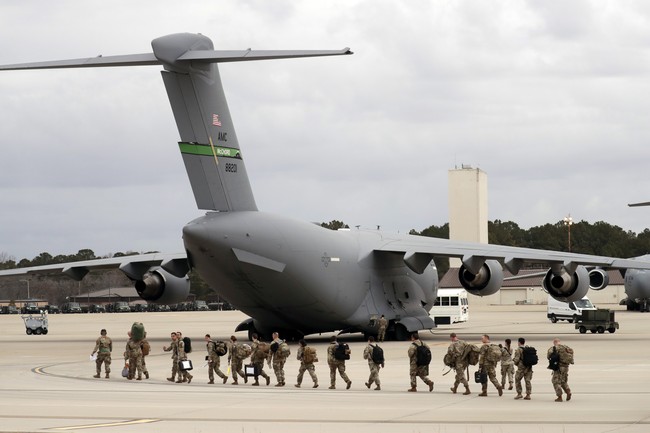
U.S. airborne and special operations movements toward the Persian Gulf suggest a clear intent to force the reopening of the Strait of Hormuz, and that buildup—combined with diplomatic pressure and tactical objectives around key islands and ports—points to a short timeline for decisive action if Iran refuses to yield control over transit routes and energy flows.
Reports indicate the division commander and headquarters of the 82d Airborne Division have been ordered to move into the U.S. Central Command area of operations, which would position a battle staff to coordinate ground elements aimed at ensuring freedom of navigation through the Strait of Hormuz. The Division Ready Brigade, roughly 3,000 paratroopers, remains able to deploy rapidly if ordered, making a rapid operational response feasible. Given recent public statements and the pattern of deployments, this is consistent with a campaign to reopen a strategically vital chokepoint.
At the strategic level, presidential representatives are said to be engaging with Iranian interlocutors, but talks appear to be drifting apart rather than closing. Tehran’s negotiating posture includes demands that would fundamentally rearrange regional security and control of maritime routes. Those demands are significant and include a set of conditions that would be unacceptable to regional partners and global commerce.
Guarantees against future military action,
Compensation for wartime losses,
Formal control of the Strait of Hormuz, and
No limitations to its ballistic missile program
Iran has reportedly softened on nuclear weapon ambitions while holding firm on its ballistic missile activities, which have become a much more prominent threat in the current conflict. The new insistence on formal control of the Strait of Hormuz raises the stakes: giving a single, hostile state de facto authority over a critical international waterway is not a sustainable option for global trade or for American allies. Markets and militaries both react to the mere threat of an Iran-controlled Hormuz, so the United States and partners are moving to prevent any permanent loss of access.
President Trump issued a 48-hour deadline to Tehran to reopen Hormuz, a demand that Iran ignored, and that dismissal appears to have accelerated U.S. force posture adjustments. Amphibious and carrier strike elements are being positioned in the theater, and Marine and joint forces are flowing into the region, setting conditions for combined sea, air, and land operations if necessary. Those movements send a clear message: diplomatic windows are open but limited, and military options are being staged in parallel.
The pattern of flights and sealift out of multiple U.S. bases points to a coordinated insertion of elite formations rather than a piecemeal response. Ranger battalions and Army special operations elements, aviation assets from the 160th Special Operations Aviation Regiment, and naval special warfare units are mentioned as likely contributors to any operation focused on rapid seizing of littoral positions. Special operations and airmobile forces excel at taking and holding small, critical terrain—precisely the kind of campaign required to clear mines, neutralize coastal batteries, and secure shipping lanes through narrow channels.
Multiple transport flights are already reported headed to the Persian Gulf, indicating a deliberate buildup rather than an emergency scramble. Key embarkation points include facilities associated with airborne and special operations units, which aligns with a campaign plan that emphasizes speed, precision, and the seizure of choke points. That posture allows commanders to conduct focused strikes and landings to deny Iran the ability to interrupt maritime traffic.
Main objectives will likely be a series of islands and narrow coastal strips rather than a single, highly defended facility. Capturing or neutralizing smaller islands and coastal positions that host fast-attack boats, mines, and anti-ship weapons is the quickest way to restore safe passage through the channel. Bandar Abbas and the islands that control the eastern exit of the shipping lane are central to any planning aimed at reopening the strait.
Those islands have been militarized for decades and are used to stage mine-laying, small boat attacks, and coastal missile launches, so they must be treated as fortified positions. Iranian anti-aircraft defenses have been degraded in recent operations, allowing U.S. A-10s and Apache attack helicopters to hunt drones, speedboats, and minelaying operations with less interference. That permissive air environment increases the likelihood of successful airborne and airmobile operations to clear and hold key terrain.
Kharg Island is discussed as an important node, but it is unlikely to be the initial objective for a forced reopening of Hormuz; a campaign that prioritizes securing the shipping lanes will first focus on the smaller islands and coastal strips that directly control vessel movement. Once those control points are secured and mines and threats are removed, larger facilities can be isolated and neutralized. The strategic outcome would deny Iran the ability to restrict energy exports or wield the strait as a bargaining chip.
If the Division Ready Brigade of the 82d Airborne is tasked to move, a rapid resolution becomes the most probable outcome because the necessary pieces for a coordinated operation will already be in place. The mix of airborne, Ranger, special forces, and naval assets staged in theater creates a toolbox suited for sequential clearance and seizure of islands and chokepoints. When political leadership decides to act, that force posture allows for quick, decisive operations to restore freedom of navigation.


Add comment