
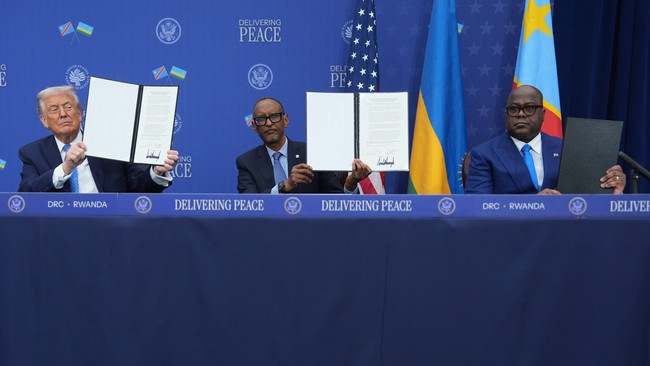
President Donald Trump has scored a strategic win aimed at reducing China’s control over critical minerals by backing an American company to develop cobalt and copper mines in the Democratic Republic of the Congo, part of a broader push to secure U.S. access to resources vital for energy, defense, and advanced manufacturing.
Trump’s approach has prioritized American investments and security interests overseas, showing up in diplomacy that pairs peacemaking with economic objectives. Officials moved to support Virtus Minerals’ involvement in the DRC, signaling a shift from passive dependence to active competition. This is being framed as a deliberate effort to loosen Beijing’s tight grip on rare earths and related supply chains.
China has held a dominant role in cobalt and related markets, controlling a large share of supply pathways tied to the DRC’s output. For years, U.S. policy lagged while manufacturing and defense industries grew more dependent on foreign sources. The Trump administration’s push is meant to reverse that trend by restoring American presence and influence where these minerals are produced.
In what’s being hailed as a major win for the Trump administration against Chinese domination of the rare earth minerals market, the U.S. has supported an American company, Virtus Minerals, in developing two major mines producing cobalt and copper in the Democratic Republic of the Congo (DRC).
This is claimed to be the first U.S. rare earth minerals acquisition in the African nation since President Donald Trump announced the Washington Accord last December.
The two mine sites in question, Étoile near Lubumbashi and Mutoshi in Kolwezi, are slated to produce substantial quantities once processing facilities come online. Projections suggest combined annual output could reach roughly 75,000 tonnes of copper and 20,000 tonnes of cobalt. Those numbers matter because these metals feed electric vehicles, renewable energy systems, and critical defense technologies.
Those processing plants are under development now and are expected to start operations next year, which would accelerate the shift in supply chains. Getting American processing back into the DRC signals more than resource access; it means rebuilding industrial capability and oversight closer to the source. That reduces vulnerabilities created by long, China-dominated chains of extraction, shipment, and refinement.
Trump’s diplomatic moves around the Washington Accord aimed to stabilize the region politically while opening space for economic collaboration. The broader strategy looks to combine conflict reduction, bilateral agreements, and commercial deals that advantage U.S. firms. It’s a mix of hard-nosed geopolitics and practical economic policy intended to strengthen national security through supply chain resilience.
American mining company Virtus is, with U.S. support, claiming to be “the first U.S.-owned operator back in the DRC in more than a decade”, with its investment in Chemaf, a local cobalt and copper producer with two mining operations, one, Étoile, in Lubumbashi and Mutoshi, in Kolwezi. Together it’s planned the mines will produce a combined 75,000 tonnes of copper, and 20,000 tonnes of cobalt a year. The processing plants are currently under development and will come online next year.
Analysts aligned with the administration view this as an intentional countermeasure to Beijing’s dominance, not a one-off deal. Restoring U.S. ownership and operational control over strategic assets means more leverage in global markets and policymaking. It also opens the door for higher environmental and labor standards under American oversight.
Frans Cronje of the Yorktown Foundation commented on the strategic implications for the U.S., framing the Virtus projects as evidence of a new posture. He emphasized the need to compete for Africa’s critical mineral base, especially in the DRC where cobalt and copper are essential to global energy and defense supply chains. That line of thinking treats minerals policy as foreign policy and economic security rolled into one.
On the domestic front, bringing supply chains home or under allied control supports manufacturing jobs and technological leadership. It cuts the risk of sudden disruptions in clean energy and defense industries, where substitutes are limited and demand is rising. Policymakers see this as part of a broader modernization push across quantum, chipmaking, and other strategic sectors.
Critics will argue about costs, oversight, and the challenges of working in complex environments like the DRC. Those are real considerations and require careful contract terms, transparency, and enforcement of standards. Still, supporters say the alternative—continued reliance on an adversary-friendly supply chain—is a greater strategic risk that the country can no longer accept.
The move to back Virtus is one element in a wider Republican agenda that ties national security to economic independence. It sends a clear message that control over critical minerals is not merely a commercial issue but a matter of sovereignty. As projects progress, the question will be whether Washington can sustain coordinated policy and private-sector engagement to turn these early wins into lasting strategic advantage.



Add comment