
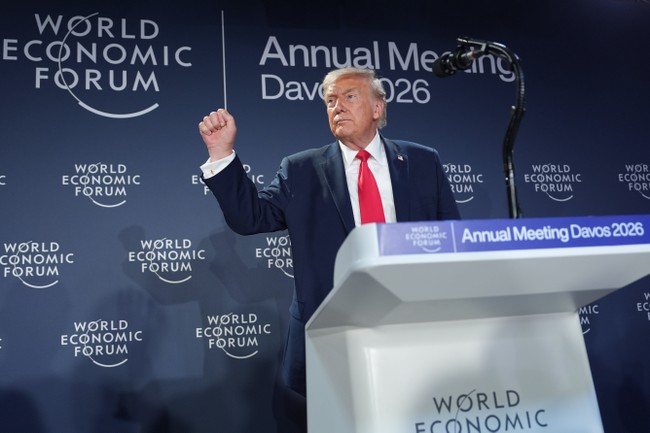
At Davos this week, senior officials from the administration took aim at globalist orthodoxies while President Trump unveiled a diplomatic breakthrough: a negotiated “framework” for Greenland and the wider Arctic, and a decision to halt planned tariffs on several European countries as part of that progress. The announcement, posted on Truth Social, laid out both the strategy and the team assigned to finalize the deal, and markets reacted positively. Below are the details reported from the World Economic Forum and the immediate fallout domestically and internationally.
Officials at Davos were blunt and unapologetic, signaling a shift from plenty of past orthodoxies. Treasury Secretary Scott Bessent delivered a sharp critique of California’s leadership, and Commerce Secretary Howard Lutnick told elites that the old model of globalization failed working Americans. The president also used the gathering to restate a commitment to making homeownership a priority, framing these moves as part of a broader push for American interests abroad and at home.
Midweek brought the biggest development: the White House announced a framework for a Greenland arrangement that aims to increase U.S. influence in the Arctic to push back against Russia and China. Along with that diplomatic progress came an immediate policy change: the administration will not move forward with tariffs on European nations that had been scheduled for early February. The dual announcement pairs negotiation with leverage, underscoring a transactional approach to foreign policy.
The president posted the details to his preferred platform, and that post was included in the public rollout of the deal framework.
Trump stressed that the work expands well beyond Greenland itself, referring to the broader strategic theater of the Arctic in his public statement. The message highlighted NATO coordination and cast the emerging arrangement as advantageous for the United States and allied partners. That framing aims to cement the move as both a security and diplomatic win that leverages U.S. negotiating strength.
Based upon a very productive meeting that I have had with the Secretary General of NATO, Mark Rutte, we have formed the framework of a future deal with respect to Greenland and, in fact, the entire Arctic Region.
This solution, if consummated, will be a great one for the United States of America, and all NATO Nations.
The tariff threat had been a central stick in the administration’s toolkit: the president had signaled plans to apply a 10 percent tariff on February 1, rising to 25 percent on June 1, against eight European countries unless a deal was reached. Those measures targeted Denmark, Norway, Sweden, France, Germany, the United Kingdom, the Netherlands and Finland, and they were explicitly tied to progress on Greenland. With this framework in hand, the tariffs will not be imposed as scheduled.
Markets reacted quickly. U.S. stocks moved higher upon the news, with the Dow Jones Industrial Average reported up about 1.5 percent as traders digested the diplomatic development and the temporary removal of trade pressure. The immediate market response underscored how geopolitical clarity and de-escalation of trade threats can calm investor nerves and lift sentiment across asset classes.
Full details of the agreement remain under negotiation, but the president indicated a designated negotiating team and a chain of command to move talks forward. The administration named senior figures who will lead discussions and report directly to the president, signaling a tightly managed process. That structure is meant to ensure focus and speed as the parties work through the technical and political elements of any eventual deal.
Additional discussions are being held concerning The Golden Dome as it pertains to Greenland. Further information will be made available as discussions progress. Vice President JD Vance, Secretary of State Marco Rubio, Special Envoy Steve Witkoff, and various others, as needed, will be responsible for the negotiations — They will report directly to me. Thank you for your attention to this matter!
DONALD J. TRUMP
PRESIDENT OF THE UNITED STATES OF AMERICA
Seen through a Republican lens, the move reads as classic dealmaking: use leverage, keep pressure on the table, and convert threats into negotiated gains that benefit national security and allied interests. That posture aims to reinforce U.S. standing in a contested region while avoiding unnecessary economic conflict with partners when a workable resolution is within reach. The next phase will be the detailed negotiations and how quickly an enforceable agreement is finalized.
Observers will now watch deployments of diplomacy and follow-on policy steps, including any changes to military posture, investment commitments in the Arctic, and the legal mechanics necessary to implement any transfer of control or cooperative arrangement. The administration’s approach blends hard-nosed bargaining with a promise of allied cooperation, and it will be judged on results rather than rhetoric.

Add comment