
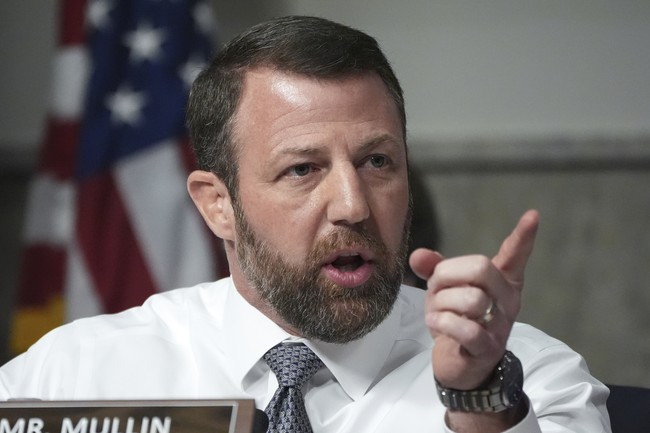
The Department of Homeland Security secretary warned that repeated funding fights driven by Democrats have left the agency scrambling to secure major events and weakened key components of homeland security ahead of several FIFA World Cup matches, with staffing, reimbursements, and cybersecurity all taking hits.
Markwayne Mullin traveled to Kansas City to make the point bluntly: partisan funding disputes have real-world consequences for public safety and event security. He said DHS faced four shutdowns in a single year, including a 76-day stretch that hamstrung planning and pushed staffing and reimbursements into disarray. That pattern, he insisted, left the department racing the clock as multiple World Cup matches approach.
Mullin argued Democrats used DHS funding negotiations to deliberately target immigration enforcement agencies while leaving broader homeland security operations exposed. He described a turn to budget reconciliation to secure multi-year funding for ICE and CBP after Democrats threatened another standoff, saying that process is meant for major fiscal policy, not routine agency operations. The consequence, he said, was damaged readiness across the department.
At the podium Mullin made his position stark and personal, framing the funding fights as games that put lives at risk and undercut recruitment and morale. “We are going to fight every single day to make sure that they can’t play games with our law enforcement anymore.” @SecMullinDHS
He repeated a variation of that message on camera: “I get that people have strong opinions about this, but the truth is, it’s the only option we have,” Mullin said. “We’re going to fight every single day to make sure that they can’t play games with our law enforcement anymore.”
DHS struggled to reimburse local law enforcement that stepped in to help plan and secure events when promised payments stalled, Mullin said, creating confusion and strain for agencies relied on to keep crowds safe. Cybersecurity and event protection units entered the FIFA preparation timeline behind schedule after hiring and training were repeatedly disrupted. The net effect was a scramble to catch up with a fixed calendar and millions of visitors expected during the World Cup cycle.
Rep. Mark Alford, who serves on the House Appropriations Committee and represents part of Missouri, joined Mullin and pressed the simple point that funding and security should not be political theater. “This did not have to be this way. We’ve got to make sure that DHS is fully funded. Quit putting the politics in front of our security as a nation,” he said, echoing the administration’s frustration with stalled appropriations. That frustration centers on delayed classes at academies, hiring freezes, and uncertainty over pay shaping the department’s ability to respond.
Mullin singled out Rep. Emanuel Cleaver for voting against DHS funding despite his district hosting one of the stadiums set for World Cup matches, and he pushed back on Cleaver’s remark claiming the agency had “lost their moral compass.” The secretary said lawmakers had years to act if they wanted to change statutes related to enforcement and border policy but chose not to, placing the burden instead on frontline personnel. Political posturing, he said, is no excuse when public safety is on the line.
“We didn’t make the laws. We didn’t even make the statutes, Congress did. And if they had wanted to change it, they could have,” Sec. Mullin said, reminding everyone that the Dems “had two years under the Biden administration, with Nancy Pelosi as [House] Speaker, that they could have changed it.” He accused opponents of putting political talking points ahead of safety: You’ve lost your moral compass when you’re willing to put the lives of your constituents at risk so you can have political talking points and get reelected.
Morale plummeted across agencies like ICE, CBP, TSA, and cybersecurity as repeated shutdowns and budget brinksmanship forced hiring pauses and delayed training classes. “How do you recruit somebody to come work for you?” Mullin asked. “Hey, by the way, we’re shut down for the fourth time, I can’t pay you, but hey, come on, let’s do this.”
Mullin warned DHS cybersecurity units were operating roughly a third below staffing targets heading into the tournament, a gap that raises risks given the scale of expected travel and digital threats during major international events. State Department projections anticipated five to seven million visitors to the U.S. during the FIFA cycle, magnifying the stakes for both physical security and cyber defenses. With about a month left before the first match in Los Angeles, Mullin said DHS must finalize plans that ideal timelines would have allowed them to work on much earlier.
An Editor’s Note acknowledged the risks faced by ICE and CBP personnel, emphasizing that those agencies continue to act to protect sovereignty and public safety. The ongoing message from DHS leadership is that funding certainty and clear priorities are essential to maintain readiness and protect Americans, especially when large international events are on the calendar.
The debate over funding and priorities will continue in Congress, but Mullin’s argument is straightforward: political brinkmanship has immediate, tangible costs for homeland security. For the communities hosting World Cup matches and the officers keeping them safe, delays and uncertainty are not abstract problems—they are operational challenges with potential consequences.

Add comment