
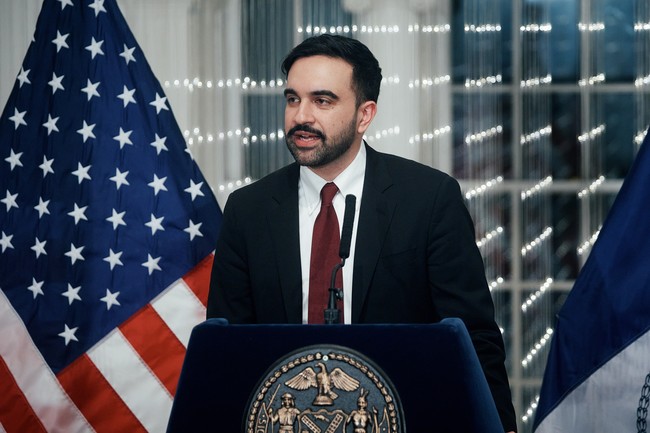
Mayor Zohran Mamdani marked his first 100 days by announcing a city-owned grocery store in Queens and a plan for five city-run markets, arguing government intervention will fix food access and affordability in New York City; critics warn that restrictive zoning, political gatekeeping of permits, and the history of centrally managed markets suggest this approach may reduce competition, raise costs, and risk shortages rather than solving price problems.
At a former factory in Queens, the new mayor touted achievements like securing $1.2 billion for universal childcare and repairing 100,000 potholes while unveiling a plan for city-run groceries. His announcement leaned on a clear theme: the city must step in where the private market has failed and provide a public alternative to corporate-controlled food supply chains.
“I know there are many who use ‘socialist’ as a dirty word, something to be ashamed of,” Mamdani told his supporters. “They can try all they want, but we will not be ashamed of using government to fight for the many, not simply the few.” That rhetoric frames the grocery initiative as a moral duty rather than a pragmatic policy experiment.
Mamdani argues that corporate control of the food chain drives up prices and leaves both workers and consumers behind, and he says a public option will address those failures. Yet New York’s grocery price problem is tied to more than corporate behavior; zoning rules and the special permit process limit where large grocers can open, keeping competition artificially constrained.
Large grocery stores often need sites over 10,000 square feet, and in many industrial and mixed-use areas of the city such stores are not allowed as of right. Where national grocers could otherwise build, developers must seek a special permit that brings the full City Council into the decision, a long and politically fraught process that has often blocked national chains from entering neighborhoods.
That political gatekeeping has tangible effects: fewer big grocers mean less purchasing power and fewer opportunities to drive down prices through scale. Meanwhile, smaller bodegas and mom-and-pop stores face rising rents, higher property taxes, and shrinking downtown foot traffic since the pandemic, creating a squeeze on both sides of the market.
By planning five city-run grocery stores, the administration aims to provide immediate relief in food deserts and control prices directly. But creating government-run competitors risks crowding out private investment, and it could leave the city with ongoing operational burdens and fiscal liabilities if the stores cannot match private-sector efficiency.
Sen. Bernie Sanders praised the plan as an example of government working for people, calling city-run groceries another step toward public solutions for private-market failures. “Today’s announcement by the mayor of new city-run grocery stores is just another example of government working for the people,” he said, echoing the broader socialist appeal behind public ownership initiatives.
History offers a cautionary tale. Central planning regimes that tried to control distribution often faced shortages and long lines, and critics point to the Soviet Union’s system as an example where command economies produced scarcity rather than abundance. In the late 1980s, when shortages were common behind the Iron Curtain, bread lines were a normal part of daily life.
Local Republican voices have been blunt: memories of Soviet breadlines are not theoretical. “I didn’t escape a childhood of Soviet breadlines just to sit quietly while a Mayoral frontrunner tries to make socialism seem like a great idea for NYC,” a New York City councilwoman posted to X, drawing a direct line between historical failures of state-controlled food systems and the rhetoric driving the new policy.
Practical problems must be considered too. Running food retail at municipal scale requires logistics expertise, supply chain contracts, distribution centers, and staffing plans to keep shelves stocked and prices stable. Cities have managed public utilities and services, but retail grocery is a different business with thin margins and intense competition.
There are alternatives that focus on enabling competition rather than replacing it: reforming zoning to allow more full-sized grocers where suitable, streamlining the special permit process, and offering targeted incentives for private investment in underserved neighborhoods. Those steps aim to expand supply, lower prices through market forces, and reduce the long-term fiscal risk to taxpayers.
Mamdani’s message taps into real concerns about food access and affordability, but the proposed remedy is ideological as much as it is practical. Policymakers should weigh the political appeal of public ownership against the economic reality that competition, not centralized control, tends to deliver lower prices and more consistent supply in mature markets.
Implementing city-run stores will be a test of whether government can handle the retail risks that private chains manage through scale and operational efficiency. If the goal is to make groceries more affordable and accessible, the policy choices—whether public ownership or enabling competition—should be driven by what produces reliable, sustainable results for New Yorkers, not just slogans about fighting for the many.



Great idea!!! Tax everyone more so your socialist mayor can have free buses free child care free markets!!!! NOTHING is free the taxpayers are paying for it one way or another!!!! Socialism DOES NOT work!!! Just look at Cuba Venezuela North Korea whether it’s socialism or communism neither works!!!! New York City you get what you voted for!!!! Hopefully you survive till the socialist commie is either removed or voted out!!!!