
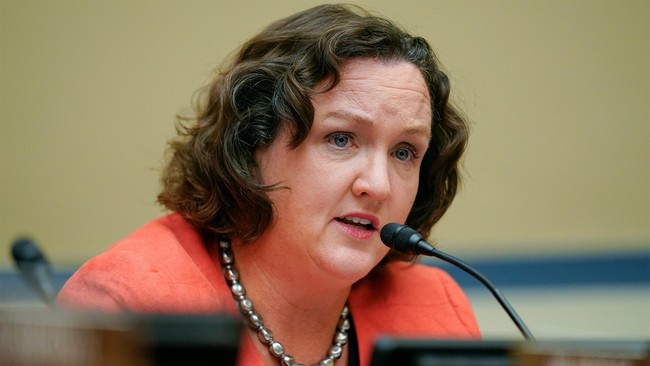
The article examines Katie Porter’s fundraising email sent shortly after the White House Correspondents’ Dinner shooting, highlighting its explicit subject line and violent rhetoric, contrasting that message with the real-world violence that had just occurred, and questioning the judgment of using a foiled assassination attempt as a political fundraising hook.
Roughly 48 hours after a gunman opened fire at the White House Correspondents’ Dinner and Secret Service evacuated the president, Katie Porter’s campaign dispatched a fundraising email with a subject line that read, simply: “F*** Trump” (minus the asterisks). The timing makes the message jarring on its face, and the email’s tone amplifies that alarm. It did not read like an offhand remark or a misfire from a junior staffer.
The email, timestamped Monday evening and sent on behalf of Porter’s gubernatorial campaign, opened with a call-and-response rally chant: . That chant is quoted verbatim inside the message and appears as the emotional center of the appeal. The choice to lead with that line framed the campaign’s pitch as raw anger rather than policy contrast or sober leadership.
“Say it with me. Ready, 1 … 2 … 3 … F*** Trump. Yeah, that’s right, F*** Trump. Together, we’re going to kick Trump’s ass in November and stop him in his tracks.”
The nation had just witnessed chaos in a ballroom where reporters ducked for cover and broadcast feeds captured the scramble. Secret Service agents protected the president and others as shots rang out, and the suspected shooter was taken into custody. In that atmosphere, political actors of all stripes faced a choice about tone and responsibility.
Instead of a measured response, Porter’s team used the moment to push an adroitly produced fundraising appeal. The email included donation buttons, a list of platform points, and repeated violent rhetoric aimed at the former president. That rhetoric was not an aside; it was the hook meant to convert outrage into small-dollar donations.
“We KNOW what Trump is willing to do and how far he’s willing to go — he’s willing to kill people in the streets, to rip health care away, to ruthlessly attack our democracy.”
From a Republican perspective, this was tone-deaf and dangerous. Characterizing someone who had just been the target of an attempted assassination as the one “willing to kill people in the streets” risks normalizing extreme language and loosening the moral boundary that separates political debate from threats. Political opponents should push for accountability, but they should also avoid inflaming an already volatile moment.
Consider the record: the president had survived multiple assassination attempts or close calls in recent years, including a shooting incident in 2024 and another dangerous episode at a golf course. Given that context, using an attempted killing as a fundraising catalyst looked less like political competition and more like exploiting trauma. That is both politically tone-deaf and ethically questionable.
The Department of Justice was publicly addressing charges related to the incident, with officials stressing that violence has no place in civic life. Those very statements underline why political communications ought to be restrained after such events. Porter’s email, by contrast, read like a campaign playbook from a team prioritizing donations over dignity.
Porter has built a brand as the “whiteboard lady,” presenting herself as a methodical problem-solver with an accountant’s sensibility. Yet this fundraising pitch betrayed that image; it leaned into scorched-earth personalization rather than policy argument. Voters who expect pragmatic governance will find the contradiction striking.
Beyond immediate optics, there is a larger responsibility for public figures to shape the environment in which political violence either escalates or abates. Lawmakers, candidates, and their teams influence rhetoric that can either calm tensions or inflame them. In this instance, the choice to frame the pitch with profanity and accusations of homicidal intent makes the larger political climate worse, not better.
Campaigns need tough contrasts and clear critiques, but they also require judgment about timing and tone. Turning a near-tragedy into a fundraising hook reflects a miscalculation about public sentiment and civic norms. For voters who care about stability and measured leadership, that miscalculation will matter at the ballot box.
Political debates should be fierce, but they also must respect the boundaries that keep civic life functioning. Using graphic language and incendiary claims in the immediate aftermath of a security incident crosses a line for many Americans. That line exists for a reason, and ignoring it invites real consequences for public discourse and public safety.
Typical stupid c-unt democrat can’t wait in till someone in her family gets hurt or killed diagnosed with something awful then we can all sing and dance repeating her same behavior. This disgusting person must be having PMS or menopause everyday of her life. Know one can be that disgusting and disgraceful everyday of their lives. Just another disgraceful democrat that should be removed from office immediately these schmucks don’t represent our country and have no respect for America anymore. Ask Waltz for Tampons and shove them in every orifice you have. Cesspool swamp swimmers