
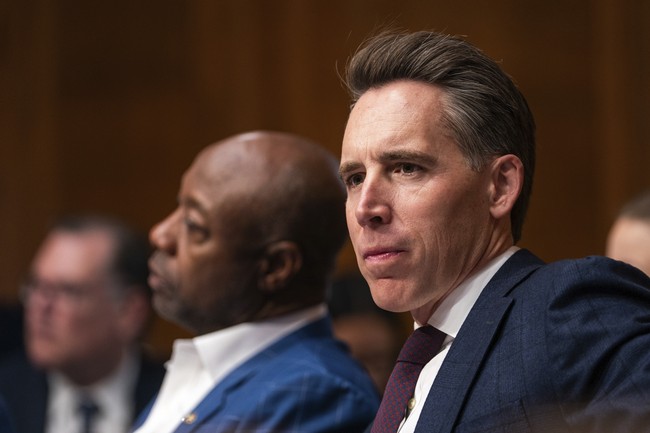
Sen. Josh Hawley is taking aim at Major League Baseball after three San Francisco Giants players wrote Bible verses on rainbow-themed caps during Pride Night and received a league warning, and GOP leaders are piling on as the dispute raises questions about free religious expression, league consistency, and potential congressional scrutiny.
The controversy began when three pitchers from the San Francisco Giants placed Bible verses on rainbow-themed caps during a game designated as Pride Night, and Major League Baseball issued a warning that the writing violated uniform rules. Fans and conservative voices immediately saw the league’s response as unequal enforcement, noting instances where the league has allowed political and social messaging. Those earlier actions, such as the leaguewide embrace of certain movements, set the stage for critics to question the motive behind this particular warning.
Sen. Josh Hawley pushed back hard, demanding answers from MLB officials and suggesting that a public congressional hearing could be necessary to examine whether the league is wielding its power unfairly. He pointed to a history in which the league “designed speech, promoted speech, and shoehorned social and political messages into the game broadcast to millions of Americans,” and contrasted that with the swift warning to players expressing religious belief. His letter frames MLB’s treatment as a troubling double standard that deserves scrutiny given baseball’s unique legal position.
https://x.com/crza_11/status/2066976254264569930
The league’s claim that it merely forbids “writing of any kind” on its uniforms does not survive a cursory review of the league’s recent history. In 2020, MLB itself turned its uniforms and its fields into a billboard for political and social messages. It created jersey patches reading “Black Lives Matter” and “United for Change.” It authorized “BLM” to be stenciled onto pitching mounds. And it suspended its own equipment rules so that players could display progressive political slogans on their cleats. The league went beyond tolerating speech—it designed speech, promoted speech, and shoehorned social and political messages into the game broadcast to millions of Americans. Yet when three players added a handful of characters citing the Book of Genesis to their caps, the league reached for its rulebook.
This does not appear to be an isolated incident. Your organization’s recent action follows an undercover investigation which revealed an admission from a Washington Nationals executive that a Catholic player on the team was not included in promotional materials for the team because of his faith. That executive has since been fired, but not before the anti-Christian bigotry was exposed.
[…]
My concern is sharpened by the singular legal position that Major League Baseball occupies. Alone among America’s professional sports leagues, baseball enjoys a sweeping, judicially manufactured exemption from the federal antitrust laws—a privilege the Senate Judiciary Committee has examined with bipartisan skepticism in recent years. A league that benefits from such an extraordinary dispensation owes the public a corresponding measure of accountability, and it invites the closest scrutiny when it appears to wield its market power to punish Americans for their beliefs. That exemption, in any event, has never been understood to shield the league from its legal obligation not to discriminate against its employees on the basis of religion.
“The freedom to live out one’s faith does not end at the ballpark gate,” Sen. Hawley wrote, pressing MLB to explain how it balances its own messaging with protection for players’ religious expressions. His language is intentional and direct, stressing that institutions tied to America’s pastime must not single out religious speech for punishment while promoting messages of their own choosing. That is a stark framing that signals Republicans will not let this pass without pushback.
Vice President J.D. Vance and other GOP officials echoed the criticism, amplifying the message that the league’s move looks like selective enforcement against Christian expression. Florida’s attorney general added his voice as well, making this more than just a media dust-up; it is a political moment with potential legal and legislative implications. The coordinated response shows how cultural flashpoints at sporting events can quickly escalate into broader fights over free expression and institutional accountability.
For many conservative fans, the issue is simple: allow players to express faith as consistently as the league allows other social or political messages, or admit that there are different rules for different viewpoints. MLB’s prior decisions to permit visible support for certain causes creates expectations that similar latitude should be afforded to expressions of faith. That sense of unfairness is fueling calls for transparency and potential oversight.
MLB must now decide whether to soften its stance, change its rule interpretation, or stand firm and risk a deeper political backlash that could include public hearings. With attendance and fan engagement already fragile in parts of the country, the league’s reaction in the coming days will send a clear signal about whether it intends to apply rules neutrally. For Republicans watching closely, this is about principle as much as it is about politics: equal treatment for religious expression in places where other messages have been celebrated.
Baseball has long been called quintessentially American, and that label carries expectations about fairness and freedom. The current dispute is forcing the league to confront whether its policies are applied uniformly or used as a tool to shape which viewpoints are visible in front of millions of fans. Either way, the national conversation around this incident will not fade quickly, and it will be a litmus test for how major institutions handle conflicting demands from different segments of the public.


Add comment