
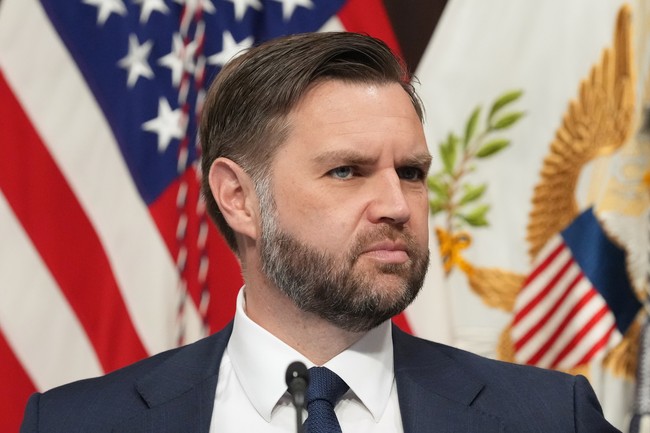
Vice President JD Vance spent Tuesday on television promoting his book Communion: Finding My Way Back to Faith and used the platform to make a plain, political point: gratitude for the United States matters. He moved from a contentious appearance on one daytime panel to a friendlier late-night stage and made a case that the deeper divide in American politics is not policy, it’s patriotism. Vance tied his personal faith and upbringing to a belief in public gratitude for the country, and he framed that as a test for people in public life. His remarks sparked reaction because they pushed beyond ordinary partisan debate into questions about character and civic gratitude.
Vance’s media tour included stops that invited very different tones, from combative morning panels to a more relaxed late-night show where humor and pointed commentary mix. On the latter, he tossed out jokes but also landed on a theme he repeated: some public figures fail to show appreciation for the United States. That observation came wrapped in anecdotes about his own upbringing and commitment to faith, which he described in his book. The interplay of personal story and political critique made his appearance feel less like a book push and more like a cultural argument about what public service should mean.
On the comedy-minded set, laughs were part of the script, but Vance used the laughter to pivot into serious territory. He questioned a cultural trend among many on the left that he believes treats the country as an object of constant critique rather than gratitude. That contrast between critique and appreciation formed the core of his message, and he said it plainly: being in public service should include a basic gratitude for the nation. Those lines struck a nerve because they turned a philosophical point about gratitude into a litmus test for civic life.
Although humor softened the edges, the substance of his claim was clear and unapologetic: he sees a real deficit of national gratitude among many Democrats. He argued that political disagreement is normal, but what is not normal is a lack of appreciation for the country itself. Framing the argument this way shifted attention away from policy fights to the character of those who seek to lead, and it put gratitude at the center of a conservative case for civic renewal. That framing appealed to viewers who think love of country should be nonnegotiable for public leaders.
Simply, there are those who love our republic and those who don’t:
https://x.com/FoxNews/status/2067074782206578786
“What really does bother me is that they don’t show gratitude for the United States of America.”
VP JD Vance blasted Democrats serving in public office during an appearance on @Gutfeldfox, arguing that too many spend their time criticizing the country rather than appreciating it.
Vance said he was raised to love America and be grateful for the opportunities it provides, calling patriotism a core value that shaped his upbringing.
He contrasted that outlook with what he sees from many on the left, saying a lack of appreciation for the country has become increasingly common in American politics.
Vance doubled down in later remarks, insisting that this is not merely a disagreement about budgets or programs but a deeper cultural rift. He told a story about being raised by patriotic Democrats who may have differed with Republicans on policy but still recognized America’s greatness. By lifting that example, he tried to show that patriotism once crossed party lines and could again. His point was to separate honest policy debate from what he sees as an ingratitude that undermines public service.
So I think this is a very, very bad thing…
And to make a bipartisan point here — the Republican VP trying to be bipartisan — I was raised by patriotic Union Democrats who maybe wouldn’t have agreed with every single policy of a Republican administration, but they recognize that this is the greatest country in the world, and every single one of us should be grateful to live here.
He expanded on that idea in plain language, refusing to soften the critique of those he believes lack appreciation. Vance said disagreements over policy are expected, but what troubles him is when people in public life “don’t show gratitude for the United States of America.” That line crystallized the argument: gratitude is a baseline civic virtue, and its absence speaks to deeper character concerns. The bluntness of his phrasing made the segment feel like a cultural manifesto as much as a media appearance.
And I think that is the fundamental problem.
Greg, it doesn’t bother me when congressional Democrats disagree with our policies. It bothers me, like, that they’re just terrible people, so many of them. But what really does bother me is that they don’t show gratitude for the United States of America. Disagree with our policies, but if you don’t feel grateful to live here and for the people who made it possible, then what are you even doing, being in public service?
Too many Democrats don’t show appreciation for the country.
The segment closed with a clear political implication: if a deficit in gratitude is widespread among opponents, then restoring civic pride becomes a political priority. Vance urged voters to weigh gratitude as part of their civic calculus and implied that electoral outcomes are the remedy for this cultural fault line. Whether viewed as a campaign signal or a genuine cultural appeal, his message was meant to sharpen the distinction between parties around patriotism rather than policy detail.
: “Did We Sign the [Iran] deal because the new ayatollah is gay and we wanted to focus on Pride Month?”



Add comment