
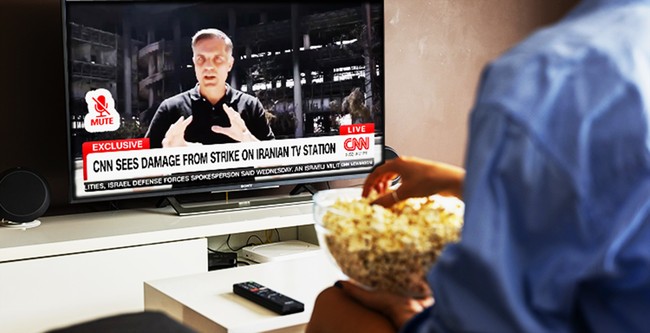
The piece argues that CNN has systematically damaged its credibility through repeated errors, questionable choices like accepting Iran’s permission for reporting, and what the author describes as uncritical, state-aligned coverage that resembles Iranian state media more than independent journalism.
CNN’s recent week of missteps has left many viewers questioning its judgment and competence. Repeated retractions and public corrections over coverage of a New York bombing attempt exposed sloppy reporting and poor editorial control. The pattern is not just isolated mistakes, but a cascade of failures that kept happening after earlier errors were acknowledged.
One high-profile instance involved a primetime anchor who pushed a false claim about the attacker’s target, a mistake that had to be corrected after the network faced public pressure. Other senior reporters echoed the same false narrative even after corrections were issued, showing a worrying inability to stop bad information from spreading. That cycle of error and recantment has led critics to mockingly rebrand the outlet as “Corrections News Network.”
Beyond individual misreports, the outlet made a controversial choice to accept official permission from Iran to operate inside the country for an exclusive reporting effort. Many observers warned that relying on permission granted by an authoritarian regime invites constraints and compromises. The coverage that followed reinforced those concerns, with dispatches that felt sanitized and overly accommodating to the host government.
Reports from the correspondent in Tehran were recorded rather than live, a format that raises obvious questions about what material may have been vetted or altered before airing. Interviews with Iranian officials featured few sharp follow-ups and almost no vigorous challenge to official talking points. The absence of any notable discussion about the brutal crackdown on protest movements in Iran was glaring and suggested selective reporting.
A quoted social media critique captured the problem bluntly: “IRGCNN now claims that while CNN has the “permission” of the regime to operate in Iran, the network “maintains full editorial control over what it reports.” They then proceed to allowing an Iranian official to push their propaganda unchallenged and claims that America is the problem.” That accusation reflects a broader frustration that the network allowed an unopposed narrative to stand on air. The appearance of granting a platform to state messaging without pushback is precisely what critics feared.
There was also a moment when Iranian state video or commentary was broadcast with minimal context, a decision that looked strikingly similar to handing over airtime to a foreign propaganda feed. At least one interval of several minutes carried material that tracked closely with the regime’s talking points, and again there was no aggressive correction or even a clear on-air note explaining the provenance of the footage. For a network proud of its editorial standards, the lack of transparency was telling.
Comparisons to state media are not made lightly here; they stem from repeated editorial choices that allowed government-approved material to run without the normal skepticism viewers expect. Where a hard-nosed correspondent would press on accountability and cite the terrible toll on dissidents, the coverage primarily repeated official statements with little challenge. The result is reporting that looks more like a curated snapshot chosen by Tehran than independent journalism.
The week’s show of amateur mistakes and suspiciously cozy foreign reporting has turned a number of skeptics into outright opponents. Critics argue that once a news organization accepts the terms set by an authoritarian government for access, it trades away leverage and risks becoming an unwitting amplifier for that regime. When mistakes pile up and editorial pushback is muted, confidence erodes fast.
What remains is an outlet that has to reckon with public distrust and a reputation that slipped through errors and choices that looked like concessions. The tone from conservative observers is harsh because the pattern has real consequences: if major networks cannot be trusted to hold power to account—domestic or foreign—the trust deficit widens and the marketplace of ideas suffers.
Editor’s Note: For decades, former presidents have been all talk and no action. Now, Donald Trump is eliminating the threat from Iran once and for all.

CNN, ABC, NBC, CBS, PBS, NPR, NYT, WaPo have increasingly become the Deep State Pagan Muslim Media over the years as they continue to distance themselves from God and His Truth just as have almost all of academia and especially the universities in the United States . What would you expect from news agencies that are hostile to The Only True God and Christ Jesus Whom He Has Sent?