
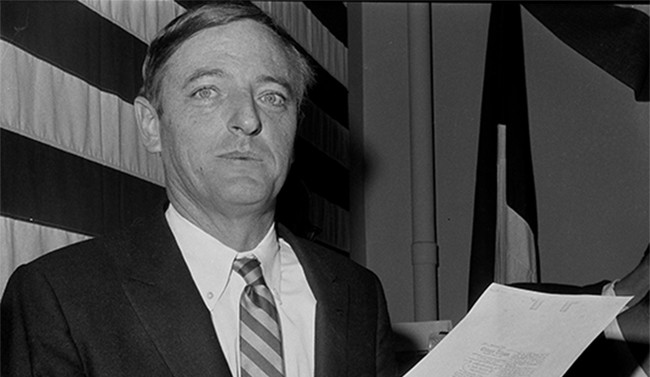
Checklist: recount Buckley’s legal fight over union dues; explain its connection to later First Amendment wins for public employees; highlight key quotes and legal outcomes; note the practical settlement and Buckley’s continued career. This article will examine William F. Buckley Jr.’s role in challenging compulsory union support, connect that fight to later decisions like Janus, and preserve his exact quoted words while keeping the narrative punchy and clear.
William F. Buckley Jr. took on a union over compulsory dues long before Janus reshaped the law for public employees. His dispute grew out of his show “Firing Line,” which operated in the world of broadcast unions and raised constitutional questions about compelled association and compelled speech. The case is worth revisiting because the arguments Buckley made anticipate issues still argued by conservatives and public employees today.
Buckley’s fight began when he was required to join the American Federation of Television and Radio Artists as a condition of working with the station that produced his program. He objected not merely to the paperwork but to being obliged to bankroll and obey an organization whose politics clashed with his own. That friction between individual conscience and institutional pressure is the same conflict at the heart of later court battles over public-sector union power.
In his 1970 lawsuit, Buckley framed the core claim plainly and forcefully. “The requirement,” the complaint stated, “that plaintiff Buckley be a member of defendant AFTRA, pay dues and obey orders as a condition of his continued employment in the television and radio industries, and the threatened denial of his access to television and radio stations, places an unreasonable restraint upon plaintiff Buckley’s right of free speech, deprives him of his property without due process of law and breaches his rights under the 1st, 5th and 9th Amendments of the Constitution.” Those words make the stakes unmistakable: Buckley saw mandated support for a union as an infringement on speech and property rights.
Buckley later broadened the political case against compulsory dues, calling on supposed liberal defenders of civil liberties to live up to their principles. He said, “Many of the people in this country labeled as liberals eloquently object to any compromise of the individual rights of the citizen against the government, particularly in the field of free speech and privacy. I think it is time they join me in demanding that the individual have a right to join or not join, to pay dues or not pay dues, to a private organization surrendering his right to speak.” That quote captures the paradox Buckley challenged: rhetoric about rights that did not always match practice when unions were involved.
Although Buckley’s case did not directly involve public-employer unions, his legal reasoning anticipated the later disputes that did. Subsequent litigation grappled with the distinction between private-sector union-shop agreements and public-sector arrangements where compelled dues implicate governmental speech and coercion. Conservatives who favor individual liberty have used Buckley’s logic to argue that no one should be forced to fund speech they oppose, whether in media or in government employment.
The Supreme Court did not hand Buckley a clear victory. His petition for certiorari was denied in the early 1970s and the lower courts had previously ruled against him. The litigation, however, did not disappear; it limped along until a negotiated resolution in 1977. That settlement let both sides claim something meaningful while clarifying certain practical limits on mandatory membership.
Under the agreement reached, employers of broadcast performers were notified that joining the union was not required to work in radio or television. At the same time, performers under AFTRA contracts could still be required to pay initiation fees and dues even if they opted out of formal membership. The compromise left unresolved tensions—protecting some individual choice while preserving collective bargaining and union revenue streams under contract.
Buckley promptly quit AFTRA but kept hosting “Firing Line” for decades afterward, producing 1,504 episodes across a 33-year run. The program’s longevity mattered because it amplified his argument about free speech and compelled association to a national audience. For many conservatives watching at a time when mainstream outlets rarely featured dissenting views, Buckley’s platform was singular and influential.
The Buckley episode should be remembered not because it settled every legal question but because it framed the issue for later victories. Janus and other decisions that expanded First Amendment protections for public employees did not spring from nowhere; they built on prior challenges to compulsory union support in media and private-sector settings. Buckley’s rhetoric and litigation helped set the tone for that evolution.
His fight also underlines a broader point: protecting individual rights sometimes requires challenging entrenched institutions and popular orthodoxies. Buckley’s willingness to press a constitutional claim against a powerful union serves as a model for those who argue that personal conscience and free speech deserve consistent, principled defense. The debate he stoked continues to matter for workers, taxpayers and anyone concerned about compelled funding of political speech.

Add comment