
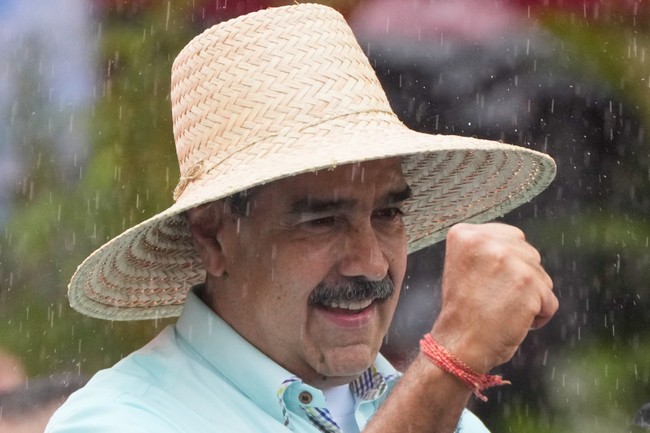
President Donald Trump has publicly urged Venezuelan ruler Nicolás Maduro to step aside, intensifying U.S. pressure that has included seizures of sanctioned oil tankers and naval deployments near Venezuela, while China and Russia protest and claim international law was violated.
Trump did not couch his words in euphemism, saying Maduro would be “smart” to step down, and his administration has backed that rhetoric with action at sea. The U.S. has seized three vessels so far under seizure warrants, and those cargos are now slated to be forfeited. This is part of a broader push aimed at choking off oil revenue streams that prop up Maduro’s regime.
The operation emphasizes two priorities at once: combatting drug trafficking and squeezing a hostile regime economically. Officials assert the maritime strikes align with efforts to curb drugs flowing into the United States, but the geopolitical effect is equally clear. Taking Venezuelan oil off the table reduces Maduro’s leverage and weakens the networks that sustain his power.
There are now three seized ships named in the seizures: the Skipper, the Centuries, and the Bella 1. Those vessels were taken under legal authority and will forfeit their cargo to the United States as part of enforcement of sanctions. The result is fewer sanctioned tankers delivering crude to the ports of rogue actors and less money for Maduro’s cronies.
President Donald Trump is taking his pressure campaign to the next level against Venezuelan President Nicolás Maduro and making it clear he doesn’t believe the strongman should be leading the country — all while China and Russia are speaking out on the escalating conflict involving their ally.
The Trump administration has launched a series of strikes targeting alleged drug boats off the coast of Latin America in recent months and announced this month a “complete blockade of all sanctioned oil tankers going into and out of Venezuela” as his administration has significantly beefed up its naval assets in the region.
Critics will howl about international norms, but the Western Hemisphere has long been treated as a special security interest for the United States. Reasserting that reality through maritime enforcement reflects a return to pragmatic, results-oriented policy. If bad actors export violence, corruption, and illegal narcotics, they will face consequences.
China and Russia have predictably complained, calling the seizures unlawful and accusing the U.S. of overreach. Those complaints are mostly rhetorical; both powers are geographically distant and logistically limited when it comes to projecting sustained force into the Caribbean. Russia could theoretically send naval assets, but such a move would risk direct confrontation with the United States, and China lacks the at-sea replenishment capabilities to operate far from home for long stretches.
China and Russia are speaking out about U.S. actions in the region, accusing the U.S. of breaking international law after the U.S. seized multiple oil tankers off the coast of Venezuela. The first seizure occurred Dec. 10, and Trump confirmed Monday that the U.S. is still pursuing another oil tanker that a U.S. official told Fox News Digital is a “sanctioned dark fleet vessel that is part of Venezuela’s illegal sanctions evasion.”
That third tanker, the Bella 1, was seized on the 22nd of December, following President Trump’s statement. The timing underscores a coordinated campaign to dismantle networks used for sanctions evasion and to degrade Maduro’s ability to trade oil illicitly. Each interdiction raises the costs for those who enable the regime.
Strategically, the administration is signaling that the hemisphere will not be a safe harbor for malign actors, and that economic choke points can be legitimate instruments of policy. By focusing on tankers and dark-fleet operations, the U.S. can reduce Maduro’s revenue streams without immediately resorting to large-scale troop deployments. It is a calibrated pressure campaign with tangible effects.
From a practical viewpoint, the likely actors shaping the outcome will be neighbors and regional partners rather than distant great powers. America can marshal diplomatic and maritime tools in concert with allies to isolate Maduro and support Venezuelan citizens seeking change. Under renewed enforcement, the Monroe Doctrine idea has real teeth again when it comes to protecting regional stability.
Editor’s Note: Thanks to President Trump and his renewal of the Monroe Doctrine, bad actors are going to be squeezed out of the Americas – bad actors like Nicolas Maduro.
Add comment