
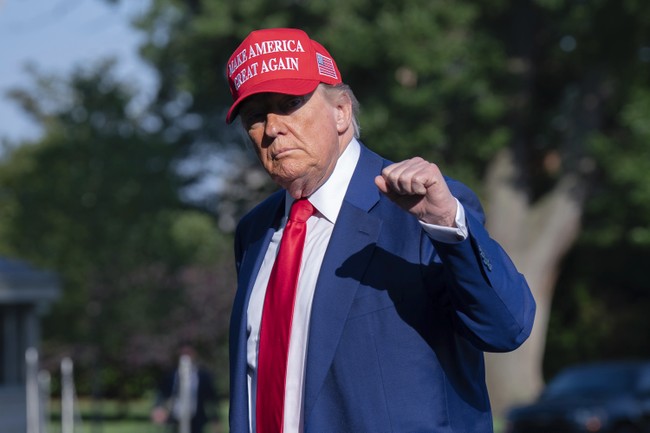
President Donald Trump explained why he backed acting Venezuelan president Delcy Rodríguez over opposition leader Maria Corina Machado, drawing on past lessons about power transitions and the risks of sweeping purges. He referenced the aftermath of Saddam Hussein’s removal in Iraq as a cautionary example and described his recent interactions with Machado, including a private meeting where she presented him with a Nobel medal. The discussion reflects a pragmatic Republican view that stability and learned caution should guide U.S. engagement in Venezuela. Below, the details of Trump’s remarks, Machado’s gesture, and the broader context are laid out.
At an impromptu press appearance outside the White House, a reporter asked, “Why align with Delcy Rodríguez and the residents of the former Venezuelan dictator Nicolás Maduro regime and not with Machado?” who the reporter said has the “support of the Venezuelan people.”
Trump answered by pointing to Iraq after Saddam Hussein was toppled and the decision to remove institutional officials wholesale. He warned that firing all police and generals left a vacuum, which, he said, facilitated the rise of ISIS. That memory informed his caution about sweeping changes in Venezuela, and he framed his choice as a lesson learned from a costly mistake.
He elaborated, saying, “Well, if you ever remember a place called Iraq, where everybody was fired — every single person, the police, the generals, everybody was fired — and they ended up being ISIS,” and added, “Instead of just getting down to business. They ended up being ISIS.” The quote was presented exactly as spoken, reflecting his emphasis on avoiding chaotic transitions. The remark underscores a central concern: the risk that removing entrenched power too quickly can produce worse outcomes.
Trump also noted his meeting with Machado, which left him impressed by her personally and politically. “But I’ll tell you I had a great meeting yesterday by a person (Machado) who I have a lot of respect for. And she has respect obviously for me and our country,” he said, stressing mutual regard. He described her as “a really, this is a fine woman,” and recounted that she presented him with the Nobel medal she had received.
“And she (Machado) gave me her Nobel Prize,” Trump continued. “But I’ll tell you what. I got to know her. I never met her before. And I was very, very impressed. She’s a really, this is a fine woman.” Those exact words were used by the president to convey both admiration and the complexity of choosing whom to back amid competing interests and security concerns. The exchange showcased a blend of personal rapport and strategic calculation.
Machado’s act of gifting the Nobel medal is notable politically and symbolically, and it feeds into the narrative about who best represents Venezuelan aspirations. She presented the medal “on behalf of the people of Venezuela” after a dramatic U.S. operation that resulted in the capture of Nicolás Maduro. That operation, and the subsequent decision to back Rodríguez as acting president, forced the administration to balance immediate security needs with long-term stability goals.
Republican instincts tilt toward preventing instability that can yield violent extremist outcomes, and Trump framed his policy through that lens. He recalled the Iraq lesson to argue for prudent, phased approaches rather than wholesale removals that leave governance voids. That logic explains why a leader might prefer a transitional figure who can maintain order while political processes unfold.
The situation remains fluid and politically charged. American forces recently removed Maduro and his wife from Venezuela, bringing them to the United States to face charges, and that intervention altered the balance of power. Given these events, backing Rodríguez was presented as a measure to prevent a chaotic scramble for control that could empower militias or extremist groups.
Machado’s supporters and other observers see her as the rightful representative of popular will, and her public praise for Trump underscores cross-border political alignment. “Because he deserves it,” Machado said during an interview, reflecting her view that Trump’s actions merited recognition. Her statement highlights the emotional and political weight of the moment, signaling gratitude from some Venezuelan opposition figures toward U.S. leadership.
The president and his advisers face a strategic choice: push for rapid political change tied to electoral legitimacy, or prioritize stability to prevent further violence and fragmentation. Trump framed his decision as the result of hard-learned lessons and a personal assessment of risk versus reward. Time will show whether that approach produces the calmer transition Republicans seek or whether critics will argue it ceded momentum to less desirable forces.

Add comment