
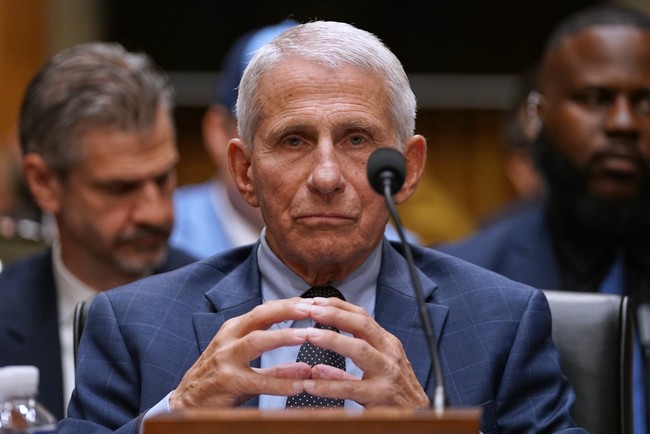
The newly surfaced text from Anthony Fauci’s government phone shows Michael Osterholm explicitly admitting he used text messaging to “avoid any FOIA issues” while talking directly to the team shaping federal COVID policy, and the contents raise questions about mask guidance, record-keeping, and potential efforts to keep policy conversations out of public view.
Journalist Catherine Herridge shared a screenshot that names Michael Osterholm as the sender of a message sent to “Jeff, Vivek, Tony and Rochelle,” the core of the administration’s COVID advisory circle. The single line, “I’m sending this via text messaging to avoid any FOIA issues,” is plain and direct, and it was sent to the group running pandemic policy. That admission alone moves this from an internal aside to a potential records and transparency problem.
Sen. Chuck Grassley, in his role overseeing the Senate Finance Committee, secured the texts from the Department of Health and Human Services as part of an inquiry into COVID origins and communication practices. The recovered messages are part of a larger haul from Fauci’s government phone, and they now sit squarely in the hands of investigators and the public. When officials admit they deliberately used certain channels to dodge FOIA, it demands scrutiny about how many others did the same.
Osterholm did not only confess to avoiding FOIA, he also told colleagues something the public apparently was not being told at the time: that cloth masks offer limited protection against aerosol transmission. He wrote, “Since April, 2020, I have been consistent in my messaging about the roles that aerosols play in transmission, and the limited benefit that cloth face coverings play in reducing risk. N-95s are necessary to be effective reducing risk with aerosol transmission.” That statement contradicts broad public messaging that emphasized cloth face coverings as an effective barrier for the general public.
https://x.com/C__Herridge/status/2090201939829031340
He also said U.S. manufacturers had enough N95s to supply health care workers, first responders, industry and the public, a practical claim that cuts against narratives of persistent shortages. If true, the claim raises questions about why the public messaging downplayed N95s while promoting cloth coverings. The difference between what was told to the public and what was told to insiders matters in a democracy where informed consent and accountability should guide public health decisions.
Federal record rules require preservation of agency business communications, regardless of the platform used to send them. Under National Archives and Records Administration guidance, messages sent for agency business are federal records and must be preserved, and the relevant statutes carry penalties for unlawful removal or destruction. Saying one used text to avoid FOIA flags a potential violation of those record-keeping obligations and points to the need for a thorough review of communication practices during the pandemic.
Context makes the admission harder to dismiss. Prosecutors recently secured a guilty plea from a former NIAID official in a scheme tied to hiding federal records, and that conviction underlines how using private channels to conceal government communications can become a criminal matter. The timing of these revelations, with one former official admitting guilt and another admitting intent to avoid FOIA in plain text, creates a pattern that investigators and the public should not ignore.
The practical consequences go beyond legal questions. When public health policy is based on a set of assumptions and the public is steered toward different practices, trust erodes. People are left wondering why stronger protections like N95s were not prioritized in public guidance if insiders believed they were necessary for true protection against aerosols. That gap between internal knowledge and public guidance deserves answers.
Investigators now have a significant collection of texts and voicemails from Fauci’s government device, but one device does not tell the whole story. There are still unanswered questions about how widespread the use of alternate communication channels was, how many people used them to keep records out of public reach, and whether any actions crossed legal lines. Republicans and others demanding transparency will press for those answers until full accountability and clarity are delivered.


Add comment