
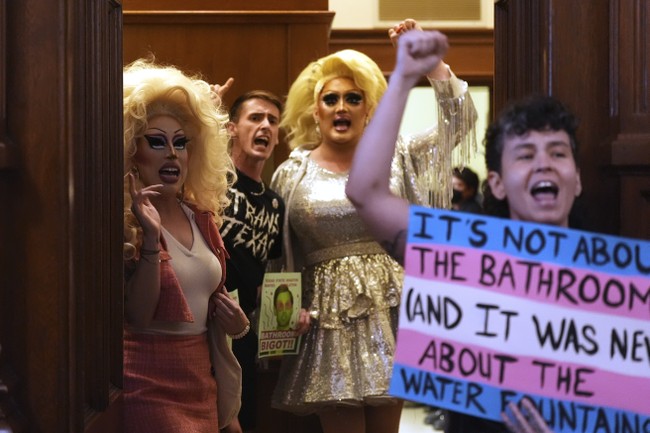
The Supreme Court oral arguments over state bans on male participation in female sports exposed a clash between legal realism and ideological rhetoric, highlighted by counsel unable to define the biological categories central to the case and blunt exchanges from justices demanding clarity on equal protection concerns.
ACLU Lawyer’s Response Shows How Badly the ‘Transgender’ Lobby Was Spanked During Oral Arguments
Oral arguments this week put the dispute over sex-based sports eligibility front and center, and the record shows the contest is really about whether law recognizes objective biological categories or yields to fluid identity claims. When a lawyer representing challengers could not articulate a workable definition of boy, girl, man, or woman, it underscored the problem courts face when a plaintiff group lacks a consistent class to claim constitutional protection.
The exchange with Justice Samuel Alito cut right to the legal heart of the matter: equal protection depends on identifiable groups, and the very question is whether separating teams by sex is permissible under the 14th Amendment. That line of questioning was practical and precise, because you cannot fairly adjudicate whether a law discriminates if the protected class cannot be reliably defined.
ALITO: To pick up on the issue of discrimination on the basis of transgender status, let me just go back to, let me go to some basics. Do you agree that a school may have separate teams for a category of students classified as boys, and a category of students classified as girls?
HARTNETT: Yes, Your Honor.
ALITO: If it does that, then is it not necessary for there to be, for equal protection purposes, if that is challenged under the equal protection clause, an understanding of what it means to be a boy or a girl, or a man or a woman?
HARTNETT: Yes, Your Honor.
ALITO: And what is that definition? For equal protection purposes? What does it mean to be a boy or a girl, or a man or a woman?
HARTNETT: Sorry, I misunderstood your question. I think that the underlying enactment, whatever it was, the policy, the law, the… we’d have to have an understanding of how the state or the government, was understanding that term, to figure out whether or not someone was excluded. We do not have a definition for the court.
Harnett’s reply, that there was no definition for the court, revealed more than a stumble. It signaled a strategy that asks judges to adjudicate without the stable categories that legal analysis demands. Courts are not designed to decide constitutional questions on shifting personal assertions of identity without a clear statutory or historical anchor to measure discrimination claims.
The factual reality of biological sex matters in competitive sports because physical differences generally correlate with distinct performance advantages. That is why many states drew lines in law to protect fair competition in women’s athletics. Arguing that the equal protection clause is violated while refusing to define the relevant class makes the claim impossible to evaluate on traditional legal grounds.
Later, the ACLU’s Joshua Block tried to reframe the issue as one of fairness for all, invoking inclusion and equal treatment language familiar in civil rights discourse. That rhetorical approach aims to broaden the analysis to encompass identity-based claims rather than focus on biological distinctions, but it sidesteps the specific equal protection challenge that depends on identifying the class allegedly harmed.
BLOCK: I don’t think that’s what is at issue in this case. What’s at issue in this case is fair treatment for all people, including cis people and trans people, and that’s what we’re here to talk about today.
Block’s formulation begs the procedural question: fair treatment under which category and by what standard? If any person can claim a protected status at any time simply by asserting an identity, the equal protection analysis loses its structure and would be unable to protect stable, legally recognized classes. That would invert the constitutional framework and privilege subjective affirmation over objective legal categories.
Practical consequences flow from these abstract disputes. Allowing unrestricted claims of membership in a protected class without a consistent definition risks undermining privacy, safety, and fairness policies that were crafted for clear, observable groups. Lawmakers who passed statutes drawing biological distinctions did so with those concerns in mind, and the courts are being asked to weigh widely divergent competing interests.
The mismatch between plea-for-inclusivity rhetoric and the need for definable legal categories will likely remain a central tension as the litigation progresses. Justices pressed advocates for specificity because constitutional adjudication depends on applying neutral principles, not accommodating every shifting social theory. The outcome will hinge on whether the Court insists on definitions rooted in law and biological reality or accepts a more fluid framework that transforms well-settled legal tests.
Regardless of individual sympathies, the core procedural issue is straightforward: you cannot resolve an equal protection claim if the plaintiff’s group is undefined. The oral argument record reflects that blunt legal truth, and the exchanges demonstrated why courts demand clarity before rewriting the rules that govern privacy and competitive fairness.


Add comment