
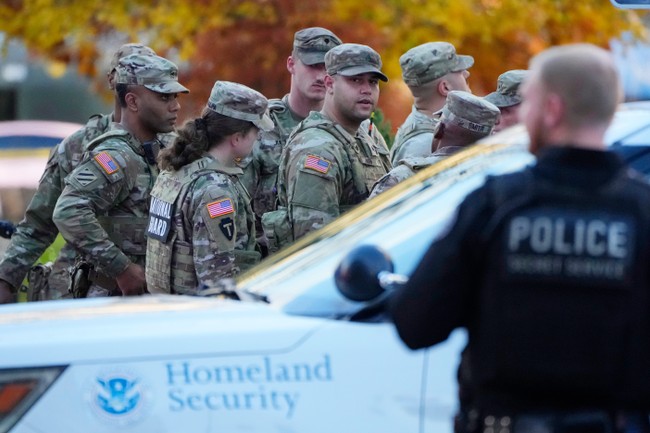
The Supreme Court stepped in briefly to block an immediate federal takeover of the Illinois National Guard, leaving a lower-court temporary restraining order intact while the legal fight continues. The decision, issued without a full merits ruling, keeps the Guard from being federalized under the administration’s cited authority for now but leaves open the possibility of future action. This article explains what the order did, why the court acted this way, how key justices viewed the matter, and where the case goes next from a conservative perspective. The core legal language at issue centers on the phrase “unable with the regular forces to execute the laws of the United States.”
In an unsigned, per curiam order the Supreme Court denied the federal government’s emergency application for a stay, which means the high court will not override the lower-court block at this stage. That procedural decision does not resolve the underlying dispute about presidential power or federalization of state Guard units. From a Republican viewpoint, the outcome reflects caution rather than hostility to executive authority; the court refused to shortcut the ordinary judicial process when the statutory triggers were not shown to be met.
The conflict began when the administration sought to federalize the Illinois National Guard after unrest tied to federal immigration enforcement. The legal hook is a statute that allows the president to federalize the Guard when he is “unable with the regular forces to execute the laws of the United States.” The court’s reading of that statute turns on what “regular forces” means and whether the required factual showing that the president was “unable” to enforce the laws was ever legitimately made.
The justices concluded that “regular forces” refers to the U.S. military, not to civilian federal law enforcement. That distinction matters. Longstanding law generally bars the military from domestic law enforcement unless Congress specifically authorizes such action, so equating “regular forces” with civilian agencies would have blurred a clear separation that Congress has maintained for decades.
Because the government did not adequately show that the military could legally perform the enforcement role described, or that the statutory condition of being “unable” with regular forces was met, the court found the statutory requirements for federalization were not satisfied at this emergency stage. The practical result is narrow: no federalization in Illinois under the authority cited while lower courts continue to hear the case. Republicans can reasonably argue the court simply demanded proper legal grounding before altering state-federal guard relationships.
Justice Brett Kavanaugh agreed with the outcome but offered separate reasoning, saying the court could have resolved the emergency request on narrower grounds. Kavanaugh accepted that “regular forces” means the military, but he also emphasized that the government failed to demonstrate that “unable” had been properly determined, which he said would independently justify denying the stay. His concurrence stresses process and the need for clear factual findings before dramatic federal measures are allowed to proceed.
By contrast, Justice Samuel Alito, joined by Justice Clarence Thomas, strongly disagreed and dissented from the denial of the stay. They argued the court unnecessarily constrained presidential authority and should have allowed the deployment to move forward. Alito pointed out that earlier briefing treated “regular forces” as meaning federal civilian law enforcement, and he criticized the court for reaching a new interpretation at the emergency stage rather than letting the case proceed in the normal course.
The court made a point of not issuing a final ruling on the president’s broader authority to deploy the National Guard. It is addressing only the emergency application and avoiding the constitutional questions, which remain for lower courts and possibly a later full Supreme Court review. That approach preserves judicial caution while keeping options open for either side to press for a definitive ruling after a fuller record is developed.
Practically, the case now returns to the lower federal courts, where judges will continue to examine whether federalization complied with statute and constitution. For now, the temporary restraining order remains effective and prevents deployment under the specific authority the administration cited. Conservatives watching this will see a court insisting on statutory clarity and proper procedure rather than a political judgment for or against executive power.

Add comment