
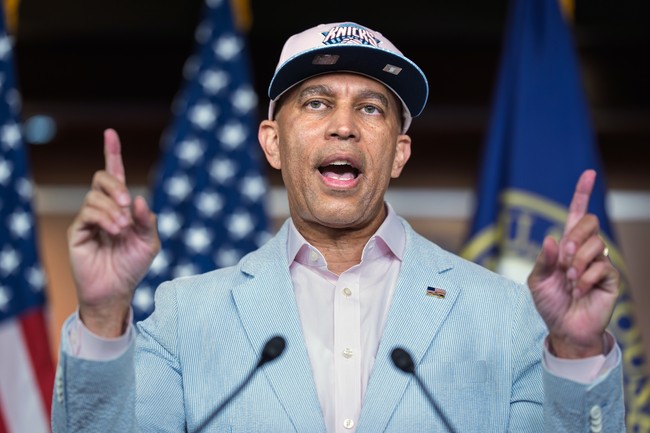
House Minority Leader Hakeem Jeffries faced tough questioning on Good Day New York about energy costs, and the exchange highlighted competing takes on who’s responsible for high prices and whether recent developments — like a deal with Iran — are easing inflationary pressure at the pump and at the grocery store.
Jeffries appeared on local TV to push back against criticism of Democrats over rising fuel costs, but the interview quickly turned into a testy back-and-forth. The anchors pressed him on historical price spikes and recent trends, and he struggled to pin the increase exclusively on the current administration. That difficulty opened the door to pointed historical reminders and hard numbers.
On air, Jeffries blamed a foreign policy decision and linked it to what he called “skyrocketing gas prices.” The exact words he used were: “It was a reckless war of choice that has obviously cost the American people significantly, particularly as it relates to skyrocketing gas prices in an environment where the cost of living was already too high.” Those remarks set the tone for the anchors to press him on specifics.
The claim has two clear problems: oil prices had already begun to ease as talks with Iran advanced, and a formal agreement is expected to bring further downward pressure as shipping and supply normalize. That shift undercuts a narrative that gas prices are purely the result of recent policy choices by one side or the other, and it points to market reactions to diplomatic developments.
Local anchor Rosanna Scotto did not let Jeffries dodge historical context, reminding him that high gas prices have appeared under multiple presidents. She asked directly about past spikes and the timing of the worst stretches, pushing Jeffries to account for how prices rose during the Biden years as well as under earlier administrations. The exchange exposed how political framing can collide with simple recall of past price points.
“It was a reckless war of choice that has obviously cost the American people significantly, particularly as it relates to skyrocketing gas prices in an environment where the cost of living was already too high,” Jeffries said.
Scotto pressed further, asking if Americans remembered pump prices topping $5.00. Jeffries replied with a reference to pandemic aftershocks, but the anchors pushed back on the timeline. The record shows the national average climbed above $5.00 in June 2022, a fact that complicates claims that those spikes were merely the immediate aftermath of the pandemic.
The interview also veered into grocery prices, with Scotto offering a memorable aside about egg prices having been “like $12 a dozen” in casual terms to emphasize how extreme inflation felt. Those remarks shifted the focus from fuel to food and gave Jeffries another set of numbers to explain or rebut as anchors compared past and present costs. Viewers heard a contrast between what was and what is now.
https://x.com/RNCResearch/status/2066542599372960085
Actual data cited during the discussion showed eggs averaged $4.82 a dozen in January 2023, and then fell to $2.19 a dozen by May 2026. Those figures were used to argue that targeted actions can reduce costs at the store, and that policy and market dynamics both play roles in price movements. The downward change in egg prices was presented as evidence of that dynamic.
Across the interview, the anchors repeatedly returned to the core question of accountability: who gets blamed when prices rise and who gets credit when they fall. Jeffries faced sustained pressure to address past spikes, recent declines driven by diplomatic progress, and the political spin that accompanies both. The exchange underscored how energy and food prices are battleground issues in political messaging.
Outside the numbers, the tone of the segment carried political weight as well as factual points. Anchors pushed for specifics rather than generalities, and the pushback made it clear that voters expect answers about timing and cause when they see sharp swings at the pump or the grocery aisle. That demand for clarity is why interviews like this matter to both policy and politics.
Ultimately, the segment highlighted the interplay between diplomacy, markets, and partisan claims about responsibility for everyday costs. As oil markets respond to changing geopolitical realities, and grocery prices move with supply and policy adjustments, public debate will continue to hinge on who offers the most persuasive explanation for price swings and who can point to concrete improvements.
Moments later the anchors returned to the exchange and the visuals, offering viewers a reminder that sound bites and data often collide on live television. The segment stayed focused on the practical impact of price changes and on whether political leaders can explain those impacts in ways that satisfy skeptical audiences. That tension between sound bite and substance kept the interview centered on real-world costs for families.


Add comment