
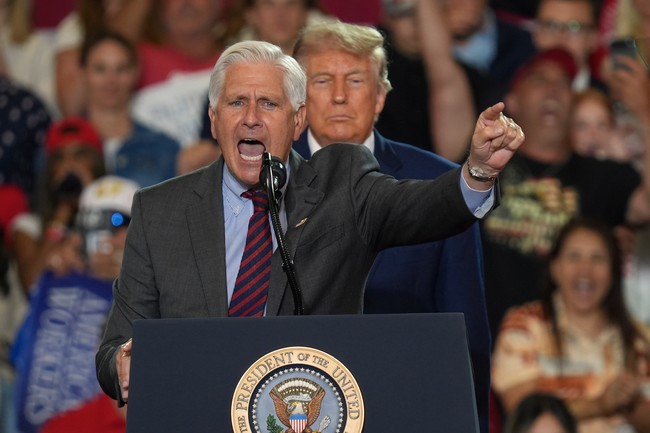
The governor’s race in New York is tightening, and the city’s new mayor is making life harder for Democrats; this piece examines a pro-Blakeman poll showing a narrow gap, compares campaign war chests, catalogs Mayor Zohran Mamdani’s controversial policies, and argues that Bruce Blakeman should use Mamdani’s record as a political weapon to force accountability.
A pro-Blakeman super PAC released a new poll claiming Gov. Kathy Hochul leads Bruce Blakeman by just four points: 47 percent to 43 percent, with 10 percent undecided. Given the source, treat it as a best-case snapshot for Blakeman, but it is a reminder that statewide dynamics can shift when voters feel fed up. The poll’s aim is obvious: show competitiveness, excite donors, and push volunteers into the streets.
Gov. Kathy Hochul leads her Republican opponent Bruce Blakeman by just 4 percentage points, according to a bombshell new poll. Just 47% of those surveyed said they’d back the Democratic incumbent, compared to 43% who supported the Nassau County executive, with 10% of registered voters undecided, the poll, conducted by a pro-Blakeman super PAC found.
Public polling averages still favor Hochul by a healthy margin, and she sits above the symbolic 50 percent threshold in many aggregated polls. Fundraising gaps are stark: Blakeman has improved his haul to roughly $11.4 million, but Hochul and allied Democrats control far more resources. That funding advantage translates into ads, staff, turnout operations, and the ability to define the narrative before the campaign heats up.
Raising money matters, but momentum and messaging do too. The 2022 governor’s race tightened more than expected, and the political mood in New York has gotten worse for Democrats since then. Voters talking about the economy, public safety, and quality of life create an opening for a Republican who focuses on holding local leaders accountable for the mess in their cities.
Enter Zohran Mamdani, whose first eight months as mayor have been marked by policies that feed political backlash. His actions look radical to many voters who want stability and competence from city government, not ideological experiments. That backlash gives Republicans a clear target to tie to statewide incumbents who have enabled city-level chaos.
Consider some of Mamdani’s headline moves and why they matter politically. He rolled out a two-year rent freeze for roughly one million residents, a populist play that risks wrecking building maintenance and bankrupting smaller landlords. He proposed city-run grocery stores intended to undercut private retailers by about 30 percent, a program that will lose money and asks taxpayers to fill a hefty gap in funding.
Mamdani announced a pied-a-terre tax aimed at wealthy second-home owners that broadly sweeps in homeowners across many neighborhoods and threatens property values. The administration also published lists of property owners tied to that levy, a step that risks exposing people to harassment and creates needless political theater.
The mayor may be removed from office by the governor upon charges and after service upon him of a copy of the charges and an opportunity to be heard in his defense. Pending the preparation and disposition of charges, the governor may suspend the mayor for a period not exceeding thirty days.
That charter language exists, but practical politics make it a remote tool. Gov. Hochul will not threaten or use removal powers against a left-wing mayor who energizes the Democratic base and minority constituencies. She has already stepped in with state dollars to backfill city budget gaps and protect her political allies.
https://x.com/Mark_Penn/status/2082373739912552706?s=20
Republican Bruce Blakeman, by contrast, can campaign aggressively on Mamdani’s record without worrying about party cover. He can point to consequences voters are feeling: rising costs, strained services, and a sense that ideological experiments are replacing sound governance. A focused campaign that connects the dots between mayoral policy and everyday pain has real traction in suburban and exurban New York.
Blakeman should highlight how these city policies ripple across the state, fueling housing market instability, pressuring small businesses, and adding to public safety concerns. He should make clear choices about enforcement, budget discipline, and protecting homeowners and small merchants from predatory municipal policies. That crisp contrast helps a Republican candidate turn local frustration into statewide momentum.
Blakeman also needs to lean into the political theater: use debates and advertising to accuse Democrats of tolerating or enabling the chaos in New York City. Voters respond to clear villains and obvious consequences, and Mamdani’s headline-making moves supply both. The campaign’s job is to tie those outcomes to the incumbent and force a defense.
Ultimately, the governor’s race will be won by the candidate who best translates voter anger into votes and organizes to get them to the polls. Blakeman’s path is narrow but real if he turns the mayor’s record into a statewide referendum on competence and consequences. New Yorkers tired of policy experiments and governance by ideology may be ready for a different approach, and the next months will reveal whether Blakeman can convert that opening into results.


Add comment