
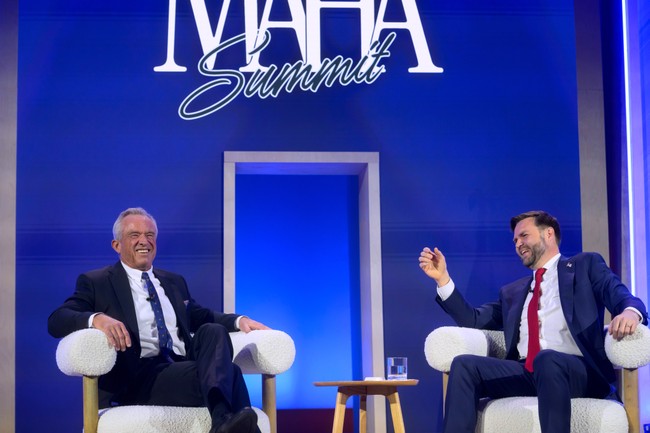
The first-ever Make America Healthy Again summit in Washington drew Vice President JD Vance and a roster of health leaders, and his onstage interview with HHS Secretary Robert F. Kennedy Jr. made clear this administration wants bold, unconventional solutions to long-running health failures. Vance praised the willingness to question accepted wisdom, explained why the White House is partnering with private industry, and described how his background shapes his approach to public service and execution. He argued that changing entrenched health policy requires people willing to challenge orthodoxy and actually get things done.
Vice President JD Vance sat for a lengthy interview at the inaugural MAHA Summit in Washington, D.C., where the conversation focused on reshaping health policy and expanding the range of acceptable ideas. The summit paired traditional health agencies with alternative health leaders and industry partners to push new solutions into the mainstream. Vance presented MAHA as a movement that forces a real debate about what works and what has failed Americans for decades.
Vance commended HHS Secretary Kennedy and his HHS team for daring to ask questions that established institutions have avoided, calling that curiosity a sign of real leadership. He said this approach breaks through the Overton window and lets fresh ideas compete in the marketplace of policy. For Vance, letting unconventional proposals breathe is not a gimmick but a necessary correction to policies that have disappointed people across the country.
Top Trump administration officials including Vice President JD Vance and Health Secretary Robert F. Kennedy Jr. are slated to speak alongside biotech executives and influencers at an all-day “Make America Healthy Again” summit on Wednesday that has not been publicly disclosed.
According to an agenda seen by The Hill, the event will feature many of the country’s leading health officials, including: Centers for Medicare and Medicaid Services Administrator Mehmet Oz, Food and Drug Administration Commissioner Marty Makary, National Institutes of Health Director Jay Bhattacharya, acting Centers for Disease Control and Prevention Director and HHS Deputy Secretary Jim O’Neill, Medicare Director Chris Klomp, and White House AI czar David Sacks.
The officials will be speaking with MAHA influencers and industry leaders from companies such as Regeneron, CRISPR Therapeutics, Walmart, Google and Neuralink.
Vance argued that the administration has been forced to reach beyond traditional allies because Democrats repeatedly refused to tackle drug prices through legislation. That hesitancy, he said, opened the door to public-private partnerships as a pragmatic alternative. He framed these partnerships as necessary workarounds when the legislative route is blocked by political cowardice.
He made a sharp, memorable line about expertise versus practical results: “You’re not going to solve America’s problems with McKinsey consultants who say everything the ‘right’ way all the time,” he said. Vance used that contrast to emphasize the difference between polished plans and real-world execution. The point was clear: good ideas matter less than the willingness and ability to implement them.
The vice president also tied his push on health to his own life story — growing up in Appalachia, serving in the military, studying at Yale, and working in both Silicon Valley and public service. That path, he explained, gives him perspective on how lack of resources, food insecurity, and inadequate healthcare shape everyday American lives. For Vance, policy must reflect those realities and provide tangible relief, not just clever rhetoric.
Vance described the vice presidency as a role defined by trust, duty, and follow-through. He said his job is twofold: to offer honest counsel and to execute presidential decisions once they are made. “When the President of the United States makes the decision, it’s time to go and get it done,” he said, stressing that political arguments stop at the point of action.
The interview wrapped with a rapid-fire exchange where Vance displayed the blend of candor and self-awareness that marked the whole conversation. He emphasized that the administration’s effectiveness comes from a team with diverse opinions who still commit to collective execution. That mix, he implied, is what will push MAHA ideas into actual policy and deliver results for Americans.
The full interview was presented during the summit and included extended discussion about administration strategy, partnerships with industry, and the scope of MAHA’s ambitions. Vance repeatedly highlighted execution as the measure of leadership: debate matters, but outcomes matter more. The summit itself served as proof of a deliberate effort to broaden the policy conversation and do the messy work of reform.

Add comment