
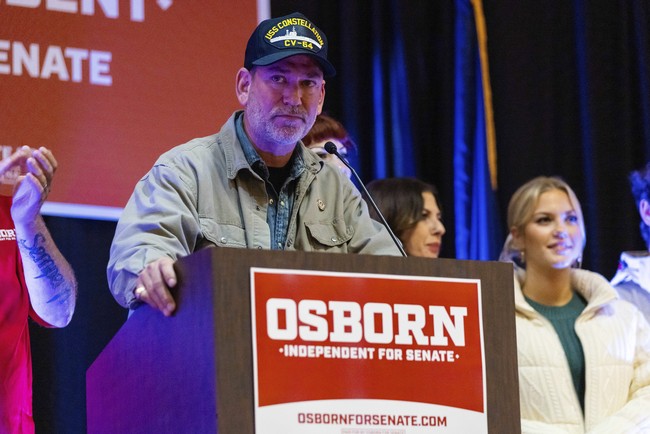
Dan Osborn bills himself as an “independent” Senate candidate from Nebraska, but closer inspection shows a candidate embraced by Democrats, with a labor leadership past that preceded a factory closure and a recent livestream where he admits his policies line up with the left. This piece lays out the timeline: his 2021 Kellogg’s strike, his failed 2024 run, Democratic backing, and the moment his independent cover slipped. The aim here is to give a clear, punchy look at why Nebraskans should judge the rhetoric against the record. Facts, quotes and the embedded clip are preserved for readers to see the evidence themselves.
Dan Osborn has been packaged as the blue-collar, veteran “independent” who can attract working-class voters in Nebraska. He did get national attention after leading a 600-person strike at a Kellogg’s plant in 2021 that resulted in improved wages and benefits. That victory came with a cost: the factory later closed, and those 600 workers lost their jobs, leaving a mixed record for anyone claiming to champion everyday workers.
Osborn tested the statewide waters in 2024 when he challenged a Republican incumbent and came up short. Despite that loss, he kept a sizable following among left-leaning activists who like his image and his labor credentials. Those same allies and donors have continued to support him financially, which raises questions about how independent his campaign really is when it benefits from Democratic money.
He’s now running again in 2026 against a Republican opponent, leaning into the same “everyman” branding—jeans, boots and a veteran backstory. That look can be persuasive in a state where more than half of registered voters are Republican, but image alone doesn’t change policy. Voters in Nebraska deserve to know whether the person in the denim shirt will actually advance their priorities or quietly drive a national leftward agenda.
Osborn’s campaign website reportedly described him in simple terms: “Navy man. Mechanic. Independent.” But independence is a claim, not a verified fact. The real test is how he describes his policies and allies when he thinks he’s off the record or among friendly audiences. That’s where his recent podcast appearance becomes politically relevant.
On a livestream with other liberal candidates, Osborn was asked whether his “substantive policies” actually differ from mainstream Democrats. His candid answer undermined the whole independent narrative, because it showed he knows the label matters more for vote-getting than policy distinction does. Voters who want someone outside the partisan trenches should pay attention when a self-described independent says his policies mirror the party he claims not to represent.
Just look at them.
KAPLAN: Your substantive policies are not a whole lot different than … other Senators running as Democrats. I mean, I suspect that you agree with maybe even Bernie Sanders on a lot of stuff. Or Elizabeth Warren. Or Troy Jackson, who is going to be running in Maine.
But, you’re running as an independent. What does that sell? Give us some of the thinking there. And is it that they brand – the Democratic brand – is just so rotten in Nebraska that the label just makes it impossible? And, if not, why do we think you’re going to be able to change that because the policies are going to be consistent?
OSBORN: Yeah, well, I mean, it’s, uh, especially, you know, Nebraska – over 50 percent of Nebraska is registered Republican. And, you know, really what it boils down to is they’re not ready to vote for a Democrat
https://x.com/townhallcom/status/2085362222478299337
That exchange reads like a confession. If your policies match the party you refuse to join only because the label hurts, you’re running a strategy built on deception, not principle. It’s a hard sell to ask Nebraska voters to accept that someone who says one thing about being independent will not act on a left-wing agenda if elected.
Beyond the livestream, Osborn’s past associations reinforce the concern. The 600-person Kellogg’s action he led produced short-term gains but ultimately coincided with a plant shutdown that cost local jobs. Whether that outcome rests at his feet or on corporate decisions, the result undermines the simplistic claim that labor actions always help the working people they intend to serve.
Voters should weigh image against record. Work boots and military service are honorable, but they don’t automatically translate into policy that protects Nebraska families from higher taxes, open-border pressures, or federal overreach. Republicans arguing for conservative stewardship of the economy and borders will point to this kind of mismatch as a warning sign.
At the end of the day, this race is about choices for Nebraska’s future. Candidates who trade labels to chase votes deserve scrutiny, and voters have every right to demand straight answers about policy priorities, funding sources, and what “independent” really means in practice. The evidence here suggests the label may be more strategic than sincere.

Add comment