
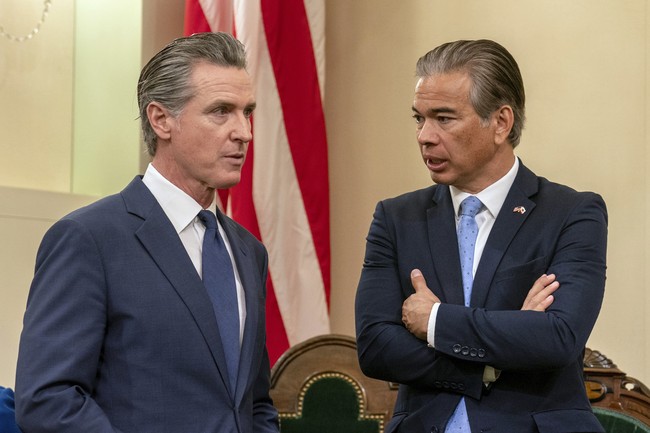
The California Court of Appeal refused a last-minute motion by Attorney General Rob Bonta to halt Riverside County Sheriff Chad Bianco’s court-authorized recount of roughly 650,000 seized ballots, allowing the sheriff’s probe into a reported 45,896-vote discrepancy in the November 2025 special election on Proposition 50 to continue while the merits of the case remain undecided.
The legal fight began after county records reviewed in the sheriff’s inquiry showed 611,428 ballots were cast in the special election, yet officials certified 657,322 votes, producing a striking gap of 45,896 votes. Sheriff Bianco moved to seize and recount the ballots to determine how such an inconsistency could exist, triggering immediate pushback from state officials. Attorney General Bonta sought an emergency writ to stop the recount, but the Court of Appeal declined to grant the emergency relief.
That denial was procedural, not a final judgment on the substance of the investigation, and a three-judge panel directed Bonta to refile in the appropriate Riverside County court. Practically, the decision gave Bianco room to keep his fact-finding effort alive, at least while the case is sorted through the correct local channels. This procedural victory matters because it keeps independent oversight moving forward rather than letting state political leaders obstruct the process.
Prop 50, which would let the state legislature redraw congressional maps through the 2030 census, is at the center of this controversy because it hands enormous power over district lines to Sacramento politicians. Critics warn that such authority invites partisan map manipulation, while proponents argue it can be used for fairness. The sheriff’s probe is focused narrowly on the arithmetic anomaly in Riverside County’s returns rather than on policy arguments about redistricting itself.
State and county election officials have pushed back, saying the real discrepancy is much smaller — roughly 103 votes — and attributing the larger figure to unprocessed or misunderstood data. Local election administrators contend that routine reporting quirks and timing of data uploads explain most of the apparent mismatch. Skeptics of the sheriff’s move argue the seizure and recount are unnecessary and sow needless doubt about the certified results.
Bianco has maintained that his aim is straightforward: find out why the certified vote total differs from ballots that were actually cast. He emphasized that the probe is not an effort to alter votes for or against Prop 50, but to uncover whether clerical errors, process failures, or worse explain the gap. To protect independence, a judge appointed a special master to oversee the inquiry, a step meant to ensure transparency and reduce partisan influence.
Bonta’s emergency motion and public posture have been framed by supporters of the sheriff as heavy-handed interference. Bianco said, “Our embarrassment to law enforcement, Attorney General Rob Bonta, just filed an emergency writ with the court of appeals to stop ballots from being counted in Riverside County,” and added, “Why in the world would Rob Bonta want that count stopped? Unless he was afraid of what that count would uncover.” These quotes have been repeated by allies who see the intervention as politically motivated.
The Court of Appeal’s direction to refile in local court effectively told the state’s top lawyer to take the proper procedural route, rather than attempt a dramatic statewide shutdown of a county-level investigation. That ruling leaves the factual work to local processes and keeps the inquiry on schedule for now. For those worried about election integrity, the message is that local courts and officials still have a role to play against potential statewide overreach.
Opponents of the sheriff’s inquiry call it a fishing expedition and warn it could erode public confidence in elections by amplifying confusion over normal administrative differences. Bianco pushed back hard against that characterization, arguing the opposite: that blocking the probe or discouraging scrutiny is what truly undermines trust. The conflict between a county law enforcement official and the state attorney general has become emblematic of broader distrust between state-level political actors and local institutions.
The dispute also has campaign implications, with Bianco a prominent Republican figure positioning himself as a watchdog on election integrity and a potential 2026 gubernatorial contender. Supporters view his actions as standing up to a politicized bureaucracy in Sacramento, while critics call it partisan grandstanding. Either way, the matter has moved beyond local vote counting into a wider fight over control, accountability, and how electoral disputes should be resolved.
As the legal process unfolds in Riverside courts, the immediate practical outcome is that Bianco can continue his review under court supervision. The appellate court’s decision left the door open for further legal challenges but did not halt the hands-on work of examining ballots and records. That means the on-the-ground investigation will proceed while judges determine the proper legal path for any broader questions about jurisdiction and authority.
Public reaction is split, with some interpreting the episode as necessary oversight and others as an escalation of partisan conflict into election administration. What happens next will depend on how quickly the county court addresses the procedural filing and whether further appeals are pursued. In the meantime, the recount and review continue to probe a discrepancy that raised alarms and forced a rare clash between county and state officials.


Add comment