
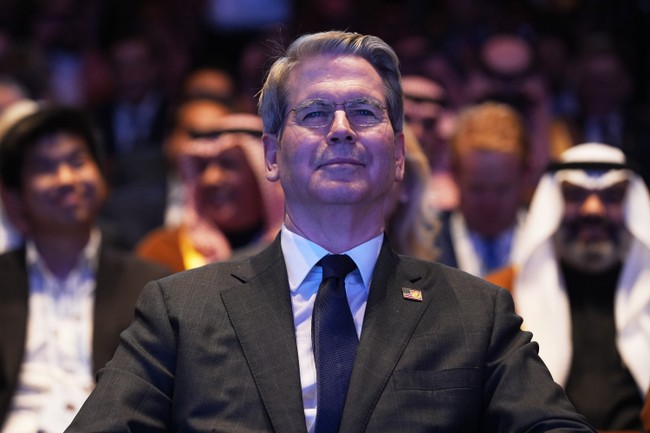
Scott Bessent laid out a blunt, strategic case for President Trump’s Greenland gambit, framed tariffs as a tool to prevent future crises, and argued that the Federal Reserve should face tougher oversight — all while defending national security priorities and insisting on accountability from institutions that wield economic power.
Bessent on Greenland, Tariffs, and Why Jerome Powell Is in a Pickle
Treasury Secretary Scott Bessent brought a clear, unapologetic tone to his Meet the Press interview, making the administration’s priorities easy to follow. He emphasized national security and strategic positioning in the Arctic, and he made no effort to soften the idea that the U.S. should assert control where its interests are vital. The conversation cut through media hand-wringing and pushed a pragmatic case for thinking long term about power and deterrence.
When Kristen Welker asked about Greenland, Bessent framed the matter as a century-long American interest, not a sudden whim. He pointed to the island’s strategic value and how controlling it ties directly to U.S. defense needs. His point was straightforward: America cannot outsource key pieces of hemispheric security and expect stability.
BESSENT: Kristen, if we look for years, for over a century, American presidents have wanted to acquire Greenland. And what we can see is that Greenland is essential to the U.S. national security — we`re building the golden dome, the missile system.
And look, President Trump is looking — is being strategic. He is looking beyond this year. He`s looking beyond next year to what could happen for a battle in the Arctic. We are not going to outsource our national security. We are not going to outsource our hemispheric security to other countries.
In Trump 1.0, President Trump told the Europeans, “Do not — do not build Nord Stream 2. Do not rely on Russian oil.” And guess what, Kristen? Guess what is funding Russia`s efforts against Ukraine? European purchases of Russian oil. So, America has to be in control here.
Bessent doubled down that acquiring Greenland, or at least securing influence there, is about preventing future conflict through strength. He argued that making Greenland part of the United States would remove incentives for future aggression and create a clearer deterrent. For Republicans focused on power projection, that kind of upfront strategic thinking is exactly what you want in Washington.
Welker probed whether the Greenland talk is real annexation talk or a negotiation tactic, and Bessent answered with a straightforward posture about deterrence. He explained that being proactive reduces the chance of getting dragged into conflict later. The message was simple: better to prevent a war than to react to one, and strong posture achieves that.
BESSENT: President Trump strongly believes that we cannot outsource our security. Because, Kristen, let me tell you what will happen, and it might not be next year, might not be in five years. But down the road, this fight for the Arctic is real. We would keep our NATO guarantees. And if there were an attack on Greenland from Russia, from some other — other area, we would get dragged in.
So, better now, peace through strength, make it part of the United States, and there will not be a conflict because the United States right now, we are the hottest country in the world. We are the strongest country in the world. Europeans project weakness. U.S. projects strength.
On tariffs, Bessent framed them as preventive tools rather than punishment for past actions. He said the president can use economic measures to head off future emergencies, treating tariffs as strategic levers in a larger geopolitical play. That perspective flips the conventional argument: tariffs are not merely trade policy, they are part of a national security toolkit.
WELKER: Let me ask you, broadly speaking, about the tariff portion of this. The president, as you well know, has justified his authority to impose previous tariffs without going to Congress by declaring national emergencies. It`s an issue before the Supreme Court right now. We`re all awaiting the high court`s decision. What is the national emergency that justifies these new slate of tariffs?
BESSENT: The national emergency is avoiding a national emergency. It is a strategic decision by the president. This is a geopolitical decision. And he is able to use the economic might of the U.S. to avoid a hot war. So, why wouldn`t — why wouldn`t we do that? You know, same — same thing that what if we had a national emergency coming with these gigantic trade balances that we had with the rest of the world — I`ve been in financial markets for 30, 45 years — much better to be strategic, avoid the emergency.
WELKER: You`re saying it`s a national emergency. But you`re also saying it`s a threat. It`s years away. How can both be true, Mr. Secretary?
BESSENT: Because you are avoiding creating the emergency, Kristen. What if during the great financial crisis, someone had raised their hand in 2005, 2006 and said, “Stop the sub-prime mortgages?” But no one did. President Trump is raising his hand. And that is preventing the emergency.
The interview then shifted to the Federal Reserve and recent reports about renovations tied to Chair Jerome Powell, sparking questions about independence and oversight. Bessent argued that independence should not mean immunity from scrutiny, especially when the Fed has enormous power to create money. He insisted on transparency and internal review, saying the Fed owes the public sunlight when it operates with fiscal consequences.
WELKER: Is President Trump committed to the independence of the Federal Reserve, Mr. Secretary?
BESSENT: Of course, he`s committed to the independence of the Federal Reserve. But independence does not mean no oversight.
WELKER: But doesn`t this undercut the independence of the Federal Reserve if the Justice Department is investigating renovations? There are renovations at the White House.
BESSENT: The renovations at the White House are not $700 million, more than $1 billion or $1.5 billion over budget, Kristen. And the White House, that is being paid for with private funds. If I want to — if I want to buy a new chair for my office at Treasury, that is an appropriation.
Just to understand, the Federal Reserve has magic money. They print their own money. So, when you have no oversight, why not have a little sunlight?
Kristen, I have called since last summer for the Fed to do its own internal investigation. And that has not been heeded, not been heeded. And again, I don`t know about you. when I received inquiry — if I were to receive inquiries from the Justice Department, I would answer them. They went unanswered.
Bessent’s closing thrust was that accountability matters, whether you run a cabinet department or an independent central bank. Republicans who prioritize a strong America and clear lines of responsibility will find that argument familiar and compelling. The interview laid out a consistent case: protect American interests, use economic power to prevent war, and insist on oversight when institutions wield extraordinary influence.
The full MTP interview with Bessent may be viewed below:
Add comment