
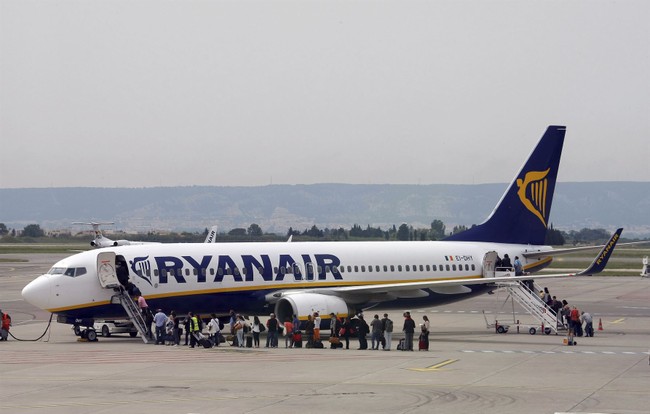
This article recounts a midair emergency on a Ryanair Boeing 737 that forced a return to Thessaloniki after engine parts reportedly struck and broke a window, leaving a 61-year-old passenger partially sucked toward the open cabin before his wife held on and crew deployed oxygen masks.
Passengers aboard a flight from Thessaloniki to Memmingen experienced a sudden, terrifying event when debris reportedly struck the fuselage and a passenger window failed. The cabin depressurized rapidly, oxygen masks dropped, and crew declared an emergency that sent the plane back to Thessaloniki. Witnesses and medical staff on the ground described a dramatic scene involving a man who was partially pulled toward the breach.
A Greek doctor who treated the injured passenger described how his wife reacted in the split second that mattered. According to the doctor, she was holding her husband’s feet to keep him from being completely pulled out of the aircraft. That quick action appears to have prevented a far worse outcome while first responders prepared medical care once the plane landed.
The doctor said the passenger’s wife was holding her husband’s feet to stop him from being completely sucked out of the aircraft. The passenger is currently in the hospital.
The aircraft declared an emergency with oxygen masks dropping in the cabin. The plane returned to Thessaloniki, landing safely on Friday morning, according to a senior Greek aviation official.
The official told ABC News that the Ryanair Boeing 737 suffered an uncontained engine failure. Parts from the engine hit the plane, damaging the fuselage and breaking a passenger window, according to the official.
Officials say the aircraft had an uncontained engine failure and that debris from that failure struck the fuselage, compromising a cabin window. That kind of damage is rare but severe, because the pressurized air inside the cabin seeks to equalize with the much lower pressure outside. The result can be an intense outward force near any breach, which is why the scene inside that cabin turned into an emergency so fast.
Local reports noted the injured passenger is 61 years old and was moved to AHEPA hospital for treatment and diagnostic scans. Medical staff reported friction burns and said a CT scan would determine whether there were any fractures. Investigators and medical teams were on the tarmac when the plane returned, and passengers were assisted off the aircraft in an orderly fashion once it landed.
https://x.com/aviationbrk/status/2075494035792285793
BREAKING: Ryanair passenger reportedly saved from being sucked out the cabin after window fails during a flight from Thessaloniki to Memmingen.
According to local media Ryanair flight FR1879, a Boeing 737-8AS, returned safely to Greece on Friday after part of a damaged engine reportedly detached and struck a cabin window.
A 61-year-old man, who is from Serbia upon the return of the plane, was taken to AHEPA and will undergo a CT scan to see if he has fractures.
Speaking about the incident, the president of POEDIN (Panhellenic Federation of Public Hospital Employees), stressed that there was almost a tragedy, as a window was broken, the body of a passenger came out in the air and was restrained by his wife. The 61-year-old is currently at AHEPA with friction burns.
Flight crews trained for emergencies followed procedures, lowering masks and coordinating with air traffic control to return as quickly and safely as possible. Passengers described alarm and fear, but also the calm professionalism of crew and the relief after a safe landing. Airline and aviation authorities will now focus on the mechanical side of what caused the engine failure and subsequent debris strike.
The formal investigation will be overseen by the Republic of North Macedonia, identified as the country of occurrence. Aviation investigators typically gather the aircraft’s maintenance history, engine records, and witness statements to reconstruct events. That process can take weeks or months, depending on the complexity of the damage and the availability of forensic evidence from the engine and airframe.
Surviving a sudden depressurization incident often comes down to seconds and reactions, both by crew and by fellow passengers. In this case, the combination of a swift return to the airport, emergency protocols, and one spouse’s quick physical intervention appears to have saved a life. Authorities will use their findings to determine if there were mechanical failures, maintenance gaps, or other factors that contributed to the engine detaching parts.
For now, the man is receiving treatment and medical teams are continuing evaluations to assess any lasting injuries. Passengers who experienced the event have been offered support and interviews are being collected for the investigation. Aviation officials will release a more detailed report when they have analyzed all available data.
The image that accompanied early coverage has been removed from this rewritten account; the focus remains on the sequence of events, the immediate response, and the ongoing inquiry into why an engine failure sent debris into the cabin. Aviation safety experts emphasize that while flying is statistically safe, rare incidents like this highlight the need for thorough investigations and transparency so operators and regulators can prevent recurrence.



Add comment