
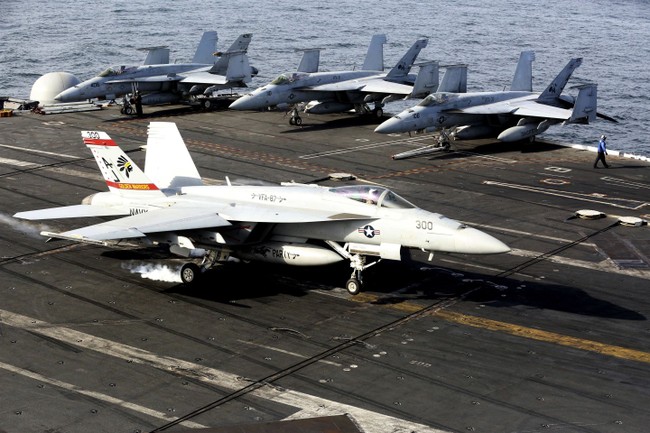
The U.S. military responded decisively after hostile strikes in the Strait of Hormuz, taking out Iranian facilities tied to attacks on American ships and sending a clear message that aggression will meet forceful consequences. This piece walks through what happened, how U.S. commanders described the response, the status of Project Freedom, and reactions from President Donald Trump.
U.S. forces struck multiple Iranian positions near the Strait of Hormuz after assets transiting the passage came under attack, officials said. Reports noted strikes on Qeshm Port and sites around Bandar Abbas and Minab, and CENTCOM described the operation as defensive in nature and limited to eliminating immediate threats. Commanders emphasized they were not seeking a wider war but were prepared to protect American forces and interests in the region.
A U.S. strike on Iran’s Qeshm Port in the Strait of Hormuz and Bandar Abbas was reported Thursday, with U.S. officials telling Fox News National Security Correspondent Jennifer Griffin that this was neither a restart of the war nor an end to the ceasefire.
The U.S. military also struck Iran’s Bandar Kargan naval checkpoint in Minab, officials confirmed. [….]
Iran’s state-run Mehr News Agency also reported attacks and exchanges of fire across Iran’s southern Hormozgan province near Bandar Abbas, Bandar Khamir, Sirik and Qeshm Island, according to reports.
CENTCOM made clear that U.S. warships were transiting the Strait when Iranian forces launched missiles, drones and swarm-boat attacks. The destroyers involved included USS Truxtun, USS Rafael Peralta and USS Mason, and CENTCOM reported no U.S. vessels were struck. The response targeted missile and drone launch sites, command-and-control nodes, and intelligence, surveillance and reconnaissance facilities tied to the attacks.
U.S. forces intercepted unprovoked Iranian attacks and responded with self-defense strikes as U.S. Navy guided-missile destroyers transited the Strait of Hormuz to the Gulf of Oman, May 7.Iranian forces launched multiple missiles, drones and small boats as USS Truxtun (DDG 103), USS Rafael Peralta (DDG 115), and USS Mason (DDG 87) transited the international sea passage. No U.S. assets were struck.
U.S. Central Command (CENTCOM) eliminated inbound threats and targeted Iranian military facilities responsible for attacking U.S. forces including missile and drone launch sites; command and control locations; and intelligence, surveillance and reconnaissance nodes.CENTCOM does not seek escalation but remains positioned and ready to protect American forces.
The tactical message was simple: attacks on U.S. ships will be met with precise strikes on the infrastructure enabling those attacks. That posture protects sailors while degrading Tehran’s ability to project power in the northern Arabian Sea. It also reassures allies that the United States will defend freedom of navigation through strategic chokepoints like the Strait of Hormuz.
There was also movement on Project Freedom, an effort tied to safeguarding commercial shipping in the region. Early constraints reportedly stemmed from limited base access in Saudi Arabia and Kuwait after attacks on regional partners, but those issues appear to be resolving. If Project Freedom resumes full activity, it would be a practical complement to military pressure by helping reopen shipping lanes and ease energy market worries.
Having a layered approach—naval defense, targeted strikes, and protective measures for commercial traffic—helps lower the chance that indirect attacks on Gulf states escalate into broader conflict. Continued naval operations and international cooperation can stabilize trade routes and reduce oil volatility, which benefits the global economy. At the same time, credible military responses keep adversaries from testing red lines with impunity.
President Donald Trump publicly praised the military’s actions, framing them as effective and decisive. His statement described the destroyers’ transit and the damage inflicted on the attackers, characterizing Iran’s leadership as dangerous and warning that stronger action could follow if negotiations falter. His remarks emphasized American strength and protection for the fleet and were meant to underscore a no-nonsense stance toward Iranian aggression.
Three World Class American Destroyers just transited, very successfully, out of the Strait of Hormuz, under fire. There was no damage done to the three Destroyers, but great damage done to the Iranian attackers. They were completely destroyed along with numerous small boats, which are being used to take the place of their fully decapitated Navy. These boats went to the bottom of the Sea, quickly and efficiently. Missiles were shot at our Destroyers, and were easily knocked down. Likewise, drones came, and were incinerated while in the air. They dropped ever so beautifully down to the Ocean, very much like a butterfly dropping to its grave! A normal Country would have allowed these Destroyers to pass, but Iran is not a normal Country. They are led by LUNATICS, and if they had the chance to use a Nuclear Weapon, they would do it, without question — But they’ll never have that opportunity and, just like we knocked them out again today, we’ll knock them out a lot harder, and a lot more violently, in the future, if they don’t get their Deal signed, FAST! Our three Destroyers, with their wonderful Crews, will now rejoin our Naval Blockade, which is truly a “Wall of Steel.”
The situation remains fluid, and further developments will depend on diplomacy, allied cooperation, and continued operational pressure. For now, the operation shows a willingness to act when American forces are threatened and to push back against destabilizing behavior. That clarity of purpose is exactly what deters repeat attacks and preserves stability in a volatile theater.
Maintaining a secure maritime environment, restoring reliable shipping, and keeping pressure on hostile actors are all parts of a strategy that combines muscle with diplomacy. If the blockade holds and Project Freedom supports commercial transit, the region could see reduced interruptions and more predictable energy markets. In the meantime, American forces remain on watch, ready to defend the fleet and keep strategic waterways open.

Add comment