
Checklist: Summarize Trump’s Davos remarks on prosecutions tied to 2020, quote his statements about Greenland and force, explain his framing of election integrity and national security, outline his economic and energy claims, and preserve original quoted material and embeds.
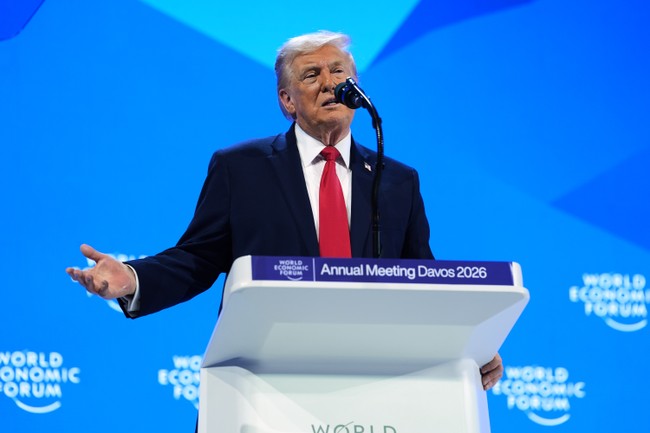
President Trump used his Davos appearance to deliver pointed claims about the 2020 election and to lay out a blunt argument for American control over Greenland, mixing legal threats, strategic warnings, and economic boasting in a single high-profile address. He told a global audience that prosecutions are coming over what he calls a rigged election and insisted the United States is uniquely capable of protecting and developing Greenland, while explicitly saying he does not plan to use military force. The remarks stitched together themes he’s pushed for years: election integrity, American strength, and an “America First” approach to global affairs.
Speaking to world leaders and executives, Trump again challenged the legitimacy of the 2020 result and forecast legal consequences for those he believes orchestrated fraud. He declared, “It wouldn’t have started if the 2020 U.S. presidential election weren’t rigged,” and added, “It was a rigged election. Everybody now knows that. They found out. People will soon be prosecuted for what they did.” That language frames future legal action as corrective and necessary, not merely political rhetoric.
Trump doubled down a moment later with a shorter restatement that underscored his certainty and the urgency he wants the public to feel. “That’s probably breaking news, but it should be—it was a rigged election, can’t have rigged elections.” Those lines were presented as both a revelation and a policy promise, intended to reassure supporters that alleged wrongdoing will not go unanswered. The tone was defiant and unambiguous, reflecting his long history of disputing the outcome.
The Davos stop also turned to Greenland, where Trump tried to neutralize concerns about coercion while still pressing a stark strategic demand. He insisted that the United States would not resort to violence, saying, “We probably won’t get anything, unless I decide to use excessive strength and force, where we would be frankly unstoppable—but I won’t do that.” That sentence was followed by a plain clarification: “That’s probably the biggest statement I’ve made. Because people thought I would use force. But I don’t have to use force. I don’t want to use force,” he added. “I won’t use force. All the United States is asking for is a place called Greenland.”
Even as he rejected military action, Trump left little doubt about the consequences he believed Denmark might face for saying no. He warned the island’s owners with a crisp ultimatum: “They have a choice: You can say yes, and we will be very appreciative, or you can say no, and we will remember.” That phrasing was meant to convey leverage rather than a threat of immediate violence—an exercise of diplomatic pressure framed as national security necessity.
His strategic argument centered on Greenland’s value in deterring rivals like Russia and China and on America’s capacity to develop the territory. “It’s the United States alone that can protect this giant piece of land, this giant piece of ice, develop it and improve it,” he said, painting a vision of American stewardship tied to defense and economic opportunity. The message was straightforward: control or influence over Greenland matters because it shapes Arctic geopolitics.
Beyond election and territory, Trump used his extended forum time to trumpet achievements at home and jab at prevailing energy and climate narratives. He declared inflation defeated, touted economic growth he credits to his leadership, and promised a booming stock market ahead. At the same time he dismissed renewable-focused policies as the “green new scam,” arguing that affordable energy from fossil fuels and nuclear power is the realistic path to prosperity.
The overall tone of the address kept to a familiar playbook: assert American strength, question the motives of rivals and critics, and prioritize national sovereignty and economic independence. That posture resonated with an audience of conservatives and skeptics of globalist prescriptions, and it was likely to unsettle European elites who favor multilateral approaches. Whatever reactions it provoked, the speech made clear that Trump sees law enforcement, territorial strategy, and energy policy as intertwined elements of a single national-security agenda.
Throughout the remarks, Trump mixed theatrical flourishes with substantive assertions, aiming to control the narrative on several fronts at once. His pledge about upcoming prosecutions, the hard-pitched take on Greenland, and the broader economic claims were all part of a larger effort to define his priorities going into the next phase of his political life. The address at Davos served as both a policy outline and a signature performance intended to rally supporters and challenge critics on the world stage.

Add comment