
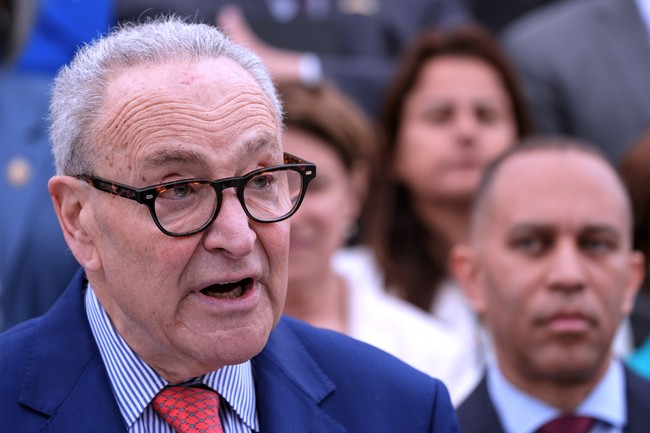
This article examines Senate Minority Leader Chuck Schumer’s recent attempts to navigate the rise of the Democratic Socialists of America within the Democratic Party, highlights his evasive public remarks, contrasts his posture with other leaders, and questions whether accommodating DSA-aligned candidates will cost him both control and credibility.
House Minority Leader Hakeem Jeffries and Sen. Minority Leader Chuck Schumer have both been careful when asked about the Democratic Socialists of America gaining influence in the party. Jeffries has at least claimed disagreements on a few high-profile issues, but Schumer’s answers have been vaguer and more protective, suggesting political calculations behind his reticence. That cautious stance matters because prominent DSA figures like Rep. Alexandria Ocasio-Cortez remain openly critical of the party establishment. For any party leader, handling internal factions is a test of strength and judgment.
Schumer’s evasions took a familiar shape in his July remarks, where he emphasized unity and defeating the MAGA agenda without addressing deeper ideological divides. He framed Democrats as a “big tent” that can contain differing views while standing together on core issues, a message aimed at minimizing public conflict. The tone suggested a desire to avoid primaries and intra-party warfare that could weaken Democrats nationally. Here’s where he was in July, before a DSA-backed primary win in Michigan:
We’re a big tent party. And not everyone has the same exact view on every single issue. But if you look at the overall issues, the costs that people pay, the chaos in the Trump administration, you see it daily.
https://x.com/Stephend1776/status/2082560540556382434
[…]
So we are a big tent party, and we’re united on the major issues facing America.
More recently, Schumer’s public tone shifted toward accommodation, praising some DSA-backed candidates as fitting their states without defining what that fit entails. That vagueness is politically useful but substance-poor: saying candidates “fit” a state dodges questions about their policy agendas and electoral viability. It also raises a clear question—fit for whom: the voters of the state or the internal DSA power structure? Watch:
He even went so far as to offer mild praise to certain DSA-backed contenders, which looked like an attempt to keep everyone on board while avoiding direct endorsements of their platform. Praising candidates without addressing their radical positions creates ambiguity about where Schumer genuinely stands. When party leaders decline to draw lines, it invites further factional growth and forces the base to pick sides.
Schumer has technically endorsed Abdul El-Sayed after his primary win, though he originally supported another Democrat during the contest, and he has not committed to campaigning with El-Sayed. That noncommittal posture leaves open whether the party will actively back these insurgent nominees or quietly hope incumbency carries them. At the same time, Republican opponents are already exploiting that uncertainty and peeling away votes by framing DSA candidates as out of step with mainstream voters.
The practical questions here are sharp: How does El-Sayed “fit” a purple Michigan where barely half of Democratic primary voters backed him, and where his GOP rival is openly trying to siphon off Democrats? How does Angie Nixon “fit” a state like Florida, which has repeatedly rejected socialist policies at the state level? Those are not abstract debates; they are immediate electoral realities that party leaders must address. Voters deserve clarity on whether nominees align with state electorates or with national activist networks.
More than semantics, the ideological stakes are real. There are vocal elements within the DSA that call for far-reaching structural changes—from abolishing certain institutions to reshaping core governance practices—that most Americans find extreme. If those ideas gain influence inside the Democratic caucus, Senate leaders will face a choice: defend traditional institutions and appeal to swing voters, or embrace a hard-left shift that risks alienating the center. Political leadership requires drawing distinctions, not comfortingly broad metaphors.
Schumer appears trapped between two imperatives: keeping enough Democrats united to control the Senate and avoiding a primary backlash from high-profile activists. That balancing act might hold for a time, but it is unstable, especially if new members refuse to support current leaders. If DSA-aligned senators or representatives arrive without loyalty to existing leadership, the internal dynamics of the caucus will change—and not necessarily in Schumer’s favor.
For now, Schumer’s strategy is clear: attempt to placate both wings by avoiding firm answers and emphasizing unity. But politics is a transactional business, and appeasement often comes with a cost. The DSA’s rise forces an unavoidable reckoning about principles, power, and what voters in battleground states will accept, and the party’s leadership will be judged by the choices they make next.

Add comment