
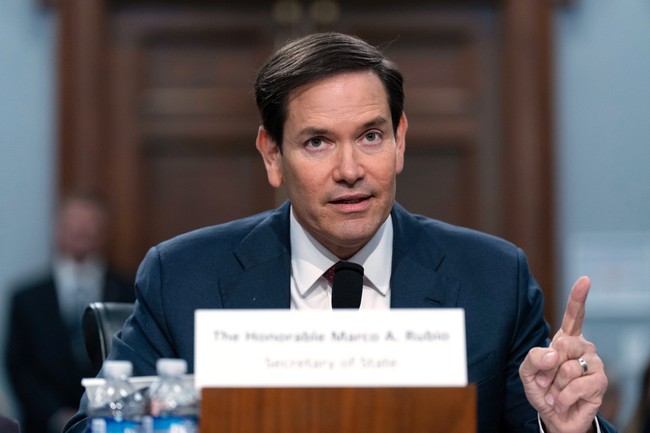
I’ll explain how Senator Marco Rubio directly confronted media claims about U.S. objectives in Operation Epic Fury, list the president’s stated goals as Rubio recited them, outline Rubio’s case on Iran’s regional threats and support for terror networks, and note how regional partners have reacted to the campaign.
Conservative voices have pushed back hard on coverage that treats the campaign against Iran as aimless or incoherent. Senator Marco Rubio took that criticism head-on in a recent interview with ABC’s George Stephanopoulos, insisting the administration’s goals are specific and achievable. He argued that anyone claiming otherwise simply hasn’t paid attention to what was laid out from the start.
Rubio made a sharp, memorable point in his exchange with the media: “You should write them down,” he said when asked about the presidency’s objectives. That line underscored his central claim that the administration did not act without a plan, and that the plan was publicly stated from the outset. He challenged reporters and commentators to recount those goals rather than repeating a narrative of confusion.
Rubio summarized the operation’s aims concisely and directly. “It’s about very specific objectives. The president laid them out on the first night of the operation,” Rubio said. He then spelled out the mission in plain military terms so there could be no mistake about what the effort was meant to accomplish.
“I’ll repeat them to you now because I hear a lot of talk about: We don’t know what the clear objectives are. Here they are. You should write them down. Number one, the destruction of their Air Force. Number two, the destruction of their Navy. Number three, the severe diminishing of their missile launching capability. And number four, the destruction of their factories so they can’t make more missiles and more drones to threaten us in the future. All of this so they can never hide behind it to acquire a nuclear weapon.”
Rubio emphasized progress on those targets, saying forces were on pace or ahead of schedule and that the time frame being discussed was measured in weeks rather than months. He framed the operation as methodical, with discrete objectives that can be assessed against observable outcomes. That matters because it gives policymakers and the public a way to measure success beyond punditry.
Despite clear indicators of degrading Iran’s military capabilities, much of the commentary in mainstream outlets has framed the campaign as a strategic failure. Rubio pushed back against that tilt, arguing the media’s narrative often ignores the operational facts that show the military pressure is working. For conservative readers, that dissonance only reinforces distrust of elite outlets covering the conflict.
Another pillar of Rubio’s argument was the longstanding role Iran plays in regional violence and terrorism. He reminded viewers that Tehran’s support for militias and extremist groups has caused American casualties and destabilized the Middle East for decades. This history, he said, explains why decisive action is necessary now.
Rubio did not mince words describing the network of proxy forces and their ties to Tehran. “Look at this region. Every single terrorist group in this region has a link to the Iranian regime. Every single one!” he asserted, and he tied broader instability directly to Tehran’s influence. His point was that dealing with Iran reduces the reach of those groups and protects U.S. interests and regional partners.
He went further on the ideological threat posed by Iran’s rulers, calling their outlook “apocalyptic” and arguing that such a mindset makes nuclear proliferation especially dangerous. “And all of their neighbors know that by the way,” he stated, noting why regional states back stronger measures to neutralize Tehran’s capabilities. That claim helps explain the political alignment emerging in the Gulf in response to U.S. actions.
Rubio also warned against any attempt by Iran to control maritime chokepoints, warning that a blockade or toll on the Strait of Hormuz would jeopardize the operation’s objectives. He stressed that keeping global trade lanes open is a strategic priority tied directly to those military goals. Preventing such escalation is part of the calculus behind continued pressure.
While refusing to disclose operational specifics that would compromise security, Rubio argued that a credible and sustained response will alter Tehran’s cost-benefit calculations. He suggested that as the world watches, the regime’s options narrow and its patrons reevaluate support. That international perception, he said, helps multiply the effect of U.S. action.
Editor’s Note: For decades, former presidents have been all talk and no action. Now, Donald Trump is eliminating the threat from Iran once and for all.

Add comment