
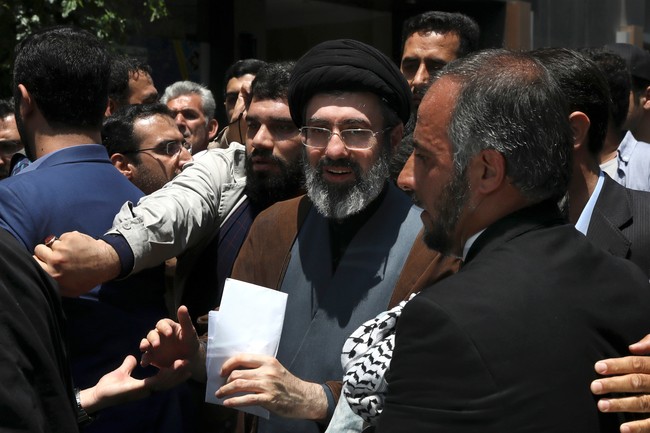
The piece examines an odd, secretive encounter between Iran’s president and the elusive Supreme Leader, describing how a requested meeting reportedly became a shadowy, handshaking‑forbidden exercise that raises more questions about who is really calling the shots in Tehran.
The narrative centers on reports that President Masoud Pezeshkian pressed for a meeting with Supreme Leader Mojtaba Khamenei and was finally granted one under strange conditions. According to accounts, Pezeshkian was taken to a covert location, put into a darkened vehicle, and told someone sitting beside him was the supreme leader. The episode is presented as an awkward, almost farcical attempt at maintaining the appearance of leadership when transparency is sorely lacking.
What stands out is the theater of secrecy. The president allegedly could not see the man he was meeting and was even prevented from shaking hands, a basic gesture of acknowledgment and respect. That kind of staging suggests either deep security paranoia or a deliberate effort to conceal the true status of the supreme leader, and both options are troubling for a regime premised on visible authority.
Iranian President Masoud Pezeshkian was whisked to a secret location in Tehran, shoved into the back seat of a dark car with blacked-out windows and told he was sitting next to Supreme Leader Mojtaba Khamenei — except he never actually saw the man, according to a bombshell report from Iran International.
The report also says the meeting only happened after Pezeshkian repeatedly begged for it and even threatened to resign, which paints a picture of a president pushed to plead for access to his own country’s top figure. When the office of the supreme leader finally relented, custom was ignored: the meeting did not occur at the official residence. That break with protocol underscores the oddity and raises the stakes of whatever power shifts are underway internally.
Even then, the supreme leader refused to meet at his official residence, as is custom.
Instead, the president was driven to a secret location in Tehran, pulled from his own security convoy and placed in the back of a commercial vehicle.
The cabin was kept so dark the two men couldn’t see each other — with guards even barring Pezeshkian from shaking the supreme leader’s hand.
The situation reportedly irritated Pezeshkian, who asked aides whether the person beside him had actually been Khamenei at all — because all he’d heard was someone talking in the dark.
There’s no clear timestamp on when this allegedly happened, which adds another layer of murk. If the supreme leader’s presence can be staged or obscured, foreign and domestic actors alike face uncertainty about who actually makes decisions. For a state built on the personality and visible leadership of a supreme guide, that uncertainty is corrosive to authority and to the chain of command.
Recent moves in Tehran hint at broader shifts. Reports indicate Khamenei’s office has handed extraordinary decision-making power to IRGC leaders, notably Ahmad Vahidi, effectively sidelining the president’s administration. That kind of consolidation, especially combined with cloak-and-dagger meetings, suggests the real levers of policy may be moving away from nominal civilian leadership toward military command.
Iranian media reported this week that Khamenei formally granted IRGC Commander-in-Chief Ahmad Vahidi the ultimate authority on decision-making, sidelining Pezeshkian’s political administration.
Personal insults and factional jabs have followed, with figures close to the supreme leader trading barbs that further humiliate the president and undermine his credibility. Reports of relatives and associates publicly attacking Pezeshkian feed the sense that dissent within the elite is being handled with humiliation rather than dialogue. That approach signals an intolerance for independent political stature, which is dangerous for any system claiming legitimacy through consensus or religious authority.
People inside Iran are surely watching this play out and wondering who to trust. The regime’s survival often depends on clear symbols of power; when those symbols become props or cardboard stand-ins, popular confidence frays. That reality is costly not just for the clerical hierarchy but for the country’s stability and for regional calculations that rely on assessing who actually leads Iran.
For outsiders, the spectacle should change how policymakers and analysts read Tehran’s actions. If decisions are increasingly driven by shadowy military authorities or staged leadership appearances, then traditional diplomatic channels and assumptions about Iranian behavior are less reliable. The U.S. and allies need to factor in a fractured power structure when evaluating moves from Tehran and planning responses.
https://x.com/IranIntl_En/status/2085303771278508323
The reported meeting may have been meant to reassure or to mask internal weakness, but in practice it seems to have done the opposite by highlighting the regime’s opacity. Whatever the true status of Mojtaba Khamenei, the episode reveals a leadership struggling to present unity and maintain control. That struggle has real consequences for Iranians and for anyone watching the region closely.
Adding to the confusion, statements from Khamenei’s office have denied some of the claims made by his critics, and the back-and-forth reflects a broader information war inside Iran. When official denials mingle with leaks and factional reports, discerning fact from theater becomes a central challenge for observers. The pattern is familiar: secrecy breeds rumor, and rumor feeds instability.
Add comment