
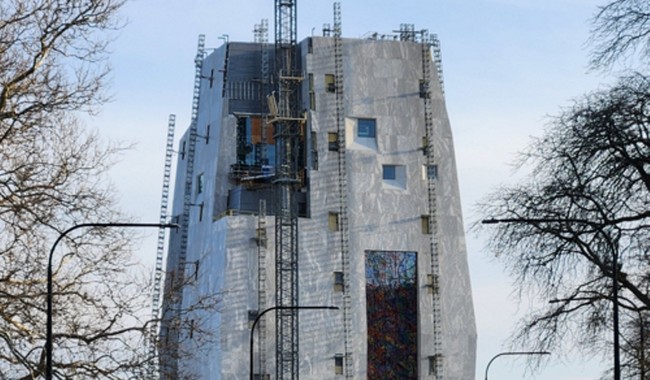
The Obama Presidential Center under construction in Chicago has become a lightning rod for critics who don’t like its size, style, or stated purpose, and a recent addition — a giant text display quoting a 2015 speech — has only made that reaction louder. The structure’s brutalist look, debate over where archives will be kept, and the Foundation’s program mix have fueled Republican-leaning skepticism about its intent and aesthetics. Visitors and online commenters are split between describing the project as monumentally misguided and dismissing it as an overblown community center dressed up as a presidential library. This article walks through the design, the new display, how the archives will be handled, and the public reaction so far.
The building’s appearance has drawn sharp words from critics who call it one of the least attractive modern civic projects. The design leans hard into heavy, fortress-like forms that feel more menacing than inspiring, and that’s exactly the sort of look many conservatives say signals a preference for spectacle over substance. People are pointing to the cost and asking why a supposedly public-minded project looks like a monument to style instead of an accessible civic space.
Adding insult to injury, the Center’s exterior now carries massive lines of text sourced from a 2015 Selma speech, wrapped around the facade in a way that makes reading it a strain. Some viewers say it’s almost unreadable at a distance, leading to jokes about headaches and confusion rather than reflection. The format feels less like thoughtful commemoration and more like a graphic design experiment gone wrong, which only amplifies criticism that the project is more about image than record-keeping.
Online reactions ranged from mild amusement to outright scorn, with comments like “Not the ideal design” and one person admitting, “I gave up after developing a headache three lines from the top.” Those lines capture a common sentiment: when art and architecture obscure the message, the message loses credibility. It’s one thing to make bold architectural choices; it’s another to do so at the expense of clarity and public goodwill.
Unlike traditional presidential libraries, the Center will not house the physical archives on site, which has provoked additional questions about authenticity and transparency. The National Archives will manage the records off-site and provide digital access instead of keeping original documents in a dedicated library building. For skeptics, that setup reinforces the sense that the site is meant more as a public relations platform and event space than a true archival institution.
The Obama Foundation is developing a campus that goes well beyond what past presidential libraries offered, including a basketball court, a museum, an Oval Office replica, studios, and a “Democracy in Action Lab.” On paper, a mix of cultural, educational, and recreational elements sounds useful, but critics argue it reads like a politically curated agenda disguised as civic programming. When government institutions and private foundations promote activism under cultural cover, it sets off alarm bells for anyone who favors clear lines between public resources and partisan organizing.
There will be a smaller public library presence on site, a 5,000-square-foot Chicago Public Library branch, and an Eleanor Roosevelt Fruit and Vegetable Garden topping part of the building. Those amenities offer community value, yet they don’t fully address concerns about the larger project’s tone and purpose. For many Republicans, the worry is that the Center will serve as a national platform for progressive activism rather than a neutral historical resource.
Social media lit up with reactions that ranged from sardonic to scathing, and several memorable snippets were shared widely. A comment posted on X captured the garbled impression some people had when trying to parse the large-format text:
what don’t you understand about
YOU ARE AMERICA
ED BY HABILAND
UNENCUMBERED
ADY TO SEIZE WE
Other posts were blunt: “The dyslexic in me is not amused,” noted one writer and another replied, “He put his own speech on the outside of his library?” Critics went further, likening the building to grim, authoritarian structures from the past and noting how tone-deaf it reads to many Americans.
The Center is set to open next June, but until then the debate over meaning, design, and intent will keep the project in the news. For those who view it through a Republican lens, the combination of costly grandeur, off-site archives, and programming that foregrounds civic activism feels like an overreach. The reactions — equal parts humor and scorn — suggest the building won’t win many converts just by standing there.
Editor’s Note: The Democrat Party has never been less popular as voters reject its globalist agenda.


Add comment