
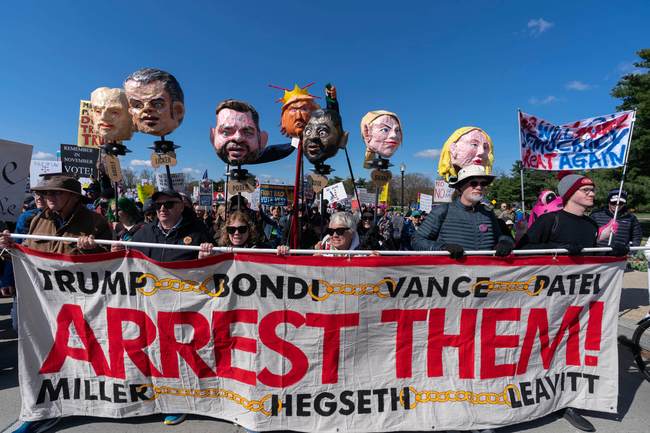
An Obama-appointed judge has blocked efforts to remove a continuous anti-Trump protest near the White House, ruling that the slogan “86 47” does not, on its face, amount to a threat; the case spotlights tensions between security concerns and free speech after recent violence near the executive residence.
Less than two weeks after a gunman opened fire near Secret Service agents by the White House, and weeks after a separate individual was charged with an alleged assassination attempt at a high-profile event, a federal judge issued a temporary order keeping a round-the-clock protest in place about a mile from 1600 Pennsylvania Avenue. The protest, organized by a left-wing group calling itself Accountability Now, raised an “86 47” flag that federal officials asserted was a threat to the president and to officers. Authorities sought to have the permit revoked and the flag removed, citing security worries and the charged atmosphere around political violence.
U.S. District Judge Randolph Moss, who was appointed by President Obama, issued a two-week restraining order preventing the National Park Service from canceling the demonstration’s permit. Judge Moss wrote that the government had not shown “any articulable — much less evidentiary — basis for concluding that the speech actually threatens the life or safety of the President.” His ruling emphasized that the phrasing in question, in the court’s view, amounted to political advocacy for impeachment and removal, rather than a direct threat.
The Secret Service had warned the court that the phrase could inspire violence, with Deputy Director Matthew Quinn writing, “Based on my training and experience, I believe that this term, as it is understood today, can incite violence by others.” The judge acknowledged rising political violence in general but maintained that the specific expression at issue did not legally cross the line into a true threat. That legal distinction is now the fulcrum of a highly charged public debate over how to balance First Amendment protections with practical safety concerns around the White House.
The protest takes place on National Park Service land near a statue outside a federal courthouse, at the intersection of Pennsylvania Avenue NW and Constitution Avenue NW. Judge Moss works in that same courthouse and is likely familiar with the protest site, which makes the decision feel even more immediate to people who work in the building or pass by daily. Nearby public spaces have also shown signs of the same messaging, raising alarm among many who worry that symbolic speech can escalate into action when tensions are high.
Recent incidents have heightened those anxieties. Vandals scrawled “86 47” at the Lincoln Memorial reflecting pool, which was already undergoing restoration ahead of national celebrations. And federal prosecutors later indicted a former high-ranking official for posting seashells arranged to read “86 47,” an act prosecutors described as “a serious expression of an intent to do harm to the president of the United States.” Those events feed the argument that such slogans are more dangerous than abstract political speech.
https://x.com/WCBM680/status/2061598013923995891
Supporters of the protest argue that the slogan is shorthand for removing a president through lawful political processes, like impeachment or voting, and that suppressing it would chill core political speech. Critics, including law enforcement veterans and many conservatives, see an effort to normalize a chant that implicitly calls for the end of a sitting president and potentially encourages violent action. That split reflects broader disagreements about where persuasion ends and incitement begins in today’s heated political climate.
Legal experts note that courts have long protected provocative speech unless it presents a real, imminent threat, and Judge Moss applied that precedent here. The ruling did not settle the broader questions, but it underscored the judiciary’s role in parsing legal standards amid public safety claims. For many Republicans and security-focused observers, the decision feels tone-deaf to the practical dangers of recent attacks on or near federal officials and properties.
Public reaction has been stark and immediate, with critics saying federal agencies and the courts should prioritize officer safety and the security of the president over permissive interpretations of aggressive political language. Others warn that politicizing permits and public space could set a precedent for unequal enforcement depending on who objects to a particular protest. That argument places pressure on both agencies and judges to explain why some speech gets curtailed and other speech remains protected.
The short restraining order keeps the status quo for now, but the underlying legal fight will continue and is likely to return to the court for a fuller decision. In the meantime, the episode reveals how fraught public space and political expression have become near the centers of power, and how difficult it is to draw clear lines where free speech and security concerns collide. The case will be watched closely as a test of where courts draw that line under today’s political stress and recent violent incidents.

Add comment