
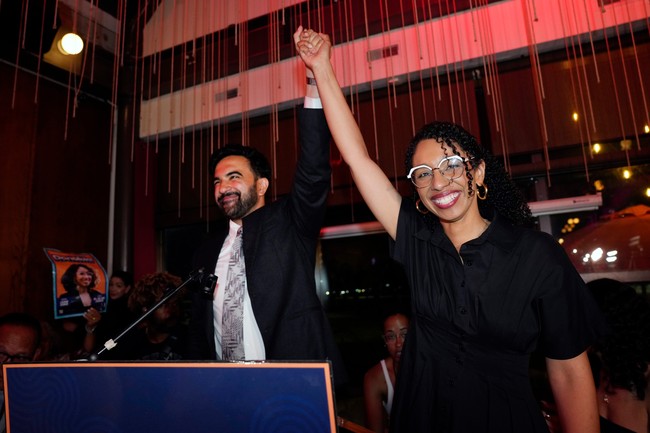
The recent New York City primaries delivered wins for candidates backed by Mayor Zohran Mamdani, and one Democratic congressional nominee in particular — Darializa Avila Chevalier, the NY-13 nominee and a current Ph.D. student at CUNY — has become a lightning rod for criticism over her past rhetoric and policy positions; this article examines her history of deleted social posts, activism, debate claims about deportations, and the way she answers questions about communism, showing how her candidacy reflects a sharp leftward shift in local Democratic politics.
The primaries in New York City tilted heavily toward candidates supported by Mayor Zohran Mamdani, and because these districts are reliably Democratic, primary victories often spell likely general election wins. That reality puts activists with radical pasts squarely on track to occupy federal seats, which is worrying to many voters who expect mainstream governance rather than ideological experiments. One of the standout winners is Darializa Avila Chevalier, who has drawn attention for online material she later deleted and for activist work going back to her college years.
Chevalier is a Ph.D. student at the City University of New York and a former organizer at Columbia. In 2016 she helped launch a group tied to the Columbia University Apartheid Divest movement, and that group posted, in 2024, “We are Westerners fighting for the total eradication of Western civilization,” a line that was later removed from social media. Those lines and her deleted posts alleging the abolition of police, prisons, and borders create an image of a candidate whose earlier rhetoric pushed well beyond mainstream Democratic policy debates.
Reports say she once called America a “f**king disgrace,” and that she joked about wiping her hand on the American flag. Those remarks were made public in coverage that cited deleted posts and clips, and they have stuck to her as she seeks office. Chevalier insists she has matured since those statements, asking voters to accept that people evolve, but critics call that an inadequate response when the positions involved the dismantling of institutions that preserve public order.
Her current campaign rhetoric still raises red flags for many. In a debate with five-term incumbent Rep. Adriano Espaillat she was challenged on deportations and responded that she does not support deportations, even for people convicted of crimes, framing such actions as somehow punitive beyond reasonable bounds. That stance raises practical and legal questions, because illegal entry and related offenses are criminal acts and deportation is a standard enforcement tool; treating removal as “double jeopardy” is an argument that many legal experts and voters reject.
Her media appearances have not quelled concerns. When asked by Ali Velshi about allegations that she is a communist, her responses avoided a direct denial and leaned on long-winded reframing. She told a host, “That framing is one that I’ve been very proud to be able to say I don’t respond to, one in which I have been very intentional to say I won’t be reactive.” That kind of answer sounds polished but fails to give plain reassurance to voters who want clarity on where she stands regarding core American institutions.
She doubled down on the broader campaign theme in other remarks: “We are presenting a vision of what we are fighting for. And I think that for far too long we have had politics that is reactive to what Republicans are doing. What we need is Democrats who are actually going to present a positive vision, one that sets the tone for what we should be talking about, which is the issue of affordability, which is the issue of how our budgets are moral documents. If we say we want to invest in working people in this country, then we need to do that, and our budgets need to reflect that. If we say we value immigration justice, we need to make sure that that is also reflective in our policy.”
She has said she was “very proud” of a campaign that “centered those ideals,” and she framed her politics as a hopeful alternative to fear-based discourse. That language positions her as a visionary to supporters, but to others it reads as an unwillingness to confront tough questions about public safety and national identity. The contrast between aspirational rhetoric and concrete policy answers remains a central critique of her candidacy.
For voters concerned about law, order, and the preservation of institutions, Chevalier’s past activism and some of her current positions underline a dramatic shift in parts of the Democratic coalition. What was once marginal is now reaching nominees in safe districts, which means these ideas could shape legislative agendas if these candidates take office. That prospect has opponents warning that ordinary, practical governance could be replaced by ideological experiments with wide-ranging consequences.
https://x.com/WesternLensman/status/2069735311370764547
The debate around Avila Chevalier captures the broader struggle inside the Democratic Party between radical elements and more traditional mainstream voices. As she moves forward in a heavily Democratic district, her track record of deleted posts, past activist statements, and evasive media answers will continue to be fodder for both defenders and critics. For many voters, the essential question is whether rhetorical flourish and past provocations should determine who represents them in Congress.
Here she is saying she still believes “all deportations are wrong.” And she doesn’t seem to understand that illegal entry into the country is a crime.
If those weren’t enough, there’s the way she responds to MS NOW’s Ali Velshi about how she would respond to allegations that she’s a communist. Talk about a Kamala Harris word salad; she’s right there with her.

Add comment