
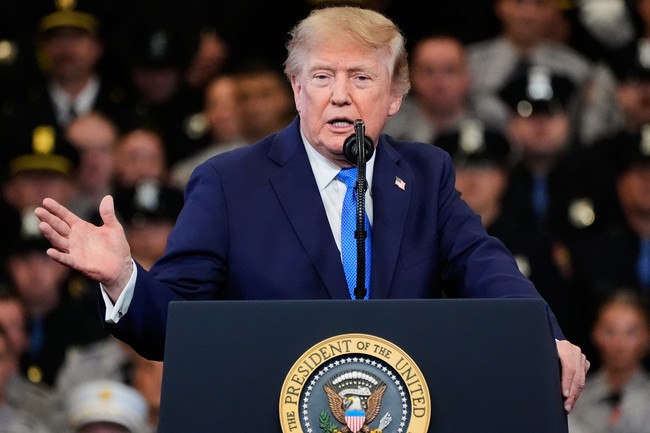
President Trump spoke in Garden City on Long Island about falling crime rates, highlighted DOJ and FBI figures, paused to comfort a grieving woman in the crowd, and used the moment to criticize New York Democratic policies and Governor Kathy Hochul.
President Trump traveled to Garden City on Long Island to highlight a nationwide drop in violent crime and to argue that his administration’s approach is making communities safer. He pointed to recent FBI data showing a 9.3 percent decline in violent crime from 2024 to 2025, with murder down 18.1 percent, robbery down 18.5 percent, rape down 7.6 percent, and aggravated assault down 7.2 percent. The speech framed those statistics as evidence that tough law-and-order policies and vigorous prosecutions are delivering results for everyday Americans. The setting in New York added a political edge, letting the president contrast federal progress with state-level policies he called harmful.
The event opened with Attorney General Todd Blanche noting the Department of Justice had moved “at lightning speed” to charge 170,000 criminals since President Trump took office, which he said was 50,000 more than the Biden DOJ had achieved in the same time frame. That claim set the tone for the rest of the gathering, which blended data points and personal stories. Trump used those figures to argue the federal government is actively restoring public safety through enforcement and prosecutions. The focus remained squarely on outcomes measured by reductions in violent crime.
https://x.com/RapidResponse47/status/2088335812656058576
When he took the stage, the president reiterated those results with a memorable line: “Last year, there were over 3,100 fewer murders than the year before I took office, 10,000 fewer rapes, and 1.1 million fewer violent crimes.” He tied these reductions to broader drops in property and theft-related offenses, citing steep declines in robberies and vehicle thefts. The rhetoric made a clear case: crime is down and that progress owes to federal leadership and backing of law enforcement. His remarks aimed to show voters concrete improvements tied to specific policies.
.@POTUS: Last year, there were over 3,100 fewer murders than the year before I took office, 10,000 fewer rapes, and 1.1 million fewer violent crimes. Robberies fell by 19%, car thefts plunged by 23% — and according to the latest data, crime has continued to plummet under our leadership in 2026, with robberies down another 20% and murders down an additional 23%.
Together, we are showing what is possible when you finally have a President in the White House who BACKS THE BLUE!
The president framed New York as ground zero for the consequences of what he called radical, left-wing policies that he insists have damaged public safety. He singled out Governor Kathy Hochul and criticized policies like no-cash bail, relaxed parole enforcement, and sanctuary measures that he said put dangerous people back on the street. The speech linked those state-level decisions to the personal harm experienced by families who lose loved ones to repeat violent offenders. That personal connection was central to his argument that federal action and tougher prosecution are the right remedies.
Midway through his remarks, the president paused after seeing a woman in the crowd who was visibly upset and walked into the audience to hug her. That moment of compassion interrupted the scripted policy talk and underscored the human toll behind the statistics. He used the interaction to highlight the story of a family affected by repeat violent offenders cycling back onto the streets. The scene reinforced his claim that victims and families deserve to be the focus of criminal justice, not the perpetrators.
The speech repeatedly contrasted the Trump administration’s approach with what he described as Democratic-led policies that “coddle” criminals. He argued that actions such as providing taxpayer-funded legal assistance to migrants or weakening parole enforcement undermine public safety and fail victims. That lineup of complaints tied policy specifics to emotional impact, aiming to mobilize voters who prioritize law-and-order issues. Throughout, the president cast his administration as the defender of police and victims.
Trump also sought to translate crime reductions into political momentum ahead of upcoming elections, insisting the improvements are tangible evidence of his leadership. He framed the DOJ and FBI figures as proof that backing law enforcement delivers measurable results that ordinary Americans feel. By combining national data with local anecdotes, he tried to make the case that his agenda is both effective and necessary. The speech mixed statistics, personal moments, and pointed criticism of Democratic governance to sharpen that message.
Speakers at the event emphasized a simple message: safer streets follow from prosecutions, strong policing, and stricter enforcement. That theme recurred across remarks and interactions, with officials boasting increased charges and reduced crime rates. The president’s stop in Long Island was meant to showcase those outcomes while spotlighting contrasts with nearby state leadership. The event aimed to leave attendees convinced that public safety improvements are real and ongoing under current federal policies.
The visit closed with an appeal to voters who prioritize security and accountability, rooted in the personal stories and statistics presented that afternoon. The president’s choice to embrace a grieving constituent underscored the emotional stakes behind the policy debate. The overall message was that criminal justice must prioritize victims and community protection. The tone mixed empathy with political critique to keep the focus squarely on safety and enforcement.


Add comment