
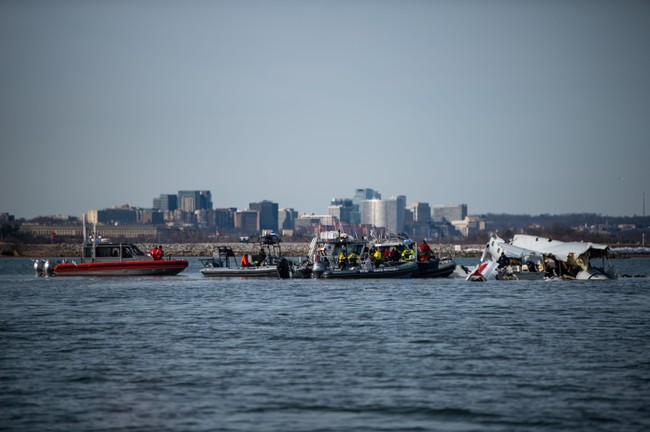
The NTSB concluded this week that the mid-air collision over the Potomac last January was entirely avoidable, laying blame across multiple agencies and crews and pointing to systemic weaknesses in route planning, traffic management, and training that converged into a fatal chain of errors.
The National Transportation Safety Board held a full-day hearing to present its final findings on the January 29, 2025 collision between a U.S. Army Black Hawk helicopter and a commercial passenger jet near Ronald Reagan Washington National Airport. The crash killed 67 people and prompted a nearly year-long probe that examined aircraft actions, airspace design, and oversight practices. Investigators found multiple failures at once rather than a single cause, and they highlighted how those failures compounded risk on a busy approach into DCA.
The NTSB singled out the Federal Aviation Administration for the primary probable cause: “the FAA’s placement of a helicopter route in close proximity to a runway approach path.” The board said the route design and the FAA’s lack of routine review allowed a hazardous overlap between helicopter traffic and jet arrival procedures. That proximity, combined with visual separation practices, left little margin for error when aircraft converged in the same airspace.
Investigators recreated the collision dynamics and explained how the aircraft made contact. “According to the NTSB, the helicopter contacted the left wing of the airplane with its main rotor. The helicopter was approaching from the right and the airplane was in a left turn, meaning the left wing was low. That means the two aircraft just clipped each other.” That description underlines how close the encounter was and how a few hundred feet and seconds determined the outcome.
Beyond route placement, the NTSB identified a pattern of missed opportunities to reduce risk, including the FAA’s failure to act on prior recommendations and to fully integrate safety management systems. The board criticized an overreliance on pilots seeing and avoiding other traffic, saying that visual separation alone was not a reliable defense in increasingly complex arrival flows. It also pointed to limitations in onboard traffic awareness and collision alerting systems that could not provide timely warnings of the impending strike.
Local air traffic control duties were also faulted for contributing to the accident. The tower team on duty that night was described as overwhelmed, with a high workload that degraded situational awareness. The board found “the tower team’s loss of situational awareness and degraded performance due to a high workload of the combined helicopter and local control positions,” noting an absence of real-time risk assessment processes. Those breakdowns led to missed advisories and a lack of safety alerts that might have warned crews sooner.
The Army’s practices were scrutinized as well, specifically training gaps related to altimeter tolerances. The NTSB reported the helicopter should have been below 200 feet on the published route but was flying near 300 feet, placing it closer to the arriving jet. Investigators stated, “Also causal was the Army’s failure to ensure pilots were aware of the effects of air tolerances on barometric altimeter in their helicopters, which resulted in the crew flying above the maximum published helicopter route altitude.”
Investigators also placed some responsibility on the Black Hawk crew for not maintaining effective pilot-applied visual separation. The board concluded that “the lack of effective pilot applied visual separation by the helicopter crew, which resulted in a mid-air collision,” was causal. At the same time, the report did not fault the pilots of the passenger jet, finding their actions consistent with proper procedures as the jet executed its approach.
The NTSB report included broader operational critiques, pointing to an unsustainable arrival rate at DCA and growing traffic volume that strains the control workforce. “An unsustainable airport arrival rate, increasing traffic volume with a changing fleet mix and airline scheduling practices at DCA, which regularly strain the DCA ATC workforce and degraded safety over time,” the board said, tying systemic pressures to the environment in which the collision occurred. The board also noted gaps in data sharing and analysis among operators and oversight bodies that prevented earlier fixes.
During the hearing, visual recreations paired with cockpit audio were shown to illustrate what each crew saw and heard as the aircraft converged. Those materials underscored the narrow window in which an alert could have made a difference and the limitations of relying on human sight under those conditions. The NTSB chair emphasized the preventable nature of the tragedy, saying, “We should be angry, because for years no one listened. This was preventable, this was 100% preventable.”
A visibly angry NTSB Chairwoman Jennifer Homendy the media of the panel’s findings, “We should be angry, because for years no one listened. This was preventable, this was 100% preventable.”

Add comment