
I’ll explain what happened in Los Angeles during the June 2025 anti-ICE riots, highlight the federal sentence handed down to one participant, preserve the official quote from prosecutors, note a parallel sentencing from the same events, and touch on the social-media commentary that followed.
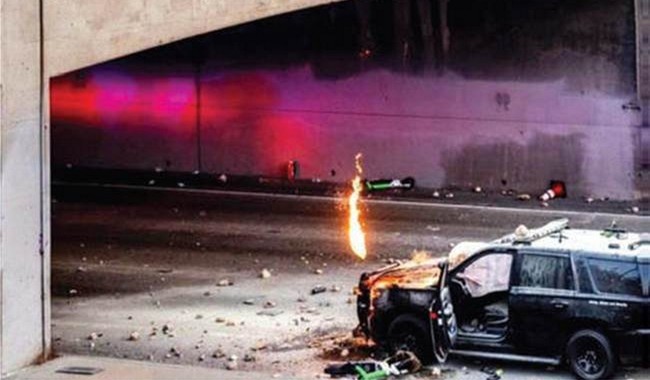
In June 2025, protests in Los Angeles targeting immigration enforcement escalated into violent confrontations that endangered officers and motorists. Demonstrations turned chaotic on the Main Street overpass above the 101 Freeway when people hurled objects and lit vehicles on fire below. What began as a political protest quickly became a scene where officers faced rocks, concrete, fireworks, and burning debris. The city watched as moments of intense danger unfolded on the freeway and nearby streets.
One man, identified as Yachua Mauricio Flores, aged 23 and from Lincoln Heights, has now received a federal prison sentence for his actions that day. Prosecutors say he poured lighter fluid onto a burning California Highway Patrol vehicle, worsening the blaze while officers were trapped beneath the overpass. He allegedly directed others to add flaming liquid and later helped throw an electric scooter over the railing toward officers and vehicles. Those actions carried a steep cost: a 37-month federal sentence and more than a quarter-million dollars in restitution.
Another day, another illegal immigration rioter from last summer is sent to federal prison.
https://x.com/USAttyEssayli/status/2084321419375374478
Yachua Mauricio Flores, 23, of Lincoln Heights, was sentenced today to 37 months in federal prison and ordered to pay $253,415 in restitution for his role in an pro-illegal immigration riot in downtown Los Angeles last year.
During the June 8, 2025 assault on officers, Flores stood on the Main Street overpass of the 101 Freeway and poured lighter fluid onto a burning California Highway Patrol vehicle below. His reckless actions escalated the flames as officers were trapped below facing rocks, concrete, street signs, fireworks, and burning debris thrown by protesters.
Flores also directed another individual to ignite and pour flaming liquid onto the same vehicle before adding more lighter fluid. Minutes later, he helped throw an electric scooter over the railing toward officers and CHP vehicles, aware of the substantial risk of death or serious injury.
Actions have consequences. Those who attack law enforcement will face the full force of justice. This defendant can now reflect on his actions from a federal prison cell.
The sentence and restitution were announced by the U.S. Attorney’s office, and the language used underlines the message prosecutors wanted to send about attacks on law enforcement. The $253,415 restitution figure covers tangible damage and sends a clear financial and legal consequence for dangerous behavior during public unrest. Federal prosecutors emphasized that escalating violence and targeting officers would meet the full weight of the law. That stance reflects a broader crackdown on those who commit violent acts under the banner of protest.
People paying attention will notice this isn’t an isolated legal result from that day. Another defendant from the same riot, Ismael Vega, a 42-year-old Westlake resident, received an identical sentence for throwing rocks from the overpass. Both defendants were sentenced by U.S. District Judge John F. Walter, and both will serve federal time for actions that endangered others. Those parallel outcomes underline how the courts treated a series of dangerous acts during the same incident.
Beyond the courtroom, public commentary tracked how officials framed the episode. First Assistant U.S. District Attorney Bill Essayli shared the news and noted the consequences in straightforward terms. Some social-media posts used a bit of dark humor to underline the point, while others framed the events in larger political terms. The riot’s images and videos circulated widely, reinforcing the stakes when protests tip into violence.
The phrase many used to describe the result is blunt: people who “fool around” with violent tactics can expect to “find out” what follows. That sentiment cut through partisan noise and landed on the legal outcome: federal prison time and a heavy restitution bill. In this instance, the legal system responded to clear physical threats and instances where property and lives were put at risk. The message to future would-be attackers is plainly stated in the sentence and the prosecutor’s words.
An editor’s note in the original coverage observed how rhetoric can escalate tensions, noting comparisons some have made between enforcement agencies and totalitarian institutions. That framing contributed to the charged atmosphere surrounding the protests and may have influenced public perception. Whatever the political arguments, the legal facts remain: dangerous acts that target officers and bystanders carry significant penalties under federal law.
Looking at these events from the legal and civic angle, the case is a reminder that protests with violent elements cross a line where public safety and criminal accountability take precedence. The Los Angeles incidents of June 2025 produced clear victims, property damage, and federal charges that led to prison terms. Those outcomes illustrate how the justice system handles violent public disorder in a way intended to deter similar conduct going forward.

Add comment