
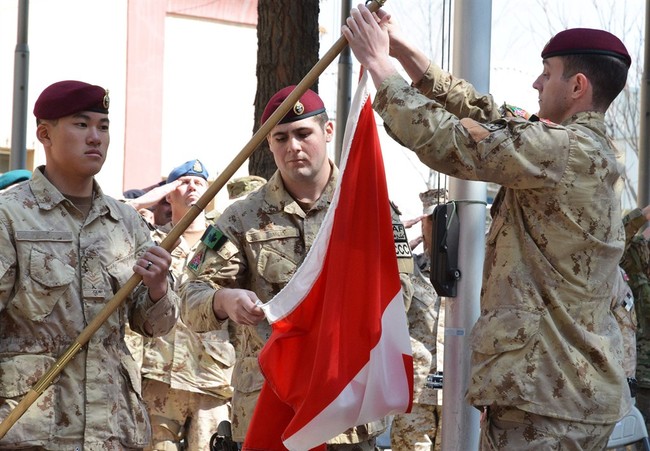
The Canadian government recently issued guidance telling military chaplains to avoid references to God at public ceremonies and replace prayers or blessings with bland, government-defined “spiritual reflections.” This move replaces longstanding religious language in parades, graduations, and memorials with sanitized, HR-friendly remarks meant to avoid offense but which end up erasing tradition. The policy has prompted sharp criticism for privileging bureaucratic neutral-speak over historical practices that honored faith and sacrifice. Below, I unpack what the policy says, how officials defended it, and why the change matters for service members who expect their faith to be respected.
‘Spiritual Reflections’: Canadian Military’s Dishonorable Discharge of God From Official Ceremonies
The new guidance directs chaplains to offer “spiritual reflections” instead of religious observances when those are requested at military events. It explicitly advises against religious-specific language, “including references to God,” and treats public remarks as an opportunity for inclusive, nonsectarian messaging. The stated aim is to make everyone feel their beliefs are valued — including atheists — by avoiding language tied to a single religion. Critics argue the result is not neutrality but a flattening of spiritual life into predictable corporate-speak.
Officials describe these reflections as meant to foster resilience, purpose, and spiritual well-being while promoting a “culture of care and service.” In practice that looks like consultant-approved remarks about gratitude, memory, and moral duty rather than prayer. For service members raised in Christian or Jewish traditions, the absence of explicit religious language at funerals and awards ceremonies feels like an erasure. When institutions remove God from rites that once invoked God, it sends a message about which values get preferred treatment.
Acting chaplain general Shaun Yaskiw defended the change by saying the policy ensures attendees feel their beliefs are respected. He emphasized the chaplain’s duty to see and respect the full expression of spiritual and religious beliefs of those who come for support. The guidance intentionally avoids privileging any one set of beliefs over another and aims for a balance between personal faith and institutional neutrality. Still, many see that balancing act as tilted: privileging absence of religious reference over open religious expression.
“It’s not our intention to restrict religious belief. In fact, as a chaplain, it is my professional responsibility to be able to see and respect the full expression of spiritual and religious beliefs of those who come to me.”
The policy goes further by telling CAF members delivering public remarks to avoid words, actions, or symbols specific to a particular religion. That prohibition covers parades, graduations, change of command ceremonies, ribbon cuttings, and honours and awards events. It extends to all CAF members and those providing spiritual or religious services in support of the military, including volunteers and contractors. The net effect is a broad administrative rule that swaps centuries-old expressions of faith for anodyne, generic reflections approved at the top.
When officials explain what to say instead, they use phrases that are distinctly managerial: reflect on lessons learned, beliefs, values, and experiences to inspire gratitude, remembrance, hope, and integrity. The policy even supplies a template for what counts as acceptable spiritual language. It all reads like diversity training turned liturgy, which is exactly the problem for those who view religious observance as more than morale-building content. Faith traditions offer distinct vocabulary and rituals that carry meaning precisely because of their specificity.
“They reflect upon lessons learned, beliefs, values, and experiences to inspire gratitude, remembrance, hope, and integrity.”
There are practical and cultural consequences here. Military funerals, memorials, and commissioning ceremonies have long used explicit religious language to console families and bind communities. Removing God from those moments risks alienating people who seek comfort in named faith. Meanwhile, the policy raises awkward questions about how authorities will treat expressions tied to non-Christian faiths at official events honoring those communities.
The policy’s stated goal is inclusivity, but the method is a blunt instrument: erase religion from public rituals rather than make room for multiple traditions. That approach treats faith as a problem to be managed instead of a freedom to be accommodated. For conservatives who value religious liberty and historical continuity, the change feels like an unnecessary bureaucratic intrusion into the sacred moments of service and sacrifice.
“I want my words to touch the hearts of those who have gathered and to be meaningful to them. But I also have an obligation, as a representative of the Canadian Forces, to be neutral and not privilege one set of religious beliefs over another. It’s about finding a balance between the two.”
Neutrality should protect public institutions from coercing belief, not erase public expressions of belief that have long been part of national life. Treating religion as a risk to be mitigated encourages a bland public culture and weakens the ties that traditions and faith provide in times of grief and celebration. The debate over this policy is more than procedural; it is about how a nation honors its past and cares for those who serve.


Canada has been circling the toilet bowl of destruction since the degradation brought on by former PM Trudeau and all of his direct destruction to “Canada’s Traditions while bringing on Communism and Islam!” He encouraged and allowed Islamist’s to run rampant throughout just has been done here most recently during the Demoncrap Fraud Auto-Pen Biden/Harris Cabal! God has nothing to do with Atheism or Islam so He is being erased from the fabric of that society and tradition must be too! What we are seeing is directly from Biblical Prophecy which says just before Jesus’ Second Coming there will be a Falling Away or the Great Apostasy!
[The Great Apostasy]
2 Thessalonians 2:1-12 “Now, brethren, concerning the coming of our Lord Jesus Christ and our gathering together to Him, we ask you, 2 not to be soon shaken in mind or troubled, either by spirit or by word or by letter, as if from us, as though the day of Christ had come. 3 Let no one deceive you by any means; for that Day will not come unless the falling away comes first, and the man of [b]sin is revealed, the son of perdition, 4 who opposes and exalts himself above all that is called God or that is worshiped, so that he sits as God in the temple of God, showing himself that he is God. 5 Do you not remember that when I was still with you I told you these things? 6 And now you know what is restraining, that he may be revealed in his own time. 7 For the mystery of lawlessness is already at work; only He who now restrains will do so until He is taken out of the way. 8 And then the lawless one will be revealed, whom the Lord will consume with the breath of His mouth and destroy with the brightness of His coming. 9 The coming of the lawless one is according to the working of Satan, with all power, signs, and lying wonders, 10 and with all unrighteous deception among those who perish, because they did not receive the love of the truth, that they might be saved. 11 And for this reason God will send them strong delusion, that they should believe the lie, 12 that they all may be condemned who did not believe the truth but had pleasure in unrighteousness.
[Stand Fast]
13 But we are bound to give thanks to God always for you, brethren beloved by the Lord, because God from the beginning chose you for salvation through sanctification by the Spirit and belief in the truth, 14 to which He called you by our gospel, for the obtaining of the glory of our Lord Jesus Christ. 15 Therefore, brethren, stand fast and hold the traditions which you were taught, whether by word or our epistle.
16 Now may our Lord Jesus Christ Himself, and our God and Father, who has loved us and given us everlasting consolation and good hope by grace, 17 comfort your hearts and establish you in every good word and work.”
Amen.
I quote: “as a representative of the Canadian Forces, to be neutral and not privilege one set of religious beliefs over another. It’s about finding a balance between the two.”
Not true, chaplain; if there is the one true God Almighty, our Savior Jesus Christ, in a Christian nation there can be no other choice or attempt to blend religions as the Globalist Elite are in the process of bringing forth upon humanity; their New World Order under Satan! That is all Antichrist and from Satan! All of this bickering is part and parcel of the evil plan to create conflict and disorder direct from the father of all lies Satan.