
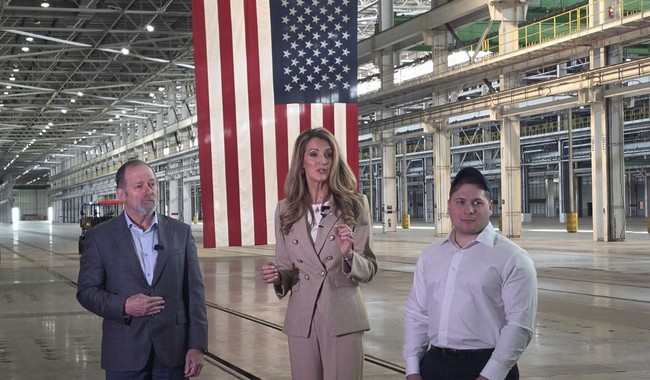
Kelly Loeffler, Administrator of the U.S. Small Business Administration, toured Hadrian Alabama Factory 4 in the Shoals and spoke about how recent federal tax changes and industrial policy are driving onshoring, supporting small business, and strengthening national security at a time when manufacturing returns to American soil.
On Friday, Loeffler visited Northern Alabama’s Hadrian F4 facility to see firsthand how a modern manufacturing anchor can lift a region and partner with local small businesses. The visit came as part of a broader push from the administration to highlight the Working Family Tax Cut and the incentives that encourage investment and production in the United States. Local leaders, company executives, and regional SBA staff joined the tour to discuss how policy translates into real projects and jobs.
Loeffler was accompanied by Hadrian Vice President of Federal, Michael Manazir, Southeastern Regional SBA Administrator Tyler Teresa, and Shoals area small business and government leaders. She used the visit to explain how federal policy aims to reduce regulatory burdens, improve access to capital, and counteract unfair trade practices that can disadvantage smaller firms. In these conversations she drew a clear line between national economic strategy and the day-to-day realities of factories and supply chains.
This is one of the things I appreciate about the Trump administration: for the most part, they work to make connections between the small dots of policy and the big picture of the economy, and how these affect American individuals and American businesses. Loeffler noted that small businesses are more than suppliers; they are community employers, innovators, and partners in large-scale projects. Her remarks stressed that federal support should aim to level the playing field so smaller companies can compete, grow, and supply critical manufacturing capacity.
We had a great conversation earlier here about how small business is absolutely critical, because not only are they building out and maintaining and developing systems and facilities like this, but they support the communities that are coming here to serve the families that are part of this business. So, they’re absolutely part of the ecosystem. And that is my job: to ensure that small businesses aren’t disadvantaged by regulation, lack of access to capital, unfair trade, and other things that a larger business might be able to solve on their own.
The timing of the tour, in the run-up to Tax Day, underlined the administration’s message that tax relief and targeted incentives are translating into higher refunds and more take-home pay for workers. Loeffler highlighted figures the administration has cited about refunds and overtime tax relief, and connected those numbers to the broader push to make Made-in-America investment attractive. The argument is straightforward: lower effective costs for employers and clearer incentives for capital investment make factories like F4 viable and competitive.
Alabama’s small business ecosystem is a key part of this story, with nearly all businesses in the state classified as small and together employing a large share of the workforce. At the plant, officials emphasized partnership: Hadrian sees itself as an anchor tenant that can attract suppliers, spur service businesses, and create opportunities for regional vendors. The goal is to rebuild local industrial capacity that had diminished over past decades and to stitch national security needs into domestic industrial policy.
This is such an impressive example of what’s happening thanks to President Trump’s economic national security agenda, which is about reassuring industries that had been hollowed out in our country for the last 50 years. [..] And as we approach Tax Day, you might say, well, what does this have to do with Tax Day? Look, next Wednesday, April 15th. Americans will see tremendous relief in their tax bills, [are] already seeing 15 percent higher refunds, averaging about $3,500. [And] about 20 million workers are already taking advantage of No Tax on Overtime. Those workers tend to work in places like this great manufacturing facility.
Michael Manazir, Hadrian’s vice president for federal programs, underscored the company’s commitment to onshoring and reindustrialization. He described the F4 facility as a deliberate response to decades of deindustrialization and framed the project as both an economic and national security priority. The factory is designed to scale, partner with local suppliers, and provide a stable base for returning advanced manufacturing to the American heartland.
Hadrian is committed to reindustrializing America. That’s what we’re doing here. We have recognized it over the last 40 years. We have deindustrialized.[…] We’ve recognized for national security we need to reindustrialize and onshore, as the Administrator just said. That’s why Hadrian, as the anchor tenant here at A.E. Shoals, is to bring those jobs back, to bring that manufacturing capacity back, to partner with small businesses, because we are the anchor tenant here. And so, you see so much potential in this factory. We’re going to build this factory out. We’re going to attract more small businesses back.
Officials say F4 will support advanced manufacturing for naval components and act as a model for public-private cooperation to rebuild supply chains. Loeffler pointed to the scale of employment expected at the facility and the multiplier effects for nearby towns. The administration’s message was consistent: targeted policy tools and tax incentives can swing decisions about where companies locate and whom they hire.
Ninety-eight percent of all of America’s manufacturers are small businesses, and this country is reindustrializing thanks to President Trump’s economic agenda. Nowhere is that more clear than right here.
This facility will ultimately host almost 1,000 jobs, maybe more. That’s transformative for a rural community. It’s going to be transformative for our country on a national security basis.
But when you think about the importance of incentives to invest in America, the Working Family Tax Cut did just that. It created 100 percent expensing for Made-in-America factories, for R&D, for purchasing capital equipment, for reindustrializing this nation, and we all know how important that is. This is a great example of Peace through Strength. That’s what companies like Hadrian represent to America.
Loeffler finished by thanking local leaders for the tour and reiterating the point that small businesses and big projects are interdependent. She echoed the administration’s line that economic security and national security are now aligned through a policy framework that rewards domestic investment. The visit is meant to show voters and business owners what those policies look like on the ground and how federal choices can restore productive capacity to American towns and regions.

Add comment