
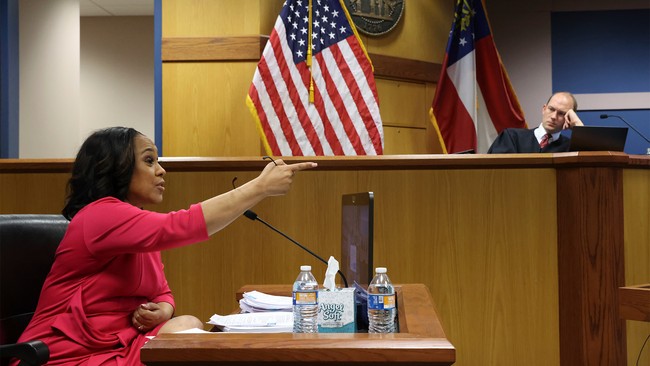
Fulton County District Attorney Fani Willis suffered another courtroom setback when a judge refused her bid to block nearly $17 million in attorney-fee claims from former defendants in the collapsed racketeering case tied to the 2020 election, reinforcing the court’s finding that her office remains disqualified from participating.
The case traces back to Willis’ 2023 RICO indictment alleging election interference, which unraveled after revelations about her relationship with lead prosecutor and subsequent disqualification for an appearance of impropriety. Defendants including former President Donald Trump pressed to recover legal costs after charges were dropped, invoking a new Georgia law that allows fee recovery when a prosecutor is disqualified. The dispute centers on $16,853,810.28 in attorney fees and costs sought by fourteen former defendants.
On Monday, Superior Court Judge Scott McAfee denied the Fulton County District Attorney’s Office motion to withhold payment and rejected Willis’ attempt to intervene in the reimbursement fight. The court allowed Fulton County itself to join the litigation over fees, but made clear the DA’s office remains sidelined. That ruling moves the dispute into a new phase with the county directly involved in defending against the claims.
A Fulton County judge on Monday rejected the Fulton County District Attorney’s Office’s attempt to withhold payment from President Trump, ruling that the office remains disqualified while allowing Fulton County itself to join the fight over nearly $17 million in legal fees sought by former defendants.
The decision from Superior Court Judge Scott McAfee sets up the next phase of litigation in the once-sweeping racketeering case, which collapsed after prosecutors dropped charges against Mr. Trump and several allies.
Fourteen former defendants — including Mr. Trump — are now seeking $16,853,810.28 in attorney’s fees and costs under a newly enacted Georgia law that allows defendants to recover expenses when a prosecutor is disqualified.
The disqualification came after the Georgia Court of Appeals found that Willis’ relationship with her lead prosecutor created an unacceptable appearance of impropriety. That decision removed Willis from the prosecution and opened the door for defendants to seek reimbursement under state law. The legal fight has shifted from criminal charges to a civil-style contest over who pays for the defendants’ mounting bills.
Judge McAfee emphasized that Willis’ office is not simply disqualified from the case in some limited way but is barred from further participation, a characterization that carries serious consequences for both the DA personally and the office she leads. The judge described the situation as “wholly disqualified,” underscoring the court’s view that the misconduct tainted the prosecution enough to require a full removal. That language bolsters the defendants’ argument that the disqualification entitles them to recover fees.
Lead defense counsel for former President Trump weighed in, arguing the court reached the right outcome and that Willis should not be allowed back into the matter or to influence the reimbursement fight. In a statement preserved as part of the record, the attorney argued the judge “has properly denied DA Willis’ motion to intervene in POTUS’ action for reimbursement of attorney fees because her disqualification for improper conduct bars Willis and her office from any further participation in this dismissed, lawfare case.”
Judge McAfee has properly denied DA Willis’ motion to intervene in POTUS’ action for reimbursement of attorney fees because her disqualification for improper conduct bars Willis and her office from any further participation in this dismissed, lawfare case.
The ruling leaves Fulton County on the hook to engage with the reimbursement claims while the DA’s office watches from the sidelines. County officials will now face the logistical and financial challenge of defending against the nearly $17 million claim or negotiating its disposition without the district attorney’s direct involvement. That dynamic could reshape how local government handles legal fallout when a prosecutor is removed for ethical lapses.
This episode is another mark against Willis’ tenure in the high-profile prosecution that once aimed to pressure the former president. It also illustrates how professional misconduct by a prosecutor can ripple outward, turning a criminal prosecution into a costly civil dispute over fees and institutional responsibility. For the defendants, the decision to pursue fee recovery under the new Georgia statute now proceeds with the county as a formal party to the fight.
The legal skirmish over attorney fees will continue, and the court’s findings about disqualification remain central to the claimants’ case. While the criminal charges collapsed, the financial and reputational consequences have not ended for those who brought them, including the Fulton County District Attorney’s Office that is now excluded from further participation in the matter.

Add comment